


The short version
Claim we investigated
About 4 in 10 of King County's unsheltered homeless people were last housed outside the county.
Mostly true. 39% of unsheltered people who answered in 2024, but only 56% answered, so the true share is uncertain. In 2024, 323 of 821 unsheltered people who answered (39%) last had stable housing outside King County. About half named elsewhere in Washington, and half another state or country. Only 56% of those surveyed answered and the sample is unweighted; counting everyone surveyed, the share could be 22% to 66%.
Quote or cite this fact-check
FactHub rates the claim “About 4 in 10 of King County's unsheltered homeless people were last housed outside the county” Mostly true (moderate confidence): 39% of unsheltered people who answered in 2024, but only 56% answered, so the true share is uncertain. Reviewed November 14, 2026.
Key points
What the evidence establishes
- Established. In the county's 2024 survey, 39% of unsheltered people who answered (323 of 821) were last stably housed outside King County.
- Established. About 20% named elsewhere in Washington, 18% another U.S. state and 1% another country.
- Established. Most, about 60%, were last housed in King County.
- Context. Only 56% of the 1,466 people surveyed answered, and answers aren't weighted. Counting everyone surveyed, the share could be anywhere from 22% to 66%.
- Not shown. Surveys in 2017-2019 found 16% to 23%, but asked a different question and included shelters, so how much the share grew is unclear.
- Established. Portland, San Francisco and Los Angeles report similar shares (36% to 42%); Alameda County (Oakland), Sacramento and San Diego report about half as much.
The evidence
The conclusion rests on the combined record. Expand each item to see its role and limitations.
| Method | Institution / country | Year(s) | What it shows | Key limitation | Primary links |
|---|---|---|---|---|---|
| Read the KCRHA 2024 count report: the residence section and Table 13, and the survey questions in Appendix I. | King County Regional Homelessness Authority United States | 2024 | In early 2024 the King County Regional Homelessness Authority (KCRHA) surveyed 1,466 unsheltered people, meaning people sleeping outside, in vehicles or in other places not meant for living. It asked what city they lived in the last time they had stable housing, such as an apartment or house. Of the 821 who answered, 163 (19.9%) named elsewhere in Washington, 150 (18.3%) another U.S. state and 10 (1.2%) another country. That is 323 people, or 39.3%. Another 491 (59.8%) named a place in King County, led by the Seattle area (26.4%) and South King County (22.7%). | Only 56% of the people surveyed answered this question, and KCRHA reports the answers as raw counts, not weighted to the whole unsheltered population. The survey did not ask when people last had stable housing, so for some the answer may be years old. It covers unsheltered people only; people in shelters were counted from records and not asked. Interviews took place at hub sites people came to, so the sample may lean toward people already in touch with services. If newcomers use services more than locals, that would push the outside share up; the report gives no way to check. | King County Regional Homelessness Authority (KCRHA) |
| Read the Count Us In reports for 2017, 2018 and 2019 (survey findings and appendix tables), then calculated how far the change of group and the missing 2024 answers could move the share. | All Home, Applied Survey Research, King County Regional Homelessness Authority United States | 2017, 2018, 2019, 2024 | From 2017 to 2019 the county's Count Us In survey asked sheltered and unsheltered people where they were living when they most recently became homeless. About 23% (2017), 17% (2018) and 16% (2019) named somewhere outside King County. Two things changed by 2024: the question (last stable housing, not where people became homeless) and the group (unsheltered people only, found through referral chains). Our arithmetic shows the change of group can't explain all of the jump: even if every 2019 respondent staying in a shelter was a local, the 2019 unsheltered share could be at most about 24%. But the missing answers matter. If all 645 people who skipped the 2024 question were locals, 2024's share of everyone surveyed would be 22%; if all were from elsewhere, it would be 66%. San Francisco, whose surveys were run by the same firm in both years, saw its share rise from 30% in 2019 to 41% in 2024. | No King County survey asked the same question of the same group in 2019 and 2024, so the size of any real rise can't be measured. The county asked the question in 2020 but published no result, and published no full report for 2022. The Count Us In authors say their survey was not a random sample. | All Home and Applied Survey Research All Home and Applied Survey Research All Home and Applied Survey Research FactHub Research Team San Francisco Department of Homelessness and Supportive Housing and Applied Survey Research |
| Read the reasons and length-of-residence tables in the Count Us In appendices for 2017, 2018 and 2019. | All Home, Applied Survey Research United States | 2017, 2018, 2019 | In 2017 and 2018 the county also asked people from outside the county why they moved here. In 2017, the most common answer was to get homeless services or benefits (25.4% of 197 people), ahead of work (21.8%) and family or friends (18.3%). In 2018, work led (31.4% of 137), then services or benefits (20.4%) and family or friends (18.2%). The county dropped the question in 2019. The 2019 survey asked people who became homeless in King County how long they had lived here. Of them, 31% were born or grew up here and 15% had lived here 10 years or more. Another 19% had lived here less than a year. | The reasons come from small groups (137 to 197 people) who could pick only one answer, and the answer choice combined homeless services with other benefits. People who named services were about 3% to 6% of everyone who answered the residence question. No King County survey since 2018 asks why people came, or whether they arrived already homeless. | All Home and Applied Survey Research All Home and Applied Survey Research All Home and Applied Survey Research FactHub Research Team |
| Searched the latest count reports for San Francisco, the Portland area, Los Angeles, Alameda County, Sacramento County and San Diego, and the 2023 California statewide study, for the share housed in the area before becoming homeless. | San Francisco Department of Homelessness and Supportive Housing, Portland State University, Multnomah County, Los Angeles Homeless Services Authority, UCSF Benioff Homelessness and Housing Initiative, Alameda County, Sacramento Steps Forward, Regional Task Force on Homelessness United States | 2020, 2022, 2023, 2024, 2025, 2026 | Other West Coast homeless counts ask a similar question. In the Portland area, about 60% of unsheltered people in each county were last housed in that county in both 2023 and 2025. San Francisco's survey found 41% were housed outside the city before becoming homeless in 2024, and 44% in 2026. In Los Angeles, about two-thirds (64%) of unsheltered adults became homeless in L.A. County in 2020, the latest year published. Shares outside the county were lower in Alameda County (22%), Sacramento County (about 22%) and San Diego (19%), and a statewide California study found 25%. | These surveys word the question differently, cover different years from 2020 to 2026, and differ in whether people in shelters were asked. Los Angeles's figure is read from a chart and covers adults 25 and older. Sacramento and San Diego published only a headline figure. None of these places is a like-for-like match for King County. | Portland State University for Multnomah, Clackamas and Washington counties Multnomah County Homeless Services Department San Francisco Department of Homelessness and Supportive Housing City and County of San Francisco Los Angeles Homeless Services Authority (LAHSA) Alameda County Sacramento Steps Forward Regional Task Force on Homelessness (San Diego) UCSF Benioff Homelessness and Housing Initiative FactHub Research Team |
1. The 2024 survey: 39% last housed outside King County Read the KCRHA 2024 count report: the residence section and Table 13, and the survey questions in Appendix I.
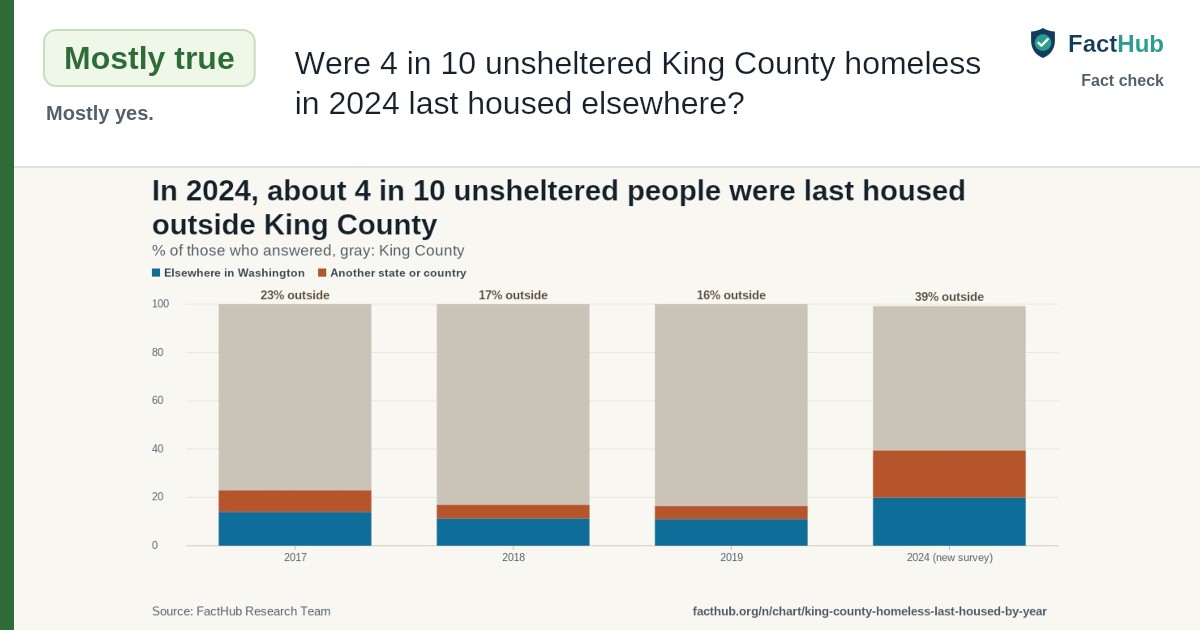
In early 2024 the King County Regional Homelessness Authority (KCRHA) surveyed 1,466 unsheltered people, meaning people sleeping outside, in vehicles or in other places not meant for living. It asked what city they lived in the last time they had stable housing, such as an apartment or house. Of the 821 who answered, 163 (19.9%) named elsewhere in Washington, 150 (18.3%) another U.S. state and 10 (1.2%) another country. That is 323 people, or 39.3%. Another 491 (59.8%) named a place in King County, led by the Seattle area (26.4%) and South King County (22.7%).
Limit: Only 56% of the people surveyed answered this question, and KCRHA reports the answers as raw counts, not weighted to the whole unsheltered population. The survey did not ask when people last had stable housing, so for some the answer may be years old. It covers unsheltered people only; people in shelters were counted from records and not asked. Interviews took place at hub sites people came to, so the sample may lean toward people already in touch with services. If newcomers use services more than locals, that would push the outside share up; the report gives no way to check.
Verify: 2024 Point-in-Time Count, King County (revised report, corrected March 2026)
- Of unsheltered people who answered, 163 (19.9%) were last stably housed elsewhere in Washington, 150 (18.3%) in another U.S. state and 10 (1.2%) in another country: 323 of 821, or 39.3%. King County Regional Homelessness Authority (KCRHA)
- The other answers named places in King County, 491 in all (59.8%), led by the Seattle area (26.4%) and South King County (22.7%); 7 (0.9%) were unknown. King County Regional Homelessness Authority (KCRHA) · Qualifies
- Only 821 of the 1,466 unsheltered people surveyed (56%) answered the question, and the survey did not ask when they were last stably housed, so some answers may describe housing from years earlier. King County Regional Homelessness Authority (KCRHA) · Qualifies
- The 2024 survey found people through referral chains: each respondent got coupons to give to others, who came to one of 20 hub sites, a method meant to reach people furthest from services. King County Regional Homelessness Authority (KCRHA) · Qualifies
- The 2024 question asked what city people lived in the last time they had stable housing. King County Regional Homelessness Authority (KCRHA)
2. Earlier surveys found 16% to 23%, but asked differently Read the Count Us In reports for 2017, 2018 and 2019 (survey findings and appendix tables), then calculated how far the change of group and the missing 2024 answers could move the share.
From 2017 to 2019 the county's Count Us In survey asked sheltered and unsheltered people where they were living when they most recently became homeless. About 23% (2017), 17% (2018) and 16% (2019) named somewhere outside King County. Two things changed by 2024: the question (last stable housing, not where people became homeless) and the group (unsheltered people only, found through referral chains). Our arithmetic shows the change of group can't explain all of the jump: even if every 2019 respondent staying in a shelter was a local, the 2019 unsheltered share could be at most about 24%. But the missing answers matter. If all 645 people who skipped the 2024 question were locals, 2024's share of everyone surveyed would be 22%; if all were from elsewhere, it would be 66%. San Francisco, whose surveys were run by the same firm in both years, saw its share rise from 30% in 2019 to 41% in 2024.
Limit: No King County survey asked the same question of the same group in 2019 and 2024, so the size of any real rise can't be measured. The county asked the question in 2020 but published no result, and published no full report for 2022. The Count Us In authors say their survey was not a random sample.
Verify: 2017 Seattle/King County Count Us In comprehensive report 2018 Seattle/King County Count Us In report 2019 Seattle/King County Count Us In report Where King County homeless survey respondents were last housed, 2017-2024 (dataset) 2019 San Francisco Homeless Count and Survey comprehensive report
- In 2017, 77% of respondents were living in King County when they lost their housing, about 15% in another Washington county and 9% out of state. All Home and Applied Survey Research · Qualifies
- In 2018, about 83% of respondents were living in King County when they lost their housing, 11% in another Washington county and 6% out of state. All Home and Applied Survey Research · Qualifies
- In 2019, about 84% of respondents were living in King County when they lost their housing, 11% in another Washington county and 5% out of state. All Home and Applied Survey Research · Qualifies
- The 2017-2019 question asked where people were living when they most recently became homeless. Of 866 answers in 2019, 32 named Pierce County, 32 Snohomish County, 10 Thurston County and 21 another Washington county. All Home and Applied Survey Research · Qualifies
- The Count Us In survey used quotas and an every-third-person approach, and its authors say it was not a random sample. All Home and Applied Survey Research · Qualifies
- Our arithmetic: even if every sheltered 2019 respondent was a local, the 2019 unsheltered share could be at most about 24%. If all 645 people who skipped the 2024 question were locals, 2024's share of everyone surveyed would be 22%; if all were from elsewhere, 66%. FactHub Research Team · Qualifies
- In 2019, 70% of San Francisco respondents were living in the city when they most recently became homeless. San Francisco Department of Homelessness and Supportive Housing and Applied Survey Research · Qualifies
3. Why people came, and how long locals had been here Read the reasons and length-of-residence tables in the Count Us In appendices for 2017, 2018 and 2019.
In 2017 and 2018 the county also asked people from outside the county why they moved here. In 2017, the most common answer was to get homeless services or benefits (25.4% of 197 people), ahead of work (21.8%) and family or friends (18.3%). In 2018, work led (31.4% of 137), then services or benefits (20.4%) and family or friends (18.2%). The county dropped the question in 2019. The 2019 survey asked people who became homeless in King County how long they had lived here. Of them, 31% were born or grew up here and 15% had lived here 10 years or more. Another 19% had lived here less than a year.
Limit: The reasons come from small groups (137 to 197 people) who could pick only one answer, and the answer choice combined homeless services with other benefits. People who named services were about 3% to 6% of everyone who answered the residence question. No King County survey since 2018 asks why people came, or whether they arrived already homeless.
Verify: 2017 Seattle/King County Count Us In comprehensive report 2018 Seattle/King County Count Us In report 2019 Seattle/King County Count Us In report Where King County homeless survey respondents were last housed, 2017-2024 (dataset)
- Of 197 respondents from outside the county in 2017, 25.4% said they moved to King County to access homeless services or benefits, the most common answer; 21.8% came for work and 18.3% for family or friends. All Home and Applied Survey Research
- Of 137 respondents from outside the county in 2018, 31.4% said they moved to King County for work and 20.4% to access homeless services or benefits; 18.2% named family or friends. All Home and Applied Survey Research · Qualifies
- Of 752 respondents who lived in King County when they became homeless, 31% were born or grew up here and 15% had lived here 10 years or more; 19% had lived here less than a year. All Home and Applied Survey Research · Qualifies
- People who said they moved to King County for homeless services or benefits were 5.8% (2017, 50 of 866) and 3.2% (2018, 28 of 888) of everyone who answered the residence question. FactHub Research Team · Qualifies
4. Other West Coast places: close to Portland, San Francisco and LA, above other California counties Searched the latest count reports for San Francisco, the Portland area, Los Angeles, Alameda County, Sacramento County and San Diego, and the 2023 California statewide study, for the share housed in the area before becoming homeless.
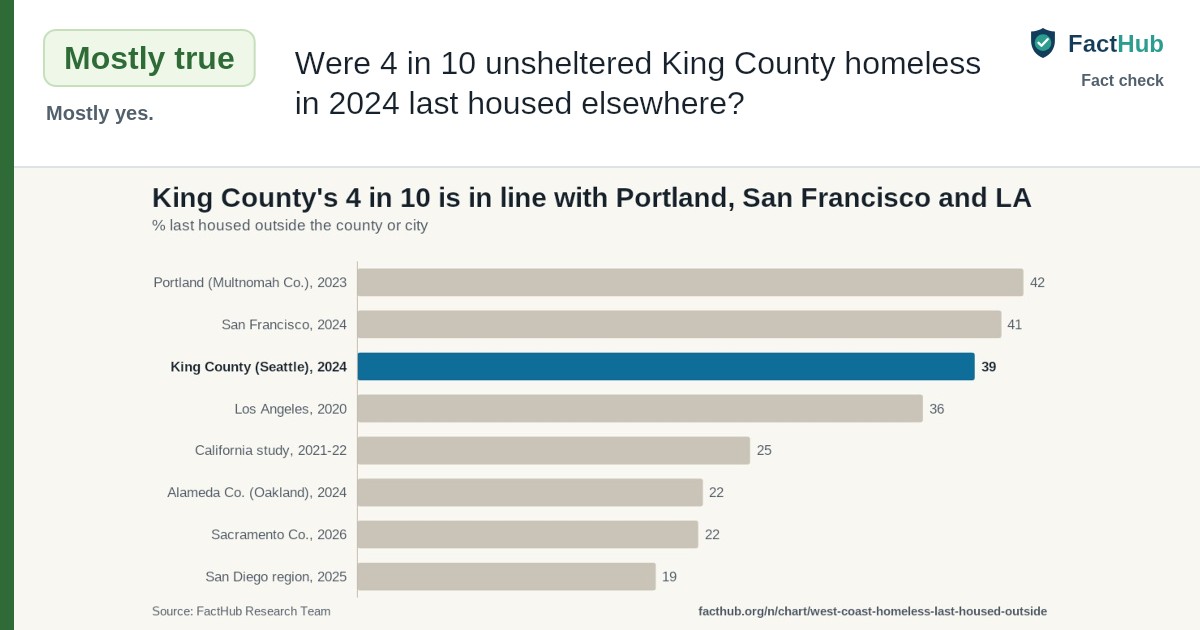
Other West Coast homeless counts ask a similar question. In the Portland area, about 60% of unsheltered people in each county were last housed in that county in both 2023 and 2025. San Francisco's survey found 41% were housed outside the city before becoming homeless in 2024, and 44% in 2026. In Los Angeles, about two-thirds (64%) of unsheltered adults became homeless in L.A. County in 2020, the latest year published. Shares outside the county were lower in Alameda County (22%), Sacramento County (about 22%) and San Diego (19%), and a statewide California study found 25%.
Limit: These surveys word the question differently, cover different years from 2020 to 2026, and differ in whether people in shelters were asked. Los Angeles's figure is read from a chart and covers adults 25 and older. Sacramento and San Diego published only a headline figure. None of these places is a like-for-like match for King County.
Verify: 2023 Tri-County Point-in-Time Count Findings Report 2025 Tri-County Point-in-Time Count Summary Report 2024 Point-in-Time Count slide deck San Francisco 2026 Point-in-Time Count report 2020 Greater Los Angeles Homeless Count presentation 2024 Point-in-Time Count Report for Alameda County 2026 Point-in-Time Count data summary 2025 Point-in-Time Count shows 7% drop in regionwide homelessness Toward a New Understanding: The California Statewide Study of People Experiencing Homelessness, executive summary (June 2023) Where King County homeless survey respondents were last housed, 2017-2024 (dataset)
- In each Portland-area county in 2023, about 60% of unsheltered respondents were last housed in that county. Portland State University for Multnomah, Clackamas and Washington counties
- In 2025, about 60% of Portland-area unsheltered respondents were last housed in the county where they were surveyed; among those from outside the three counties, 18% named homeless services as a reason they moved. Multnomah County Homeless Services Department
- In San Francisco's 2024 survey, 59% were housed in the city before becoming homeless, so 41% were not. San Francisco Department of Homelessness and Supportive Housing
- In 2026, 44% came from outside San Francisco; of those who moved there after becoming homeless, 32% said they came to access homeless services. City and County of San Francisco
- In Los Angeles's 2020 count, about two-thirds of unsheltered adults became homeless in L.A. County. Los Angeles Homeless Services Authority (LAHSA)
- In Alameda County in 2024, 78% of surveyed people said their previous permanent address was in the county; the county notes some of the other 22% may have lived there before. Alameda County · Qualifies
- In Sacramento County in 2026, 78.3% first became homeless while living in the county. Sacramento Steps Forward · Qualifies
- In the San Diego region in 2025, 81% said they began experiencing homelessness in San Diego County. Regional Task Force on Homelessness (San Diego) · Qualifies
- Across California, 90% of homeless adults lost their last housing in the state and 75% lived in the same county as their last housing. UCSF Benioff Homelessness and Housing Initiative · Qualifies
- Shares last housed outside the area, latest published survey: Portland's Multnomah County 42% (2023, our count from its table), San Francisco 41% (2024), King County 39% (2024), Los Angeles 36% (2020), California study 25%, Alameda County 22%, Sacramento County 22%, San Diego 19%. FactHub Research Team
Common questions 11
“Is King County's share higher than Portland's, San Francisco's and Los Angeles's?”
Short answer: No, about the same
No, about the same. King County's 39% sits between Los Angeles (about 36%, 2020) and San Francisco (41%, 2024) and Portland's Multnomah County (42%, 2023). It is about double Alameda County, Sacramento and San Diego (19% to 22%), and above a statewide California study (25%). The surveys ask differently, so the comparison is rough.
- In each Portland-area county in 2023, about 60% of unsheltered respondents were last housed in that county. Portland State University for Multnomah, Clackamas and Washington counties
- In 2025, about 60% of Portland-area unsheltered respondents were last housed in the county where they were surveyed; among those from outside the three counties, 18% named homeless services as a reason they moved. Multnomah County Homeless Services Department
- In San Francisco's 2024 survey, 59% were housed in the city before becoming homeless, so 41% were not. San Francisco Department of Homelessness and Supportive Housing
- In Los Angeles's 2020 count, about two-thirds of unsheltered adults became homeless in L.A. County. Los Angeles Homeless Services Authority (LAHSA)
- In Alameda County in 2024, 78% of surveyed people said their previous permanent address was in the county; the county notes some of the other 22% may have lived there before. Alameda County · Qualifies
- In Sacramento County in 2026, 78.3% first became homeless while living in the county. Sacramento Steps Forward · Qualifies
- In the San Diego region in 2025, 81% said they began experiencing homelessness in San Diego County. Regional Task Force on Homelessness (San Diego) · Qualifies
- Shares last housed outside the area, latest published survey: Portland's Multnomah County 42% (2023, our count from its table), San Francisco 41% (2024), King County 39% (2024), Los Angeles 36% (2020), California study 25%, Alameda County 22%, Sacramento County 22%, San Diego 19%. FactHub Research Team
“Did at least 1 in 5 homeless newcomers say they came for homeless services or benefits?”
Short answer: Yes, 20–25% (the top reason in 2017)
Yes. When King County last asked, 25.4% of 197 people from outside the county chose "homeless services and/or benefits" in 2017, the top answer that year. In 2018 it was 20.4% of 137, second to work (31.4%). Those people were about 3% to 6% of everyone who answered the residence question. The county stopped asking in 2019. In San Francisco in 2026, 32% of people who moved there after becoming homeless named homeless services. In the Portland area in 2025, 18% of people from outside named homeless services, among reasons they could pick more than one of.
- Of 197 respondents from outside the county in 2017, 25.4% said they moved to King County to access homeless services or benefits, the most common answer; 21.8% came for work and 18.3% for family or friends. All Home and Applied Survey Research
- Of 137 respondents from outside the county in 2018, 31.4% said they moved to King County for work and 20.4% to access homeless services or benefits; 18.2% named family or friends. All Home and Applied Survey Research · Qualifies
- In 2026, 44% came from outside San Francisco; of those who moved there after becoming homeless, 32% said they came to access homeless services. City and County of San Francisco
- In 2025, about 60% of Portland-area unsheltered respondents were last housed in the county where they were surveyed; among those from outside the three counties, 18% named homeless services as a reason they moved. Multnomah County Homeless Services Department
- People who said they moved to King County for homeless services or benefits were 5.8% (2017, 50 of 866) and 3.2% (2018, 28 of 888) of everyone who answered the residence question. FactHub Research Team · Qualifies
See the evidence: Why people came, and how long locals had been here
“Did the share really rise from 16% in 2019?”
Short answer: Probably some; the survey changed
Probably some, but the survey changed, so the size of any rise is unknown. In 2024 only unsheltered people were asked, about their last stable housing, and 44% didn't answer. Even if every 2019 respondent in a shelter was a local, 2019's unsheltered share could be at most about 24%. If every 2024 non-answer was a local, 2024's share would be 22%; if every one was from elsewhere, 66%. The new question may also raise the share by itself: someone who left an apartment in Spokane, then lost a room with friends in Seattle, might answer Seattle in 2019 but Spokane in 2024.
- In 2019, about 84% of respondents were living in King County when they lost their housing, 11% in another Washington county and 5% out of state. All Home and Applied Survey Research · Qualifies
- Only 821 of the 1,466 unsheltered people surveyed (56%) answered the question, and the survey did not ask when they were last stably housed, so some answers may describe housing from years earlier. King County Regional Homelessness Authority (KCRHA) · Qualifies
- Our arithmetic: even if every sheltered 2019 respondent was a local, the 2019 unsheltered share could be at most about 24%. If all 645 people who skipped the 2024 question were locals, 2024's share of everyone surveyed would be 22%; if all were from elsewhere, 66%. FactHub Research Team · Qualifies
- In 2019, 70% of San Francisco respondents were living in the city when they most recently became homeless. San Francisco Department of Homelessness and Supportive Housing and Applied Survey Research · Qualifies
- In San Francisco's 2024 survey, 59% were housed in the city before becoming homeless, so 41% were not. San Francisco Department of Homelessness and Supportive Housing
See the evidence: Earlier surveys found 16% to 23%, but asked differently
“Are most homeless people in King County from somewhere else?”
Short answer: No, about 6 in 10 are local
No. In 2024, 59.8% of unsheltered people who answered were last housed in King County. In 2019, of respondents who lost their housing in King County, 31% were born or grew up here and 15% had lived here 10 years or more. But 19% had lived here less than a year.
- The other answers named places in King County, 491 in all (59.8%), led by the Seattle area (26.4%) and South King County (22.7%); 7 (0.9%) were unknown. King County Regional Homelessness Authority (KCRHA) · Qualifies
- Of 752 respondents who lived in King County when they became homeless, 31% were born or grew up here and 15% had lived here 10 years or more; 19% had lived here less than a year. All Home and Applied Survey Research · Qualifies
See the evidence: The 2024 survey: 39% last housed outside King County
“Is 39% more than the share of housed King County residents who came from elsewhere?”
Short answer: Can't tell; no matching figure
We can't tell, because no census figure asks the same question. The census asks housed residents where they lived a year ago and where they were born, not where they last had a stable home. In 2024, about 7% of King County residents had lived outside the county a year earlier. But 62% were born outside Washington: 33% in another state, 27% abroad and 2% in U.S. territories or abroad to American parents. The homeless figure, 39%, falls between these two. The survey doesn't say how long ago people left their last stable home, so the two groups can't be compared directly.
- In 2024, 5.1% of King County residents aged 1 and over had lived in a different U.S. county a year earlier (1.7% elsewhere in Washington, 3.4% another state) and 1.8% abroad: about 7% in all. U.S. Census Bureau · Qualifies
- In 2024, 38.0% of King County residents were born in Washington; 32.8% were born in another state, 27.1% abroad and 2.1% in U.S. territories or abroad to American parents. U.S. Census Bureau · Qualifies
- Only 821 of the 1,466 unsheltered people surveyed (56%) answered the question, and the survey did not ask when they were last stably housed, so some answers may describe housing from years earlier. King County Regional Homelessness Authority (KCRHA) · Qualifies
See the evidence: The 2024 survey: 39% last housed outside King County
“Does 'last housed elsewhere' mean people arrived already homeless?”
Short answer: Not necessarily
Not necessarily. The 2024 survey asked only where people last had stable housing, not when, or whether they were homeless when they arrived. Someone who left an apartment elsewhere years ago and then stayed with friends in Seattle would answer 'elsewhere.' The county's homelessness authority notes that the date of last stable housing was not collected. The figure can also include King County natives who lived elsewhere for a while and came back. Alameda County's report flags this for its own figure; King County's doesn't say how many such returnees there are.
- Only 821 of the 1,466 unsheltered people surveyed (56%) answered the question, and the survey did not ask when they were last stably housed, so some answers may describe housing from years earlier. King County Regional Homelessness Authority (KCRHA) · Qualifies
- The 2024 question asked what city people lived in the last time they had stable housing. King County Regional Homelessness Authority (KCRHA)
- In Alameda County in 2024, 78% of surveyed people said their previous permanent address was in the county; the county notes some of the other 22% may have lived there before. Alameda County · Qualifies
See the evidence: The 2024 survey: 39% last housed outside King County
“Does the 4 in 10 include people in shelters?”
Short answer: No, unsheltered only
No. In 2024 only unsheltered people were interviewed. The 2017-2019 surveys asked people in shelters too, and 77% to 84% of all respondents had been living in King County. So the share for all homeless people, sheltered and not, may be lower than 4 in 10.
- Of unsheltered people who answered, 163 (19.9%) were last stably housed elsewhere in Washington, 150 (18.3%) in another U.S. state and 10 (1.2%) in another country: 323 of 821, or 39.3%. King County Regional Homelessness Authority (KCRHA)
- In 2017, 77% of respondents were living in King County when they lost their housing, about 15% in another Washington county and 9% out of state. All Home and Applied Survey Research · Qualifies
- In 2019, about 84% of respondents were living in King County when they lost their housing, 11% in another Washington county and 5% out of state. All Home and Applied Survey Research · Qualifies
See the evidence: Earlier surveys found 16% to 23%, but asked differently
“Does 'outside the county' include nearby places like Tacoma and Everett?”
Short answer: Yes
Yes. In 2024, 19.9% named somewhere in Washington outside King County, about half of the outside share; the report doesn't say which counties. In 2019, the neighboring counties that hold Tacoma (Pierce) and Everett (Snohomish) together made up 64 of 95 answers from elsewhere in Washington, about two-thirds.
- Of unsheltered people who answered, 163 (19.9%) were last stably housed elsewhere in Washington, 150 (18.3%) in another U.S. state and 10 (1.2%) in another country: 323 of 821, or 39.3%. King County Regional Homelessness Authority (KCRHA)
- The 2017-2019 question asked where people were living when they most recently became homeless. Of 866 answers in 2019, 32 named Pierce County, 32 Snohomish County, 10 Thurston County and 21 another Washington county. All Home and Applied Survey Research · Qualifies
See the evidence: The 2024 survey: 39% last housed outside King County
“Are some 'elsewhere in Washington' answers people released from prisons or hospitals in other counties?”
Short answer: Possibly; no figure is published
Possibly, but no figure is published. Someone released from a prison or state hospital in another Washington county who then came to Seattle could count as last housed elsewhere. In 2019, about 1 in 10 respondents were in jail, prison, a hospital, treatment, foster care or juvenile detention just before becoming homeless. Neither that survey nor the 2024 survey says where those places were. The 2024 question asked about an apartment or house, so some people may have named their home before the institution instead.
- In 2019, just before becoming homeless, 6% of respondents were in jail or prison, 3% in a hospital or treatment facility, and 1% each in foster care and a juvenile justice facility. The report doesn't say where those places were. All Home and Applied Survey Research · Qualifies
- The 2024 question asked what city people lived in the last time they had stable housing. King County Regional Homelessness Authority (KCRHA)
See the evidence: The 2024 survey: 39% last housed outside King County
“Could the way people were found tilt the 39% up or down?”
Short answer: Yes, in either direction
Yes, in either direction. In 2024 the county found people through referral chains: each respondent handed coupons to others, who came to one of 20 hub sites. The method aims to reach people furthest from services, and the answers weren't weighted. If newcomers were more likely to come to hub sites, the 39% would be too high. If they had fewer local contacts to pass them a coupon, it would be too low. The report gives no way to check which.
- The 2024 survey found people through referral chains: each respondent got coupons to give to others, who came to one of 20 hub sites, a method meant to reach people furthest from services. King County Regional Homelessness Authority (KCRHA) · Qualifies
- Only 821 of the 1,466 unsheltered people surveyed (56%) answered the question, and the survey did not ask when they were last stably housed, so some answers may describe housing from years earlier. King County Regional Homelessness Authority (KCRHA) · Qualifies
See the evidence: The 2024 survey: 39% last housed outside King County
“Is there newer King County data than 2024?”
Short answer: Not yet
Not yet. KCRHA's June 2026 report on its 2026 count has no figures on where people were last housed and says a fuller report will follow later in the year. The county asked the question in 2020 but published no result.
- KCRHA's first 2026 report says a fuller report will come later in the year; the June report has no figures on where people were last housed. King County Regional Homelessness Authority (KCRHA) · Qualifies
Conclusion
The claim is mostly true. In King County's 2024 survey of unsheltered people, 323 of the 821 who answered, or 39%, said they last had stable housing outside the county. About half of them named another part of Washington and half another state or country. But the claim is about all unsheltered people, and the survey can show that only roughly.
Two cautions keep the rating at mostly true and our confidence at moderate. First, 44% of the people surveyed didn't answer, and the answers aren't weighted to the whole unsheltered population. If every person who skipped the question was a local, the share of everyone surveyed would be 22%; if every one was from elsewhere, it would be 66%. We have no sign either way, so the true share could be lower or higher than 39%. People were also found through referral chains at hub sites, so we can't tell whether the sample leans toward newcomers or locals. Second, the survey doesn't say when people last had stable housing, so some answers may describe a home left years ago.
Whether the share has grown is less clear. Earlier surveys found 16% to 23%, but they included people in shelters and asked where people lived when they became homeless. The change of group alone can't explain the jump: even counting every 2019 shelter respondent as a local, 2019's unsheltered share could be at most about 24%. The new question may also push answers toward 'elsewhere', since a person's last stable home can be older than the place they became homeless. San Francisco, whose surveys were run by the same firm in both years, saw a similar rise, from 30% to 41%, which suggests part of the change is real, though how much can't be measured.
The finding also has limits critics should note. Most unsheltered people, about 6 in 10, were last housed in King County. 'Last housed elsewhere' doesn't mean someone came here homeless, or came for services. When the county last asked, in 2017 and 2018, 20% to 25% of people from outside chose "homeless services and/or benefits", about 3% to 6% of all respondents. Some people counted as from elsewhere may be King County natives who moved away and came back, or people released into King County from a prison, hospital or treatment program in another county. King County's share is close to Portland's, San Francisco's and Los Angeles's, though about double that of Alameda County, Sacramento and San Diego. And there's no matching figure for housed residents: about 7% moved in from outside the county in the past year, but 62% were born outside Washington.
How we checked
- We rated the claim as people repeat it: the share of all King County's unsheltered homeless people last housed outside the county. The best measure, the county's 2024 survey, reached only part of that group, so we rated the claim Mostly true rather than True.
- We read the King County Regional Homelessness Authority's 2024 count report (revised March 2026): the residence section, Table 13 and the survey questions in Appendix I.
- We read the Count Us In reports for 2017, 2018 and 2019 for the residence, reasons-for-moving and length-of-residence tables, and checked the 2020 report and the 2022 and 2026 releases for residence figures; none had them.
- We calculated how far the switch to unsheltered-only interviews and the 44% missing answers in 2024 could move the share, using the published counts.
- We searched the latest count reports for San Francisco, the Portland area, Los Angeles, Alameda County, Sacramento County and San Diego, and the 2023 California statewide study, for comparable figures. We found no national figure: the U.S. Department of Housing and Urban Development's yearly homelessness report does not publish where people lived before.
- We compared the 39% with the 2024 American Community Survey's figures on where King County's housed residents lived a year earlier and where they were born; neither asks the same question.
- We used surveys by several separate agencies and researchers in three West Coast states, but all are self-reported surveys of homeless people, so they share the same kind of weakness.
Editorial note: This check covers where homeless people in King County said they were last housed, in surveys from 2017 to 2024. It does not judge whether services draw people to the region, which the data can't settle. The 2024 figure covers unsheltered people only. No external specialist review has been recorded.
Expert-review status
No external specialist review has been recorded.
Funding and conflicts
Funding: No external funding for this piece.
Ownership: Published by the FactHub Research Team.
Conflicts: None known.
Sources 19
Sources are labeled by kind, with what this fact check takes from each, so readers can check the evidence independently.
-
Government
King County Regional Homelessness Authority (KCRHA).
2024 Point-in-Time Count, King County (revised report, corrected March 2026)
The regional homelessness agency's report on its 2024 count, with a survey of 1,466 unsheltered people.
Reliability: The agency runs the county's homeless services and the count. Unsheltered people were surveyed at 20 hub sites through referral chains designed with University of Washington researchers. Table 13 gives raw answer counts, not weighted estimates.
-
Of unsheltered people who answered, 163 (19.9%) were last stably housed elsewhere in Washington, 150 (18.3%) in another U.S. state and 10 (1.2%) in another country: 323 of 821, or 39.3%.
What the source says
Table 13: Unsheltered People by Last Region in which They Reported Being Stably Housed … Washington State 163 19.90% United States 150 18.30% International 10 1.20%
Table 13, p. 79Not yet checked
-
Qualifies: The other answers named places in King County, 491 in all (59.8%), led by the Seattle area (26.4%) and South King County (22.7%); 7 (0.9%) were unknown.
What the source says
Seattle Metro 217 26.40% South King County 186 22.70% East King County 37 4.50% North King County 32 3.90% Unincorporated Areas 9 1.10% South East King County 6 0.70% Snoqualmie Valley 4 0.50% … Unknown 7 0.90%
Table 13, p. 79Not yet checked
-
Qualifies: Only 821 of the 1,466 unsheltered people surveyed (56%) answered the question, and the survey did not ask when they were last stably housed, so some answers may describe housing from years earlier.
What the source says
Of the 1,466 people surveyed directly, a total of 821 responses (56%) included information on the last city or location in which the respondent had last had stable housing. … It is important to note that the date when they were last stably housed was not provided as part of the response.
p. 78Not yet checked
-
Qualifies: The 2024 survey found people through referral chains: each respondent got coupons to give to others, who came to one of 20 hub sites, a method meant to reach people furthest from services.
What the source says
This process creates a referral tree based on pre-existing relationships (networks) and expands recruitment to reach populations furthest from service connections.
Methodology, Seeding, pp. 15-16Not yet checked
-
The 2024 question asked what city people lived in the last time they had stable housing.
What the source says
What city did you live in the last time you had stable housing such as an apartment or house?
Appendix I, p. 126Not yet checked
-
-
Government
All Home and Applied Survey Research.
2019 Seattle/King County Count Us In report
The county's 2019 homeless count report, with a survey of 1,171 sheltered and unsheltered people.
Reliability: Written by Applied Survey Research for All Home, the county's homelessness planning body at the time. Peer surveyors used quotas and approached every third person they met; answers are unweighted shares of people who answered.
-
Qualifies: In 2019, about 84% of respondents were living in King County when they lost their housing, 11% in another Washington county and 5% out of state.
What the source says
During the 2019 Count Us In Survey, approximately 84% of respondents reported living in Seattle/King County immediately prior to loss of housing. Eleven percent (11%) of survey respondents lived in another Washington county prior to loss of housing, while 5% were residing out of state.
p. 29Not yet checked
-
Qualifies: The 2017-2019 question asked where people were living when they most recently became homeless. Of 866 answers in 2019, 32 named Pierce County, 32 Snohomish County, 10 Thurston County and 21 another Washington county.
What the source says
Where were you living at the time you most recently became homeless? Out of State 47 5% King County 724 84% Pierce County 32 4% Thurston County 10 1% Snohomish County 32 4% Another County in WA 21 2% Total 866 100%
Appendix C, p. 100Not yet checked
-
Qualifies: Of 752 respondents who lived in King County when they became homeless, 31% were born or grew up here and 15% had lived here 10 years or more; 19% had lived here less than a year.
What the source says
If in King County, how long were you living in King County before you became homeless? Less than 1 year 144 19% 1-2 years 119 16% 3-4 years 78 10% 5-9 years 61 8% 10+ years 114 15% Born/grew up here 236 31% Total 752 100%
Appendix C, p. 100Not yet checked
-
Qualifies: The Count Us In survey used quotas and an every-third-person approach, and its authors say it was not a random sample.
What the source says
It is important to recognize that while efforts were made to randomize the respondents, it was not a random sample methodology.
p. 86Not yet checked
-
Qualifies: In 2019, just before becoming homeless, 6% of respondents were in jail or prison, 3% in a hospital or treatment facility, and 1% each in foster care and a juvenile justice facility. The report doesn't say where those places were.
What the source says
smaller percentages reported residing in jail or prison (6%), in a motel or hotel (4%), or in a hospital or treatment facility (3%). Other living arrangements of survey respondents prior to experiencing homelessness included foster care placement (1%), military base or active duty (1%), and juvenile justice facility (1%).
p. 30, Figure 24Not yet checked
-
-
Government
All Home and Applied Survey Research.
2018 Seattle/King County Count Us In report
The county's 2018 homeless count report, with a survey of sheltered and unsheltered people.
Reliability: Written by Applied Survey Research for All Home, the county's homelessness planning body at the time. Peer surveyors used quotas and approached every third person they met; answers are unweighted shares of people who answered.
-
Qualifies: In 2018, about 83% of respondents were living in King County when they lost their housing, 11% in another Washington county and 6% out of state.
What the source says
During the 2018 Count Us In Survey, approximately 83% of respondents reported living in Seattle/King County immediately prior to loss of housing. Eleven percent (11%) of survey respondents lived in another Washington county prior to loss of housing, while 6% were residing out of state.
Survey findings, pp. 29-30Not yet checked
-
Qualifies: Of 137 respondents from outside the county in 2018, 31.4% said they moved to King County for work and 20.4% to access homeless services or benefits; 18.2% named family or friends.
What the source says
If from outside the county, why did you move to King County? For a job/seeking work 43 31.4% … Family/friends are here 25 18.2% To access homeless services and/or benefits 28 20.4% … Total 137 100.0%
Appendix 3, p. 119Not yet checked
-
-
Government
All Home and Applied Survey Research.
2017 Seattle/King County Count Us In comprehensive report
The county's 2017 homeless count report, with a survey of sheltered and unsheltered people.
Reliability: Written by Applied Survey Research for All Home, the county's homelessness planning body at the time. Peer surveyors used quotas and approached every third person they met; answers are unweighted shares of people who answered.
-
Qualifies: In 2017, 77% of respondents were living in King County when they lost their housing, about 15% in another Washington county and 9% out of state.
What the source says
During the 2017 Count Us In survey, over three-quarters (77%) of respondents reported living in Seattle/King County prior to losing their housing. Approximately fifteen percent (15%) were living in another Washington county, while 9% were residing out of state.
Survey findings, p. 28Not yet checked
-
Of 197 respondents from outside the county in 2017, 25.4% said they moved to King County to access homeless services or benefits, the most common answer; 21.8% came for work and 18.3% for family or friends.
What the source says
If from outside the county, why did you move to King County? For a job/seeking work 43 21.8% … Family/friends are here 36 18.3% To access homeless services and/or benefits 50 25.4% … Total 197 100.0%
Appendix 3, p. 97-98Not yet checked
-
-
FactHub record
FactHub Research Team.
Where King County homeless survey respondents were last housed, 2017-2024 (dataset)
Our check of how far the change of survey group and the missing 2024 answers could move the share.
-
Qualifies: Our arithmetic: even if every sheltered 2019 respondent was a local, the 2019 unsheltered share could be at most about 24%. If all 645 people who skipped the 2024 question were locals, 2024's share of everyone surveyed would be 22%; if all were from elsewhere, 66%.
Not yet checked
-
-
Government
San Francisco Department of Homelessness and Supportive Housing.
2024 Point-in-Time Count slide deck
San Francisco's 2024 count and survey, the nearest-year comparison to King County's 2024 survey.
Reliability: The city's homelessness department; the survey was run by Applied Survey Research, the firm that ran King County's 2017-2019 surveys.
-
In San Francisco's 2024 survey, 59% were housed in the city before becoming homeless, so 41% were not.
What the source says
59% of respondents were housed in San Francisco before becoming homeless.
Slide 49Not yet checked
-
-
Government
San Francisco Department of Homelessness and Supportive Housing and Applied Survey Research.
2019 San Francisco Homeless Count and Survey comprehensive report
San Francisco's 2019 count by the same survey firm as its 2024 count, used to compare the change since 2019.
Reliability: Same department and survey firm as the 2024 count.
-
Qualifies: In 2019, 70% of San Francisco respondents were living in the city when they most recently became homeless.
What the source says
Seventy percent (70%) of respondents reported living in San Francisco at the time they most recently became homeless.
p. 18Not yet checked
-
-
Government
City and County of San Francisco.
San Francisco 2026 Point-in-Time Count report
San Francisco's 2026 count, run with a new firm and method; used for its newer share and for why people came.
Reliability: The city's own count report; a different survey firm and method from 2019-2024.
-
In 2026, 44% came from outside San Francisco; of those who moved there after becoming homeless, 32% said they came to access homeless services.
What the source says
Fifty-six percent were living in San Francisco immediately before becoming homeless, while 44% came from outside the city. Among those who moved to San Francisco after becoming homeless, the most common reasons were accessing homeless services (32%), seeking work (18%), reconnecting with family or friends (16%), and having traveled and simply stayed (9%).
pp. 30-31Not yet checked
-
-
Academic
Portland State University for Multnomah, Clackamas and Washington counties.
2023 Tri-County Point-in-Time Count Findings Report
The Portland area's 2023 count, which, like King County's, surveyed unsheltered people about where they were last housed.
Reliability: University researchers writing for the three counties, which fund homeless services. The Multnomah rows of Table 4.9 print percentages that don't match their counts; we used the counts (773 of 1,342 known answers in Multnomah County).
-
In each Portland-area county in 2023, about 60% of unsheltered respondents were last housed in that county.
What the source says
For each county in the tri-county region, the most common place a person who responded to this question was last housed was in that county. This number was consistent for all three counties (about 60% for each county).
Section 4.4, p. 97Not yet checked
-
-
Government
Multnomah County Homeless Services Department.
2025 Tri-County Point-in-Time Count Summary Report
The Portland area's 2025 count, used to show its share held and for why people came.
Reliability: The county department that runs Portland-area homeless services, reporting on its own count.
-
In 2025, about 60% of Portland-area unsheltered respondents were last housed in the county where they were surveyed; among those from outside the three counties, 18% named homeless services as a reason they moved.
What the source says
For each county in the tri-county region, the majority of respondents (around 60% in each county) were last housed in the same county in which they were surveyed. … The next most common answers were "other" (23%), homeless services (18%), and employment (12%).
pp. 44-45Not yet checked
-
-
Government
Los Angeles Homeless Services Authority (LAHSA).
2020 Greater Los Angeles Homeless Count presentation
Los Angeles's latest published figure on where unsheltered adults lived before becoming homeless, a large West Coast comparison.
Reliability: The city-county homelessness agency's own presentation. The chart covers unsheltered adults 25 and older in LAHSA's own service area, which leaves out Glendale, Pasadena and Long Beach; LAHSA has published no such figure since 2020.
-
In Los Angeles's 2020 count, about two-thirds of unsheltered adults became homeless in L.A. County.
What the source says
Two-thirds of unsheltered Angelenos became homeless here in L.A. County
PDF p. 24Not yet checked
-
-
Academic
UCSF Benioff Homelessness and Housing Initiative.
Toward a New Understanding: The California Statewide Study of People Experiencing Homelessness, executive summary (June 2023)
A representative study of about 3,200 homeless adults in eight California counties, 2021-2022, used as a statewide benchmark.
Reliability: A university study funded by the California Health and Human Services Agency, with a representative sample of sheltered and unsheltered adults.
-
Qualifies: Across California, 90% of homeless adults lost their last housing in the state and 75% lived in the same county as their last housing.
What the source says
Nine out of ten participants lost their last housing in California; 75% of participants lived in the same county as their last housing.
Executive summary, p. 2Not yet checked
-
-
Government
Alameda County.
2024 Point-in-Time Count Report for Alameda County
The Oakland area's 2024 count, a same-year West Coast comparison that surveyed unsheltered people.
Reliability: The county's own count report.
-
Qualifies: In Alameda County in 2024, 78% of surveyed people said their previous permanent address was in the county; the county notes some of the other 22% may have lived there before.
What the source says
Seventy-eight percent (78%) of those surveyed reported their previous permanent address was within the county, while 22% became homeless most recently outside of Alameda County. (We do not know how many of those people may have previously lived in Alameda County.)
p. 20Not yet checked
-
-
Other
Sacramento Steps Forward.
2026 Point-in-Time Count data summary
Sacramento County's 2026 count summary, included so the comparison isn't limited to the largest cities.
Reliability: Has a stake in this finding. The nonprofit that runs the county's homeless system and count. The summary gives neither the exact question nor who answered it.
-
Qualifies: In Sacramento County in 2026, 78.3% first became homeless while living in the county.
What the source says
78.3% first became homeless while living in Sacramento County.
p. 1Not yet checked
-
-
Other
Regional Task Force on Homelessness (San Diego).
2025 Point-in-Time Count shows 7% drop in regionwide homelessness
The San Diego region's 2025 count release, included so the comparison isn't limited to the largest cities.
Reliability: Has a stake in this finding. The body that runs the region's homeless system and count; a release, not a full report, with no question wording or sample.
-
Qualifies: In the San Diego region in 2025, 81% said they began experiencing homelessness in San Diego County.
What the source says
Eighty-one percent of individuals counted this year said they began experiencing homelessness in San Diego County
Release textNot yet checked
-
-
Government
King County Regional Homelessness Authority (KCRHA).
2026 Point-in-Time Count executive report (June 2026)
The first report on the county's 2026 count.
Reliability: Same agency as the 2024 report. It gives no last-housed figures.
-
Qualifies: KCRHA's first 2026 report says a fuller report will come later in the year; the June report has no figures on where people were last housed.
What the source says
A comprehensive report with additional analysis will be published later this year.
Executive reportNot yet checked
-
-
FactHub record
FactHub Research Team.
Where King County homeless survey respondents were last housed, 2017-2024 (dataset)
Our table of the latest published West Coast figures.
-
Shares last housed outside the area, latest published survey: Portland's Multnomah County 42% (2023, our count from its table), San Francisco 41% (2024), King County 39% (2024), Los Angeles 36% (2020), California study 25%, Alameda County 22%, Sacramento County 22%, San Diego 19%.
Not yet checked
-
-
FactHub record
FactHub Research Team.
Where King County homeless survey respondents were last housed, 2017-2024 (dataset)
Reasons for moving as shares of all residence answers, our calculation from the Count Us In tables.
-
Qualifies: People who said they moved to King County for homeless services or benefits were 5.8% (2017, 50 of 866) and 3.2% (2018, 28 of 888) of everyone who answered the residence question.
Not yet checked
-
-
Government
U.S. Census Bureau.
American Community Survey 2024 1-year estimates, Selected Social Characteristics (DP02), King County, Washington
The census survey of housed residents, used as a rough baseline for how many King County residents moved in from elsewhere.
Reliability: The federal statistical agency's annual survey of households and group quarters; estimates carry margins of error (about ±0.3 to ±0.6 points here).
-
Qualifies: In 2024, 5.1% of King County residents aged 1 and over had lived in a different U.S. county a year earlier (1.7% elsewhere in Washington, 3.4% another state) and 1.8% abroad: about 7% in all.
What the source says
RESIDENCE 1 YEAR AGO … Different county 5.1% … Same state 1.7% … Different state 3.4% … Abroad 1.8%
Table DP02, Residence 1 year ago, King County, 2024 1-yearNot yet checked
-
Qualifies: In 2024, 38.0% of King County residents were born in Washington; 32.8% were born in another state, 27.1% abroad and 2.1% in U.S. territories or abroad to American parents.
What the source says
PLACE OF BIRTH … State of residence 38.0% … Different state 32.8% … Born in Puerto Rico, U.S. Island areas, or born abroad to American parent(s) 2.1% … Foreign-born 27.1%
Table DP02, Place of birth, King County, 2024 1-yearNot yet checked
-
-
FactHub dataset
Where King County homeless survey respondents were last housed, 2017-2024
-
Tables: king-county-by-year
Saved analysis outside-share-by-year
-
Tables: king-county-2024-last-region
Saved analysis last-region-2024
-
Tables: method-bounds
Saved analysis method-bounds
-
Tables: reasons-moved
Saved analysis reasons-moved
-
Tables: time-in-king-county
Saved analysis time-in-king-county
-
Tables: west-coast-comparison
Saved analysis west-coast
-
Tables: san-francisco-trend
Saved analysis san-francisco-trend
-
- FactHub chart king-county-homeless-last-housed-by-year
- FactHub chart west-coast-homeless-last-housed-outside
Update history 5 changes, last
- Reworded two lead objections so each asks a question the data settles: whether King County's share is higher than Portland's, San Francisco's and Los Angeles's, and whether homeless services was the top reason people gave for moving here. Added a comparison with census figures on housed residents who moved in from elsewhere. Shortened the title, description and several long sentences.
- Reworded the lead objection on reasons for moving so the data settles it, using the survey's exact answer wording. Noted that people last housed elsewhere can include King County natives who moved away and came back. Gave the effect of missing answers in both directions: 22% if every person who skipped was a local, 66% if every one was from elsewhere.
- Put the survey's respondents into the title and claim, since the 39% is of people who answered. Reworded the lead objection on reasons for moving to ask whether at least 1 in 5 newcomers named homeless services or benefits (yes, 20% to 25%). Shortened a key point.
- Rated the claim as people repeat it, about all of King County's unsheltered homeless people, and changed the rating from True to Mostly true: the 39% is of the 56% who answered an unweighted survey. Restored the unsheltered scope and the year to the title. Added objections on people released from institutions in other counties and on how the survey's referral-chain sampling could tilt the share.
- First version.
Feedback these versions applied
- Version 5 First Look, 2 findings Skeptic, 8 findings
Cited by
- Briefing Homelessness and addiction in Seattle: what we've checked Cites version 6 of this article.
Version details
The exact citing versions, and the version of this article each cites.
-
Briefing
seattle-homelessness-addiction— version 3 (published)cites version 6
Challenge this fact-check
Every source above is linked so you can check it yourself. Identify the specific conclusion you dispute and provide verifiable evidence that could change it. Credible challenges deserve review and a visible response.
Submit evidence Send general feedback insteadTechnical details: node handle article:king-county-homeless-last-housed-outside:5