


The short version
Claim we investigated
Olympia and the courts can just reverse I-638.
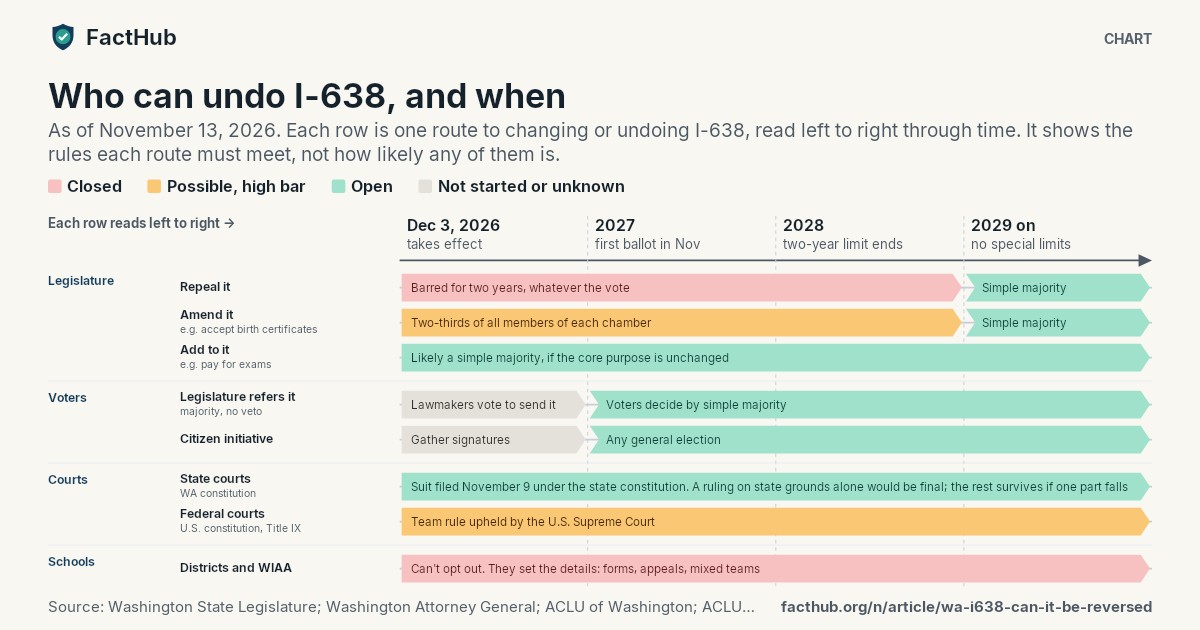
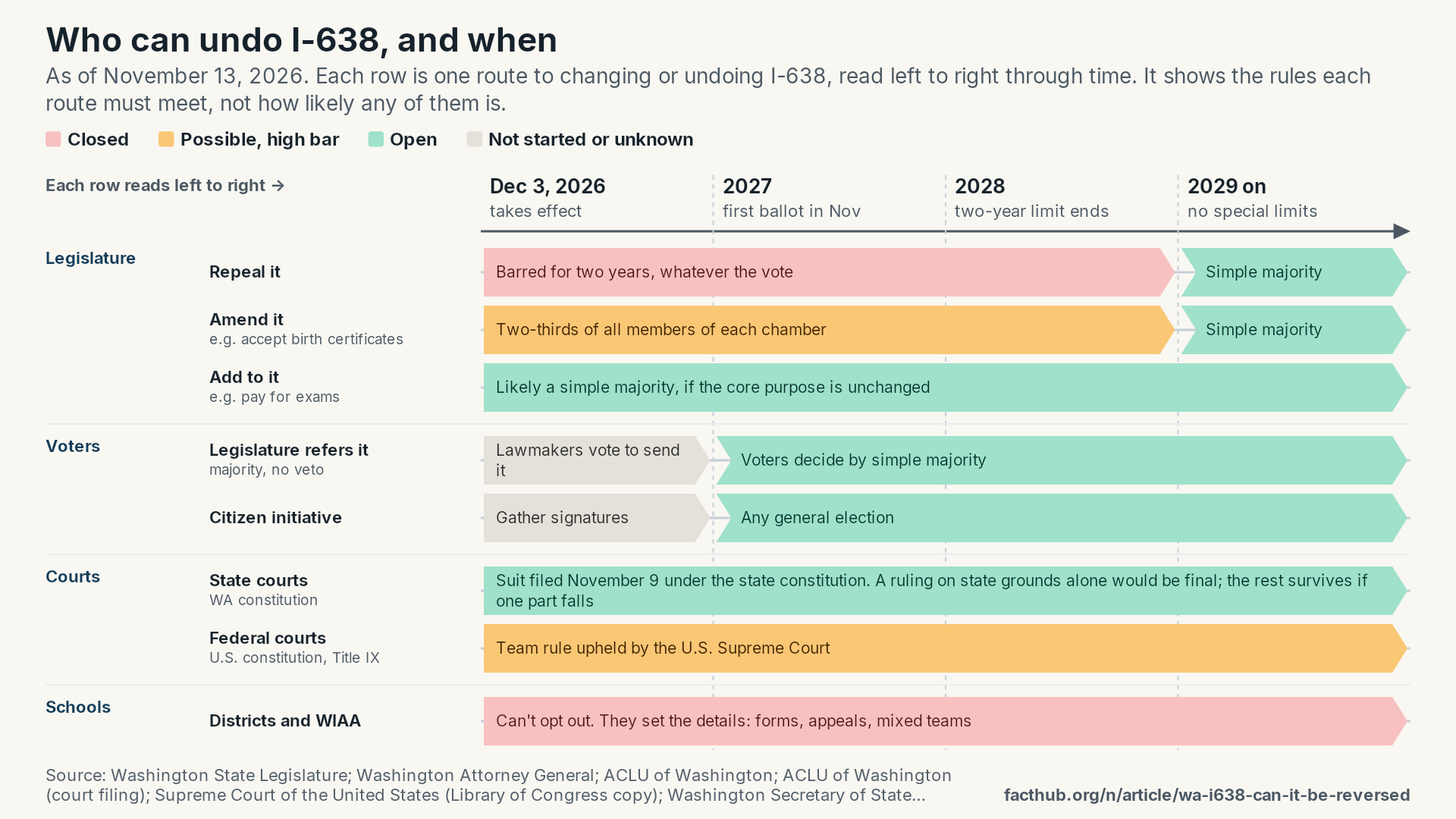
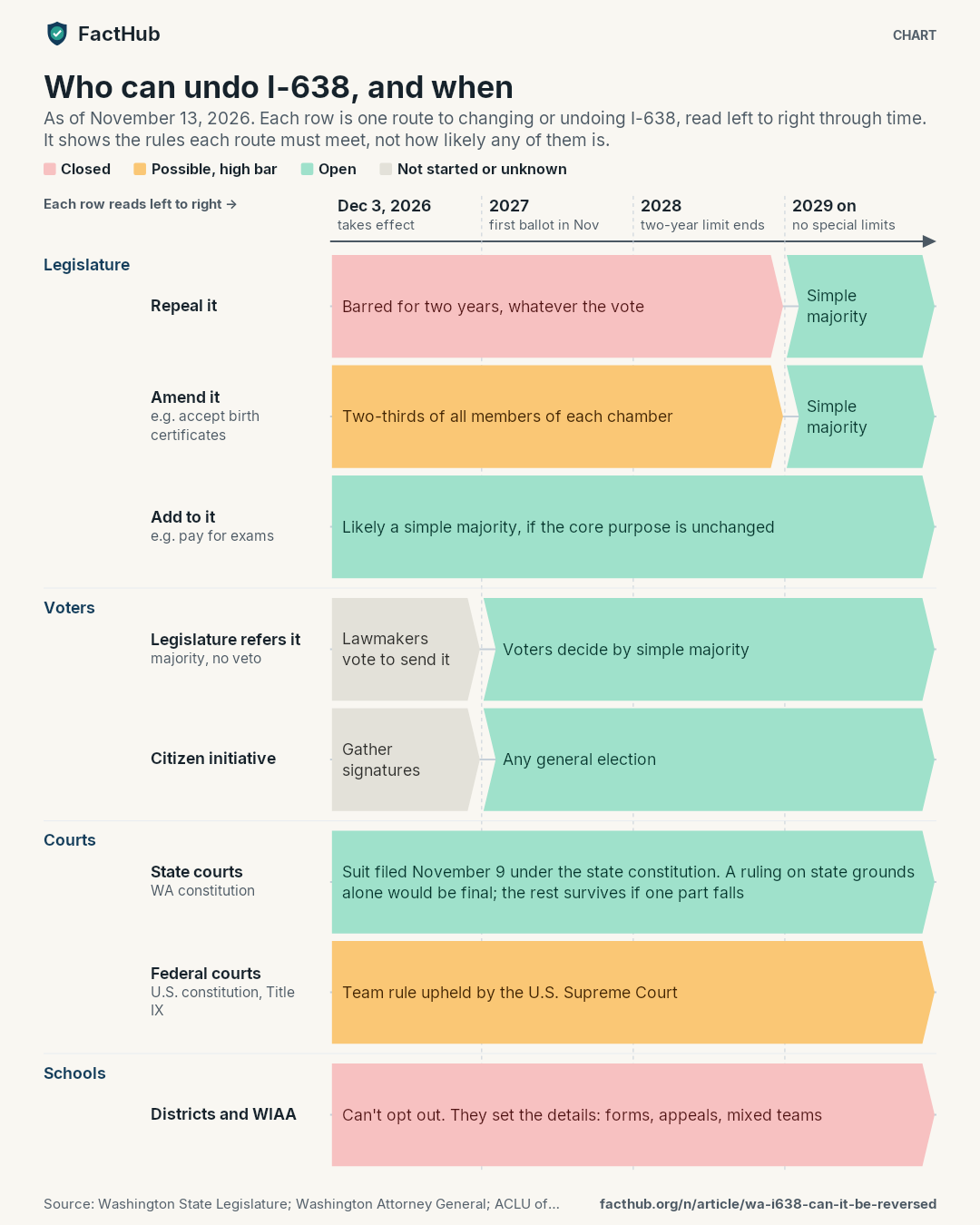
Misleading. A pending lawsuit could block it, but no court has ruled, and lawmakers need two-thirds to amend it until 2029. The constitution bars lawmakers from repealing a voter-approved law for two years and requires two-thirds to amend it, which Senate Democrats lack. A new lawsuit under the state constitution could block I-638, but no court has ruled.
Quote or cite this fact-check
FactHub rates the claim “Olympia and the courts can just reverse I-638” Misleading (moderate confidence): A pending lawsuit could block it, but no court has ruled, and lawmakers need two-thirds to amend it until 2029. Reviewed November 13, 2026. https://facthub.org/n/article/wa-i638-can-it-be-reversed/3
Key points
What the evidence establishes
- Established. Until about late 2028, lawmakers can't repeal I-638, and amending it takes two-thirds of each chamber: 66 House and 33 Senate votes.
- Established. Democrats lead in 69 of 98 House races but are set for about 30 of 49 Senate seats, three short of two-thirds.
- Established. Parents, the statewide educators' union and a family support group sued on November 9 to stop I-638; no court had ruled by November 13.
- Established. The suit relies only on the state constitution, so the U.S. Supreme Court's June ruling allowing girls-only teams doesn't decide it.
- Established. Washington's Supreme Court has voided voter-approved measures before, including the car-tab limit in 2020 and the natural gas measure in 2026.
- Context. We read “just reverse” as quickly or easily. Can it be reversed at all? Yes: by a court, by voters, or by lawmakers from 2029.
The evidence
The conclusion rests on the combined record. Expand each item to see its role and limitations.
| Method | Institution / country | Year(s) | What it shows | Key limitation | Primary links |
|---|---|---|---|---|---|
| We read the current text of Article II, Section 1 of Washington's constitution, an Attorney General's opinion on it, and the House staff summary of I-638. | Washington State Legislature, Washington Attorney General, Washington House Office of Program Research United States | 1952, 1988, 2026 | For two years after voters approve a law, the Legislature may not repeal it. It may amend it only with two-thirds of all members elected to each chamber: 66 of 98 representatives and 33 of 49 senators. The Attorney General reads the rule the same way. I-638 takes effect December 3, 2026, so the protection runs until about late 2028, through the 2027 and 2028 sessions. The rule applies to any law voters approve by a majority, however large the margin. I-638 started as an initiative to the Legislature, but lawmakers did not act on it, so it went to voters, and their approval brings it under the rule. | No court has said whether the two years count from the election or from the effective date. Either way, the 2029 session is the first that can act by simple majority. The Attorney General's opinion is advice, not a ruling, and a 1957 court decision treated even a sweeping rewrite as an amendment, so the line between amending and repealing is not sharp. | Washington State Legislature Washington Attorney General Washington House Office of Program Research |
| We counted the party preference of the leading candidate in every legislative race in the Secretary of State's results feed as of November 13, and checked the Senate total against a November 9 news count. | Washington Secretary of State, KUOW United States | 2026 | Candidates who prefer the Democratic Party lead in 69 of 98 House races, three more than two-thirds. In the Senate, news reports on November 9 said Democrats had flipped one seat and were two short of two-thirds. Later ballots reversed the closest Senate race, in the 35th District, where the Republican incumbent led by 399 votes on November 13. That leaves Democrats about 30 of 49 senators, three short of 33. Amending I-638 before 2029 would therefore need every Senate Democrat plus at least three Republicans. I-638 itself led with 56.0% of the vote. | Results are unofficial until counties certify on November 24 and the state by December 3, and about 35,600 ballots were still to be counted statewide. One House seat in the Democrats' 69 was led by 82 votes, and a Republican led the closest Senate race by 399 votes. Party preference does not guarantee how a member would vote on I-638. | Washington Secretary of State KUOW |
| We read the session laws, vote certificates and bill reports for changes lawmakers made to recent initiatives within two years, and for the 2025 rewrite of the parents' rights initiative. | Washington State Legislature, Washington State Standard United States | 2019, 2024, 2025, 2026 | Changes inside the two years usually pass with large bipartisan votes. In 2019, lawmakers rewrote parts of the police use-of-force initiative, I-940, two months after it took effect, 98-0 and 47-0. The same year, a bill amended the gun initiative I-1639 with only 56 House votes and 30 Senate votes. The parents' rights initiative rewritten in 2025 is a different case: lawmakers had passed it themselves in 2024, so voters never approved it and the two-year rule never applied. | We found no court case challenging the 2019 gun bill under the two-year rule, but we searched news and the web, not court dockets. That bill added to the initiative rather than weakening it, and a challenge to a change that weakened I-638 would be more likely. This is a sample of recent cases, not a full history. | Washington House of Representatives Washington State Legislature Washington State Legislature Washington State Legislature Washington State Standard |
| We read the constitution's referendum provisions and two Attorney General opinions on what lawmakers may do within two years. | Washington Attorney General, Washington State Legislature United States | 1973, 1988 | Lawmakers have three routes that skip the two-thirds rule. A new law can add to I-638, such as paying for verification exams, if it leaves the initiative's essential purpose and effect unchanged. A simple majority can send an amendment or repeal to voters at any time, with no governor's veto. And from 2029, a simple majority can amend or repeal it outright. Voters can also change it at any election through their own initiative. | The Attorney General's opinions are advice; a court decides where adding ends and amending begins. Any measure sent to voters takes effect only if voters approve it, and the next general election is November 2027. We found no case of lawmakers sending a repeal of a new voter-approved initiative back to voters. | Washington Attorney General Washington Attorney General Washington State Legislature |
| We read the Supreme Court's June 30, 2026 opinion in West Virginia v. B. P. J. and its 1983 rule on reviewing state court decisions. | Supreme Court of the United States United States | 1983, 2026 | The Court held that states may limit girls' and women's teams to biological females, which closes the main federal challenge to I-638's team rule. The ruling does not address how sex is verified. The November 9 lawsuit raises only state-constitution claims, which the June ruling did not decide. The U.S. Supreme Court will not review a state ruling that rests clearly on state grounds, so a ruling against I-638 on those grounds alone would be final. A female athletes' group says it will argue that blocking I-638 would break federal law, a question the Court left open. A state ruling that rejected that argument could be appealed on that federal question. | The Court reviewed West Virginia and Idaho laws, not I-638. It left open whether federal law requires schools to keep transgender girls off girls' teams, a question now in lower courts. | Supreme Court of the United States Supreme Court of the United States (Library of Congress copy) ACLU of Washington (court filing) Alliance Defending Freedom |
| We read the complaint, the plaintiffs' lawyers' release, Female Athletes United's motion to intervene, the Attorney General's release, the Seattle School Board's release and the Seattle mayor's post. | ACLU of Washington, Alliance Defending Freedom, Washington Attorney General, Seattle Public Schools United States | 2026 | On November 9, the Washington Education Association, a statewide union of educators, joined TransFamilies, a support group for families of transgender children, and parents to sue the state in King County Superior Court. Their claims rest on four parts of the state constitution: privacy, the Equal Rights Amendment, the right to education, and the rule for how a new law may amend existing laws. They ask the court to block I-638 while the case goes on and plan to seek emergency relief before it takes effect December 3. On November 12, the Attorney General appointed an outside firm, Bryan Cave Leighton Paisner, to defend I-638 for the state. He cited his office's work defending transgender rights. On November 13, Female Athletes United asked to join the case as a defendant. The Seattle School Board separately authorized legal action, and Mayor Katie Wilson backed it. | The complaint states the plaintiffs' claims; no court had ruled on them or on the motion to intervene. We did not search the court docket, so a hearing date or later ruling may be missing. The Seattle district had announced no court filing by November 13. | ACLU of Washington Alliance Defending Freedom ACLU of Washington (court filing) Washington Attorney General Seattle Public Schools Seattle Mayor Katie Wilson on X |
| We read the state Supreme Court's opinions on three recent initiatives and I-638's own severability section. | Washington Supreme Court, Washington Secretary of State United States | 2012, 2020, 2026 | The court voided the car-tab measure, I-976, in 2020 and the natural gas measure, I-2066, in 2026, both for combining more than one subject. It upheld the 2011 liquor measure, I-1183, against the same kind of challenge. I-638 also says that if a court strikes one part, the rest stays in force. The November 9 suit raises different state claims, and no court had ruled on it by November 13. | Three cases show the court acts both ways; they do not give odds for I-638, which is narrower than the measures it voided and faces different claims. We did not search court dockets for other suits or later rulings. The severability clause would not keep I-638 working if a court voided its core rules, the girls'-team limit or the sex check, which the privacy and Equal Rights Amendment claims target; that reading is ours. | Washington Supreme Court Washington Supreme Court Washington Supreme Court (Caselaw Access Project copy) Washington Secretary of State Alliance Defending Freedom |
| We read I-638's text, the WIAA Handbook, the state schools office's athletics rule, and written statements from the WIAA and the schools office. | Washington Interscholastic Activities Association, Office of Superintendent of Public Instruction, The Center Square United States | 2026 | I-638 says district and WIAA rules must bar biologically male students from girls-only teams, so districts cannot opt out. The WIAA says its changes will be in place by December 3, and it can expel member schools that break its rules. Districts and the WIAA decide the details, such as how the provider's form is handled, and the WIAA's rules must give a student notice and a chance to contest a decision. Any team with both boys and girls counts as a boys' team. | The current WIAA gender identity rule and a state schools office rule (WAC 392-190-025) still protect participation by gender identity, and neither had been revised by November 5. The schools office says it has no formal role in carrying out I-638. How the form will work is still under legal review at the WIAA. | Washington Secretary of State The Center Square Washington Interscholastic Activities Association (WIAA) Washington State Legislature (Office of the Code Reviser) |
1. The constitution protects a voter-approved law for two years We read the current text of Article II, Section 1 of Washington's constitution, an Attorney General's opinion on it, and the House staff summary of I-638.
For two years after voters approve a law, the Legislature may not repeal it. It may amend it only with two-thirds of all members elected to each chamber: 66 of 98 representatives and 33 of 49 senators. The Attorney General reads the rule the same way. I-638 takes effect December 3, 2026, so the protection runs until about late 2028, through the 2027 and 2028 sessions. The rule applies to any law voters approve by a majority, however large the margin. I-638 started as an initiative to the Legislature, but lawmakers did not act on it, so it went to voters, and their approval brings it under the rule.
Limit: No court has said whether the two years count from the election or from the effective date. Either way, the 2029 session is the first that can act by simple majority. The Attorney General's opinion is advice, not a ruling, and a 1957 court decision treated even a sweeping rewrite as an amendment, so the line between amending and repealing is not sharp.
Verify: Washington State Constitution, Article II, Section 1, and Article XXIII AGO 1988 No. 25: Authority of the Legislature to amend initiatives Summary of Initiative 26-638
- For two years after voters approve a law, the Legislature may not repeal it, and may amend it only with two-thirds of all members elected to each house. Washington State Legislature · Contradicts
- A voter-approved measure takes effect 30 days after the election, which for I-638 is December 3, 2026. Washington State Legislature · Qualifies
- The Attorney General reads the constitution to bar repeal within two years and to allow amendment only with two-thirds of both houses. Washington Attorney General · Contradicts
- The Legislature did not act on I-638 in its 2026 session, which is why it went to voters. Washington House Office of Program Research · Qualifies
- I-638 takes effect 30 days after the election. Washington House Office of Program Research · Qualifies
2. Democrats are short of two-thirds in the Senate We counted the party preference of the leading candidate in every legislative race in the Secretary of State's results feed as of November 13, and checked the Senate total against a November 9 news count.
Candidates who prefer the Democratic Party lead in 69 of 98 House races, three more than two-thirds. In the Senate, news reports on November 9 said Democrats had flipped one seat and were two short of two-thirds. Later ballots reversed the closest Senate race, in the 35th District, where the Republican incumbent led by 399 votes on November 13. That leaves Democrats about 30 of 49 senators, three short of 33. Amending I-638 before 2029 would therefore need every Senate Democrat plus at least three Republicans. I-638 itself led with 56.0% of the vote.
Limit: Results are unofficial until counties certify on November 24 and the state by December 3, and about 35,600 ballots were still to be counted statewide. One House seat in the Democrats' 69 was led by 82 votes, and a Republican led the closest Senate race by 399 votes. Party preference does not guarantee how a member would vote on I-638.
Verify: November 3, 2026 General Election Results (unofficial) Washington Dems nab supermajority in state House
- I-638 led 1,760,044 Yes to 1,384,206 No (56.0%). Democrats led in 69 of 98 House races. In the 35th District Senate race, Republican Drew MacEwen led Democrat Carolina Mejia 39,262 to 38,863. Washington Secretary of State · Contradicts
- As of November 9, Democrats had flipped one Senate seat and were two seats short of two-thirds, which is 33 of 49. KUOW · Contradicts
3. How lawmakers have changed recent initiatives We read the session laws, vote certificates and bill reports for changes lawmakers made to recent initiatives within two years, and for the 2025 rewrite of the parents' rights initiative.
Changes inside the two years usually pass with large bipartisan votes. In 2019, lawmakers rewrote parts of the police use-of-force initiative, I-940, two months after it took effect, 98-0 and 47-0. The same year, a bill amended the gun initiative I-1639 with only 56 House votes and 30 Senate votes. The parents' rights initiative rewritten in 2025 is a different case: lawmakers had passed it themselves in 2024, so voters never approved it and the two-year rule never applied.
Limit: We found no court case challenging the 2019 gun bill under the two-year rule, but we searched news and the web, not court dockets. That bill added to the initiative rather than weakening it, and a challenge to a change that weakened I-638 would be more likely. This is a sample of recent cases, not a full history.
Verify: Final Bill Report, Substitute House Bill 1064 (2019) Substitute House Bill 1739, Chapter 243, Laws of 2019 Engrossed Substitute House Bill 1296, Chapter 369, Laws of 2025 RCW 28A.605.005, history note WA Democrats won't hold hearings on parental rights, trans athlete initiatives
- Lawmakers rewrote parts of I-940 about two months after it took effect, with unanimous votes in both chambers. Washington House of Representatives · Qualifies
- The bill amended a section of law enacted by voter-approved Initiative 1639, months after that initiative passed in November 2018. Washington State Legislature
- It passed 56-40 in the House and 30-18 in the Senate, short of two-thirds in both. Washington State Legislature
- The rewrite passed 59-39 in the House and 30-19 in the Senate, short of two-thirds. Washington State Legislature · Qualifies
- It amended a section first enacted in 2024 chapter 4. Washington State Legislature · Qualifies
- 2024 chapter 4 is Initiative 2081, which the 2025 law amended. Washington State Legislature · Qualifies
- Lawmakers, not voters, passed the parents' rights initiative in 2024, and a 2025 law rewrote it. Washington State Standard · Qualifies
- Legislative leaders chose to send I-638 to voters rather than pass it. Washington State Standard · Qualifies
4. Other routes for lawmakers and voters We read the constitution's referendum provisions and two Attorney General opinions on what lawmakers may do within two years.
Lawmakers have three routes that skip the two-thirds rule. A new law can add to I-638, such as paying for verification exams, if it leaves the initiative's essential purpose and effect unchanged. A simple majority can send an amendment or repeal to voters at any time, with no governor's veto. And from 2029, a simple majority can amend or repeal it outright. Voters can also change it at any election through their own initiative.
Limit: The Attorney General's opinions are advice; a court decides where adding ends and amending begins. Any measure sent to voters takes effect only if voters approve it, and the next general election is November 2027. We found no case of lawmakers sending a repeal of a new voter-approved initiative back to voters.
Verify: AGO 1988 No. 25: Authority of the Legislature to amend initiatives AGLO 1973 No. 14: Amending a voter-approved measure through a referendum bill Washington State Constitution, Article II, Section 1, and Article XXIII
- A new law on the same subject that leaves the initiative's essential purpose and effect unchanged is not an amendment, so the two-thirds rule doesn't apply to it. Washington Attorney General
- Less than two-thirds of the Legislature can amend or even repeal a voter-approved measure by sending a referendum bill to voters. Washington Attorney General
- Voters can amend or repeal a voter-approved law at any election, with no two-year wait. Washington State Legislature
- The Legislature can send a law to voters the way it passes other bills, by majority vote, and the governor cannot veto a measure referred to voters. Washington State Legislature
5. The U.S. Supreme Court upheld laws like I-638 in June We read the Supreme Court's June 30, 2026 opinion in West Virginia v. B. P. J. and its 1983 rule on reviewing state court decisions.
The Court held that states may limit girls' and women's teams to biological females, which closes the main federal challenge to I-638's team rule. The ruling does not address how sex is verified. The November 9 lawsuit raises only state-constitution claims, which the June ruling did not decide. The U.S. Supreme Court will not review a state ruling that rests clearly on state grounds, so a ruling against I-638 on those grounds alone would be final. A female athletes' group says it will argue that blocking I-638 would break federal law, a question the Court left open. A state ruling that rejected that argument could be appealed on that federal question.
Limit: The Court reviewed West Virginia and Idaho laws, not I-638. It left open whether federal law requires schools to keep transgender girls off girls' teams, a question now in lower courts.
Verify: West Virginia v. B. P. J. (decided June 30, 2026), slip opinion Michigan v. Long, 463 U.S. 1032 (1983) Complaint for Declaratory Judgment and Injunctive Relief, J. Doe A v. State of Washington (King County Superior Court) Female Athletes United's Motion to Intervene as Defendant, Washington Education Association v. State of Washington, No. 26-2-36880-5 SEA (King County Superior Court)
- States may limit girls' and women's teams to biological females under the U.S. Constitution and Title IX. Supreme Court of the United States · Contradicts
- The Court did not decide whether schools may let transgender girls play on girls' teams, so it neither requires nor forbids that. Supreme Court of the United States · Qualifies
- The U.S. Supreme Court will not review a state court decision that rests clearly on independent state-law grounds. Supreme Court of the United States (Library of Congress copy) · Contradicts
- The complaint asks the court to declare that I-638 violates four parts of the Washington Constitution: privacy, the Equal Rights Amendment, education, and the rule on amending laws. Its claims cite no federal law. ACLU of Washington (court filing) · Qualifies
- The group argues that blocking I-638 would violate Title IX and the U.S. Constitution's equal protection clause. Alliance Defending Freedom · Contradicts
6. A state lawsuit seeks to block I-638 before December 3 We read the complaint, the plaintiffs' lawyers' release, Female Athletes United's motion to intervene, the Attorney General's release, the Seattle School Board's release and the Seattle mayor's post.
On November 9, the Washington Education Association, a statewide union of educators, joined TransFamilies, a support group for families of transgender children, and parents to sue the state in King County Superior Court. Their claims rest on four parts of the state constitution: privacy, the Equal Rights Amendment, the right to education, and the rule for how a new law may amend existing laws. They ask the court to block I-638 while the case goes on and plan to seek emergency relief before it takes effect December 3.
On November 12, the Attorney General appointed an outside firm, Bryan Cave Leighton Paisner, to defend I-638 for the state. He cited his office's work defending transgender rights. On November 13, Female Athletes United asked to join the case as a defendant. The Seattle School Board separately authorized legal action, and Mayor Katie Wilson backed it.
Limit: The complaint states the plaintiffs' claims; no court had ruled on them or on the motion to intervene. We did not search the court docket, so a hearing date or later ruling may be missing. The Seattle district had announced no court filing by November 13.
Verify: Nonprofits and families sue state over transgender sports ban initiative Female Athletes United's Motion to Intervene as Defendant, Washington Education Association v. State of Washington, No. 26-2-36880-5 SEA (King County Superior Court) Complaint for Declaratory Judgment and Injunctive Relief, J. Doe A v. State of Washington (King County Superior Court) AGO appoints outside law firm to defend Initiative 638 Seattle School Board Authorizes Legal Action Regarding Initiative IL26-638 Post of November 10, 2026
- Parents and educators sued on November 9 to stop I-638 from being carried out. ACLU of Washington
- The plaintiffs are TransFamilies, a support group for families of transgender children; the Washington Education Association, a statewide union of educators; and parents of girls who play school sports. ACLU of Washington · Qualifies
- The suit claims I-638 violates the state constitution, including its privacy protection and its Equal Rights Amendment. ACLU of Washington
- The suit also claims I-638 broke the state constitution's rules for how a new law may amend existing laws. ACLU of Washington
- The plaintiffs plan to ask for emergency relief to keep I-638 from taking effect December 3. ACLU of Washington
- Female Athletes United asks to join the case, No. 26-2-36880-5 SEA in King County Superior Court, as a defendant alongside the State. Alliance Defending Freedom · Qualifies
- The complaint asks the court to declare that I-638 violates four parts of the Washington Constitution: privacy, the Equal Rights Amendment, education, and the rule on amending laws. Its claims cite no federal law. ACLU of Washington (court filing) · Qualifies
- The group filed its motion four days after the November 9 suit, on November 13, before any ruling in the case. Alliance Defending Freedom · Qualifies
- On November 12, 2026, the Attorney General appointed the outside firm Bryan Cave Leighton Paisner to defend I-638 for the state. Washington Attorney General · Qualifies
- He cited his office's work defending transgender rights, which he said it cannot abandon. Washington Attorney General · Qualifies
- He called appointing outside counsel a common step when the office can't handle a case itself. Washington Attorney General · Qualifies
- In a resolution announced November 10, 2026, the Seattle School Board authorized hiring lawyers for any legal action it finds warranted over I-638. Seattle Public Schools
- On November 10, 2026, Seattle's mayor backed the school board's decision to challenge I-638. Seattle Mayor Katie Wilson on X
- The plaintiffs, including TransFamilies and the Washington Education Association, sued the State of Washington, which is the only defendant. ACLU of Washington (court filing) · Qualifies
- The plaintiffs ask the court to bar I-638 from being carried out, both while the case goes on and permanently. ACLU of Washington (court filing)
7. Washington's Supreme Court has voided and upheld initiatives We read the state Supreme Court's opinions on three recent initiatives and I-638's own severability section.
The court voided the car-tab measure, I-976, in 2020 and the natural gas measure, I-2066, in 2026, both for combining more than one subject. It upheld the 2011 liquor measure, I-1183, against the same kind of challenge. I-638 also says that if a court strikes one part, the rest stays in force. The November 9 suit raises different state claims, and no court had ruled on it by November 13.
Limit: Three cases show the court acts both ways; they do not give odds for I-638, which is narrower than the measures it voided and faces different claims. We did not search court dockets for other suits or later rulings. The severability clause would not keep I-638 working if a court voided its core rules, the girls'-team limit or the sex check, which the privacy and Equal Rights Amendment claims target; that reading is ours.
Verify: Climate Solutions v. State, No. 104240-0 (Sept. 17, 2026) Garfield County Transportation Authority v. State, No. 98320-8 (Oct. 15, 2020) Washington Ass'n for Substance Abuse & Violence Prevention v. State, 174 Wn.2d 642 (2012) Initiative Measure No. IL26-638, final text Female Athletes United's Motion to Intervene as Defendant, Washington Education Association v. State of Washington, No. 26-2-36880-5 SEA (King County Superior Court)
- The court voided all of I-2066 because it combined more than one subject. Washington Supreme Court
- The court voided I-976 because it covered more than one subject and its title misdescribed it. Washington Supreme Court
- The court upheld I-1183 against a challenge under the same one-subject rule. Washington Supreme Court (Caselaw Access Project copy) · Contradicts
- If a court strikes one part of I-638, the rest stays in force. Washington Secretary of State · Qualifies
- The group filed its motion four days after the November 9 suit, on November 13, before any ruling in the case. Alliance Defending Freedom · Qualifies
8. Schools must comply but decide the details We read I-638's text, the WIAA Handbook, the state schools office's athletics rule, and written statements from the WIAA and the schools office.
I-638 says district and WIAA rules must bar biologically male students from girls-only teams, so districts cannot opt out. The WIAA says its changes will be in place by December 3, and it can expel member schools that break its rules. Districts and the WIAA decide the details, such as how the provider's form is handled, and the WIAA's rules must give a student notice and a chance to contest a decision. Any team with both boys and girls counts as a boys' team.
Limit: The current WIAA gender identity rule and a state schools office rule (WAC 392-190-025) still protect participation by gender identity, and neither had been revised by November 5. The schools office says it has no formal role in carrying out I-638. How the form will work is still under legal review at the WIAA.
Verify: Initiative Measure No. IL26-638, final text I-638 reactions from the Democratic Party, OSPI and the WIAA (November 5, 2026) WIAA Handbook 2026-27 WAC 392-190-025, Recreational and athletic activities
- School district and WIAA rules must bar biologically male students from girls-only teams; the measure gives districts no option to opt out. Washington Secretary of State · Contradicts
- Before a student is finally turned away, the rules must give notice of the reasons and a fair chance to contest them. Washington Secretary of State · Qualifies
- The WIAA, which runs school sports, says its changes will be in place when I-638 takes effect. The Center Square · Contradicts
- The state schools office says I-638 requires districts to adopt new policies but gives the office no formal role. The Center Square · Qualifies
- Until it changes, WIAA rules let students compete consistent with their gender identity. Washington Interscholastic Activities Association (WIAA) · Qualifies
- Any team with both boys and girls counts as a boys' team. Washington Interscholastic Activities Association (WIAA) · Qualifies
- The WIAA can expel a member school that breaks its rules. Washington Interscholastic Activities Association (WIAA) · Contradicts
- A state rule still bars districts from excluding students from school sports based on a protected status, which includes gender identity. Washington State Legislature (Office of the Code Reviser) · Qualifies
Common questions 10
“Lawmakers have changed a voter-approved initiative within two years without a two-thirds vote.”
Short answer: Yes, in 2019
In 2019, lawmakers amended the voter-approved gun initiative I-1639 within months, with only 56 of 98 House votes. We found no court case challenging that bill. It added to the initiative rather than weakening it. The constitution's text requires two-thirds, so a change that weakened I-638 would likely be challenged.
- The bill amended a section of law enacted by voter-approved Initiative 1639, months after that initiative passed in November 2018. Washington State Legislature
- It passed 56-40 in the House and 30-18 in the Senate, short of two-thirds in both. Washington State Legislature
See the evidence: How lawmakers have changed recent initiatives
“If Washington's Supreme Court strikes down I-638, the U.S. Supreme Court can restore it.”
Short answer: Only on a federal question
Not if the ruling rests only on the state's constitution. The U.S. Supreme Court won't review a state decision that rests clearly on state grounds. But if a state court also rejects a federal argument, such as the female athletes' group's claim that federal law requires girls-only teams, that part could be appealed. The June ruling says states may limit girls' teams; whether federal law requires it is a question the Court left open.
- The U.S. Supreme Court will not review a state court decision that rests clearly on independent state-law grounds. Supreme Court of the United States (Library of Congress copy) · Contradicts
- States may limit girls' and women's teams to biological females under the U.S. Constitution and Title IX. Supreme Court of the United States · Contradicts
- The Court did not decide whether schools may let transgender girls play on girls' teams, so it neither requires nor forbids that. Supreme Court of the United States · Qualifies
- The group argues that blocking I-638 would violate Title IX and the U.S. Constitution's equal protection clause. Alliance Defending Freedom · Contradicts
See the evidence: The U.S. Supreme Court upheld laws like I-638 in June
“The U.S. Supreme Court's June ruling settles any court challenge to I-638.”
Short answer: Only questions of federal law
No: it settled only questions of federal law, and the November 9 lawsuit relies only on Washington's constitution. The June ruling held that the U.S. Constitution and Title IX, the federal law against sex discrimination in schools, let states keep girls' teams for biological females. On the state constitution, Washington's own courts have the final word. A female athletes' group says it will argue that blocking I-638 would break federal law, a question the June ruling left open.
- States may limit girls' and women's teams to biological females under the U.S. Constitution and Title IX. Supreme Court of the United States · Contradicts
- The Court did not decide whether schools may let transgender girls play on girls' teams, so it neither requires nor forbids that. Supreme Court of the United States · Qualifies
- The complaint asks the court to declare that I-638 violates four parts of the Washington Constitution: privacy, the Equal Rights Amendment, education, and the rule on amending laws. Its claims cite no federal law. ACLU of Washington (court filing) · Qualifies
- The suit claims I-638 violates the state constitution, including its privacy protection and its Equal Rights Amendment. ACLU of Washington
- The U.S. Supreme Court will not review a state court decision that rests clearly on independent state-law grounds. Supreme Court of the United States (Library of Congress copy) · Contradicts
- The group argues that blocking I-638 would violate Title IX and the U.S. Constitution's equal protection clause. Alliance Defending Freedom · Contradicts
See the evidence: The U.S. Supreme Court upheld laws like I-638 in June
“The Attorney General refused to defend I-638.”
Short answer: He hired an outside firm
His office won't argue the case itself, but the state will defend I-638. On November 12, Attorney General Nick Brown appointed an outside firm, Bryan Cave Leighton Paisner, to defend it on the state's behalf. He said his office has done extensive work defending transgender rights and cannot abandon it. He called outside counsel a common step when the office can't handle a case itself.
- On November 12, 2026, the Attorney General appointed the outside firm Bryan Cave Leighton Paisner to defend I-638 for the state. Washington Attorney General · Qualifies
- He cited his office's work defending transgender rights, which he said it cannot abandon. Washington Attorney General · Qualifies
- He called appointing outside counsel a common step when the office can't handle a case itself. Washington Attorney General · Qualifies
See the evidence: A state lawsuit seeks to block I-638 before December 3
“Democrats rewrote the 2024 parents' rights initiative by majority vote, so they can do the same to I-638.”
Short answer: Different rule applies
Lawmakers passed the parents' rights initiative themselves in 2024, so voters never approved it and the two-year rule never applied. The 2025 rewrite passed 59-39 and 30-19, short of two-thirds. I-638 went to voters because legislative leaders declined to act on it, and voters approved it, so the rule applies.
- Lawmakers, not voters, passed the parents' rights initiative in 2024, and a 2025 law rewrote it. Washington State Standard · Qualifies
- The rewrite passed 59-39 in the House and 30-19 in the Senate, short of two-thirds. Washington State Legislature · Qualifies
- It amended a section first enacted in 2024 chapter 4. Washington State Legislature · Qualifies
- 2024 chapter 4 is Initiative 2081, which the 2025 law amended. Washington State Legislature · Qualifies
- Legislative leaders chose to send I-638 to voters rather than pass it. Washington State Standard · Qualifies
See the evidence: How lawmakers have changed recent initiatives
“Courts struck down the car-tab and natural gas initiatives, so I-638 will go the same way.”
Short answer: Not necessarily
The state Supreme Court voided both because each combined more than one subject, a rule about how a measure is written. I-638 is narrower. The court has also upheld initiatives under the same rule, such as the 2011 liquor measure. No court had ruled on I-638 by November 13.
- The court voided all of I-2066 because it combined more than one subject. Washington Supreme Court
- The court voided I-976 because it covered more than one subject and its title misdescribed it. Washington Supreme Court
- The court upheld I-1183 against a challenge under the same one-subject rule. Washington Supreme Court (Caselaw Access Project copy) · Contradicts
See the evidence: Washington's Supreme Court has voided and upheld initiatives
“Democrats are already suing to overturn I-638.”
Short answer: A suit is filed; the party isn't in it
A suit was filed on November 9, but the Democratic Party isn't a plaintiff. The plaintiffs are parents, the statewide educators' union and TransFamilies, a family support group; the party chair had said the party backs groups planning to sue. They plan to ask a judge to stop I-638 before December 3, and no court had ruled by November 13. The Seattle School Board also authorized legal action, which the mayor backed, but had announced no court filing.
- The state Democratic Party chair called I-638 unconstitutional and said the party backs groups planning to sue. The Center Square
- Opponents say they will work to overturn I-638. Robert Cruickshank on X
- Parents and educators sued on November 9 to stop I-638 from being carried out. ACLU of Washington
- The plaintiffs are TransFamilies, a support group for families of transgender children; the Washington Education Association, a statewide union of educators; and parents of girls who play school sports. ACLU of Washington · Qualifies
- The plaintiffs plan to ask for emergency relief to keep I-638 from taking effect December 3. ACLU of Washington
- The group filed its motion four days after the November 9 suit, on November 13, before any ruling in the case. Alliance Defending Freedom · Qualifies
- In a resolution announced November 10, 2026, the Seattle School Board authorized hiring lawyers for any legal action it finds warranted over I-638. Seattle Public Schools
- On November 10, 2026, Seattle's mayor backed the school board's decision to challenge I-638. Seattle Mayor Katie Wilson on X
See the evidence: A state lawsuit seeks to block I-638 before December 3
“Voters could repeal I-638 before lawmakers can.”
Short answer: Yes, at any election
The constitution lets voters amend or repeal a voter-approved law at any election, through their own initiative or a measure lawmakers refer to them. A simple majority of lawmakers can refer one, and the governor can't veto it. The next general election is November 2027.
- Voters can amend or repeal a voter-approved law at any election, with no two-year wait. Washington State Legislature
- The Legislature can send a law to voters the way it passes other bills, by majority vote, and the governor cannot veto a measure referred to voters. Washington State Legislature
- Less than two-thirds of the Legislature can amend or even repeal a voter-approved measure by sending a referendum bill to voters. Washington Attorney General
- Supporters see talk of repealing I-638 already. Brandi Kruse on X
“Lawmakers need two-thirds to pay for sex-check exams or keep the doctor's signed form on a student's sex private.”
Short answer: Probably not
Probably not for paying for exams. The Attorney General has said lawmakers can pass a new law on the same subject without two-thirds. The new law must leave the initiative's essential purpose and effect unchanged. Paying for exams adds to I-638 rather than changing it. Accepting birth certificates or exempting middle schools would change its text and need two-thirds.
“Washington's school sports rules still let transgender girls play on girls' teams.”
Short answer: Until December 3
Yes, until it takes effect. The gender identity rule of the Washington Interscholastic Activities Association (WIAA), which runs school sports, and a state schools office rule still protect participation by gender identity. Unless a court blocks it, I-638 takes effect December 3 and requires district and WIAA rules to bar biologically male students from girls-only teams. The WIAA says its changes will be ready by then; the schools office says it has no formal role.
- Until it changes, WIAA rules let students compete consistent with their gender identity. Washington Interscholastic Activities Association (WIAA) · Qualifies
- A state rule still bars districts from excluding students from school sports based on a protected status, which includes gender identity. Washington State Legislature (Office of the Code Reviser) · Qualifies
- The WIAA, which runs school sports, says its changes will be in place when I-638 takes effect. The Center Square · Contradicts
- The state schools office says I-638 requires districts to adopt new policies but gives the office no formal role. The Center Square · Qualifies
See the evidence: Schools must comply but decide the details
Conclusion
The claim treats reversing I-638 as easy. The record shows the Legislature's path is slow and hard, and the court path is now open but undecided.
Lawmakers face the firmest limit. The constitution bars them from repealing a voter-approved law for two years and requires two-thirds of each chamber to amend it. On unofficial results, Democrats will hold about 30 of 49 Senate seats, three short. Changes inside the two years have usually passed with broad support, like the 2019 police use-of-force fix, which passed unanimously. Lawmakers can also add to I-638 without changing its purpose, refer a repeal to voters, or wait until 2029.
The courts are where things moved in November. Parents, the statewide educators' union and a family support group sued on November 9 and plan to ask a judge to stop I-638 before December 3. Their claims rest only on the state constitution. That matters: the U.S. Supreme Court's June ruling answered federal questions, so it does not decide these claims. A Washington ruling resting only on state grounds would be final, though a ruling that rejected a federal argument could be appealed on that point.
Still, the state's high court has upheld initiatives as well as voided them. I-638's severability clause keeps the rest in force if one part falls, though it would not save the measure if a court voided its core rules. An outside firm will defend I-638 for the state, and a female athletes' group has asked to join the defense with federal arguments.
Schools cannot opt out. Unless a court blocks it, I-638 takes effect December 3, and districts set the details.
We rate the claim Misleading with moderate confidence. The legal rules are clear, but no one can know how the lawsuit will turn out.
How we checked
- Defined the claim as it circulates on X after the November 3 election: that the Legislature and courts can simply reverse I-638. We checked what each can do under current law, plus what schools and voters can do.
- Read the constitution's text on initiatives, referendums and amendments, and two Attorney General opinions on it.
- Counted the 2027 House and Senate from the Secretary of State's unofficial results feed as of 5:01 p.m. Pacific on November 13, and checked the Senate total against a November 9 news count.
- Read the session laws, vote certificates and bill reports for recent changes to initiatives, and the opinions in recent court cases on initiatives.
- Read I-638's text, the WIAA Handbook, the state schools office's athletics rule, and officials' written statements.
- Checked each legal rule against more than one kind of record: the constitution's text, Attorney General opinions, how lawmakers have actually voted on past initiatives, and court rulings.
- For the November 9 lawsuit, read the complaint, the plaintiffs' lawyers' release and Female Athletes United's motion to intervene with its proposed answer. We also read the Attorney General's and the Seattle School Board's releases. We did not search court dockets, and we did not assess the merits of any legal challenge.
Editorial note: Scope: this article explains what the Legislature, the courts, schools and voters can do about I-638 under current law, as of November 13, 2026. It does not predict what they will do, rate any legal theory, or take a position on I-638. Seat counts and vote totals are unofficial and will be updated after certification if they change the finding. No external specialist review has been recorded.
Expert-review status
No external specialist review has been recorded.
Funding and conflicts
Funding: No external funding for this piece.
Ownership: Published by the FactHub Research Team.
Conflicts: None known.
Sources 28
Sources are labeled by kind, with what this fact check takes from each, so readers can check the evidence independently.
-
Government
Washington State Legislature.
Washington State Constitution, Article II, Section 1, and Article XXIII
The full current text of Washington's constitution, published by the Legislature.
Reliability: The Legislature publishes the constitution's official text. The two-year rule in Article II, Section 1(c) also appears as Article II, Section 41, which the 1952 Amendment 26 added.
-
Contradicts: For two years after voters approve a law, the Legislature may not repeal it, and may amend it only with two-thirds of all members elected to each house.
What the source says
No act, law, or bill approved by a majority of the electors voting thereon shall be amended or repealed by the legislature within a period of two years following such enactment:…That any such act, law, or bill may be amended within two years after such enactment at any regular or special session of the legislature by a vote of two-thirds of all the members elected to each house
Article II, Section 1(c)Not yet checked
-
Qualifies: A voter-approved measure takes effect 30 days after the election, which for I-638 is December 3, 2026.
What the source says
Such measure shall be in operation on and after the thirtieth day after the election at which it is approved.
Article II, Section 1(d)Not yet checked
-
Voters can amend or repeal a voter-approved law at any election, with no two-year wait.
What the source says
But such enactment may be amended or repealed at any general regular or special election by direct vote of the people thereon.
Article II, Section 1(c)Not yet checked
-
The Legislature can send a law to voters the way it passes other bills, by majority vote, and the governor cannot veto a measure referred to voters.
What the source says
either by petition signed by the required percentage of the legal voters, or by the legislature as other bills are enacted:…The veto power of the governor shall not extend to measures initiated by or referred to the people.
Article II, Section 1(b) and 1(d)Not yet checked
-
-
Government
Washington Attorney General.
AGO 1988 No. 25: Authority of the Legislature to amend initiatives
A formal Attorney General's opinion, issued October 31, 1988, on what the Legislature may do to an initiative within two years.
Reliability: Attorney General opinions are official legal advice to state officials. Courts give them weight but are not bound by them. This one predates I-638 by decades.
-
Contradicts: The Attorney General reads the constitution to bar repeal within two years and to allow amendment only with two-thirds of both houses.
What the source says
the Legislature shall not "repeal" any initiative within two years of the initiative's passage. At the same time, however, it permits amendments to an initiative within…two years so long as the amendments receive a two-thirds vote by both houses of the Legislature.
Answer to question 2Not yet checked
-
A new law on the same subject that leaves the initiative's essential purpose and effect unchanged is not an amendment, so the two-thirds rule doesn't apply to it.
What the source says
Thus, the Legislature may validly enact new legislation that deals with the same general subject matter as a…prior initiative so long as the essential purpose and effect of the prior initiative is not altered.
Analysis of question 1Not yet checked
-
-
Government
Washington Attorney General.
AGLO 1973 No. 14: Amending a voter-approved measure through a referendum bill
A 1973 Attorney General's letter opinion on amending the voter-approved Shoreline Management Act within two years.
Reliability: An informal letter opinion, which carries less weight than a formal opinion. It addresses the general rule, not I-638.
-
Less than two-thirds of the Legislature can amend or even repeal a voter-approved measure by sending a referendum bill to voters.
What the source says
it would be possible for this or any other measure approved by the voters at the November 7, 1972, general election to be amended (or even repealed) by the affirmative action of less than a two-thirds majority of the members of each house of the legislature approving a referendum bill submitted to the voters
AnalysisNot yet checked
-
-
Government
Washington House Office of Program Research.
Summary of Initiative 26-638
Nonpartisan House staff's summary of I-638, prepared for the 2026 ballot.
Reliability: Nonpartisan legislative staff wrote it for House members. It describes the measure and takes no side.
-
Qualifies: The Legislature did not act on I-638 in its 2026 session, which is why it went to voters.
What the source says
The Legislature did not act on Initiative 26-638 during its 2026 Regular Session.
Background, p. 1Not yet checked
-
Qualifies: I-638 takes effect 30 days after the election.
What the source says
The initiative takes effect 30 days after the election at which it is approved.
Effective DateNot yet checked
-
-
Government
Washington Secretary of State.
Initiative Measure No. IL26-638, final text
The full text of I-638 as filed with the Secretary of State.
Reliability: The official measure text. Let's Go Washington sponsored it; the Secretary of State publishes the filed text.
-
Contradicts: School district and WIAA rules must bar biologically male students from girls-only teams; the measure gives districts no option to opt out.
What the source says
must prohibit biologically male students from competing with and against female students in athletic activities with separate classifications for male and female students
Sec. 3(1)Not yet checked
-
Qualifies: Before a student is finally turned away, the rules must give notice of the reasons and a fair chance to contest them.
What the source says
provide for notice of the reasons and a fair opportunity to contest such reasons prior to a final determination to reject a student's request to participate in or to continue in an interschool activity.
Sec. 2(3)Not yet checked
-
Qualifies: If a court strikes one part of I-638, the rest stays in force.
What the source says
If any provision of this act or its application to any person or circumstance is held invalid, the remainder of the act or the application of the provision to other persons or circumstances is not affected.
Sec. 6Not yet checked
-
-
Government
Washington Secretary of State.
November 3, 2026 General Election Results (unofficial)
The state's results site, with I-638 and every legislative race. Results were unofficial as of November 13; counties certify November 24 and the state by December 3.
Reliability: County canvass results reported by the Secretary of State. The figures used here are as of 5:01 p.m. Pacific on November 13, with all 39 counties reporting and about 35,600 ballots left to count, and may still change slightly.
-
Contradicts: I-638 led 1,760,044 Yes to 1,384,206 No (56.0%). Democrats led in 69 of 98 House races. In the 35th District Senate race, Republican Drew MacEwen led Democrat Carolina Mejia 39,262 to 38,863.
What the source says
Initiative Measure No. IL26-638
Statewide results: I-638; State Representative and State Senator racesNot yet checked
-
-
News report
KUOW.
Washington Dems nab supermajority in state House
A November 9, 2026 news report on the legislative results.
Reliability: Seattle's public radio newsroom. Its Senate count reflects results as of November 9, before later ballots changed the closest race.
-
Contradicts: As of November 9, Democrats had flipped one Senate seat and were two seats short of two-thirds, which is 33 of 49.
What the source says
Democrats would need to flip two Senate seats…Democrats flipped one Senate seat this election
BodyNot yet checked
-
-
Government
Washington State Legislature.
Substitute House Bill 1739, Chapter 243, Laws of 2019
The 2019 law on untraceable and undetectable guns, as signed, with its certified votes.
Reliability: The enrolled session law, with the chamber clerks' vote certificate. Our search found no court case challenging it under the two-year rule; we did not search court dockets.
-
The bill amended a section of law enacted by voter-approved Initiative 1639, months after that initiative passed in November 2018.
What the source says
Sec. 1. RCW 9.41.010 and 2019 c 3 s 16 (Initiative Measure No.…1639) are each amended to read as follows:
Sec. 1, p. 1Not yet checked
-
It passed 56-40 in the House and 30-18 in the Senate, short of two-thirds in both.
What the source says
Passed by the House April 23, 2019 Yeas 56 Nays 40…Passed by the Senate April 16, 2019 Yeas 30 Nays 18
Certificate of enrollmentNot yet checked
-
-
Government
Washington House of Representatives.
Final Bill Report, Substitute House Bill 1064 (2019)
Nonpartisan staff report on the 2019 law that rewrote parts of the voter-approved police use-of-force initiative, I-940.
Reliability: Legislative staff report. The changes were negotiated before the 2018 election among the initiative's backers, police groups and legislators.
-
Qualifies: Lawmakers rewrote parts of I-940 about two months after it took effect, with unanimous votes in both chambers.
What the source says
November 2018 general election, and it took effect December 6, 2018.…Votes on Final Passage: House 98 0 Senate 47 0
Background; Votes on Final PassageNot yet checked
-
-
Government
Washington State Legislature.
Engrossed Substitute House Bill 1296, Chapter 369, Laws of 2025
The 2025 law that rewrote the 2024 parents' rights initiative, I-2081, with its certified votes.
Reliability: The enrolled session law and vote certificate.
-
Qualifies: The rewrite passed 59-39 in the House and 30-19 in the Senate, short of two-thirds.
What the source says
Passed by the House April 24, 2025 Yeas 59 Nays 39
Certificate of enrollmentNot yet checked
-
Qualifies: It amended a section first enacted in 2024 chapter 4.
What the source says
Sec. 501. RCW 28A.605.005 and 2024 c 4 s 1 are each amended to
Sec. 501, p. 19Not yet checked
-
-
Government
Washington State Legislature.
RCW 28A.605.005, history note
The current law, whose history note names the initiative it came from and the 2025 law that changed it.
Reliability: The Code Reviser's official compilation of state law.
-
Qualifies: 2024 chapter 4 is Initiative 2081, which the 2025 law amended.
What the source says
2025 c 369 s 501 ; 2024 c 4 s 1 (Initiative Measure No. 2081).
History noteNot yet checked
-
-
News report
Washington State Standard.
WA Democrats won't hold hearings on parental rights, trans athlete initiatives
A January 9, 2026 news report on legislative leaders sending I-638 and the parental rights measure to voters.
Reliability: A nonprofit statehouse news outlet. It quotes the Senate majority leader directly.
-
Qualifies: Lawmakers, not voters, passed the parents' rights initiative in 2024, and a 2025 law rewrote it.
What the source says
That law rewrote a Let’s Go Washington initiative known as the parental “bill of rights” that lawmakers passed in 2024.
BodyNot yet checked
-
Qualifies: Legislative leaders chose to send I-638 to voters rather than pass it.
What the source says
“I’m certain that we will not be passing either of those initiatives,” Pedersen said. “They’ll be up to the voters to decide.”
Body · Sen. Jamie Pedersen, Senate Majority LeaderNot yet checked
-
-
Government
Supreme Court of the United States.
West Virginia v. B. P. J. (decided June 30, 2026), slip opinion
The ruling, decided with Little v. Hecox, on state laws limiting girls' and women's teams to biological females.
Reliability: The Court ruled 6-3 on equal protection; the dissent agreed the Title IX claim failed. It reviewed West Virginia and Idaho laws, not Washington's, and did not address how sex is verified.
-
Contradicts: States may limit girls' and women's teams to biological females under the U.S. Constitution and Title IX.
What the source says
we hold that the States may maintain women's and girls' sports for biological females. They may determine eligibility for women's and girls' sports based on biological sex.
Opinion of the Court, p. 28Not yet checked
-
Qualifies: The Court did not decide whether schools may let transgender girls play on girls' teams, so it neither requires nor forbids that.
What the source says
these cases do not present the distinct question of whether, under Title IX and the Equal Protection Clause, schools may allow biological males who identify as female to participate on girls' and women's sports teams.…Nothing in this opinion is intended to decide that question.
Opinion of the Court, footnote 1Not yet checked
-
-
Government
Supreme Court of the United States (Library of Congress copy).
Michigan v. Long, 463 U.S. 1032 (1983)
The ruling that sets when the U.S. Supreme Court will review a state court decision.
Reliability: The official United States Reports text, hosted by the Library of Congress. It is long-settled doctrine.
-
Contradicts: The U.S. Supreme Court will not review a state court decision that rests clearly on independent state-law grounds.
What the source says
If the state court decision indicates clearly and expressly that it is alternatively based on bona fide separate, adequate, and independent grounds, we, of course, will not undertake to review the decision.
463 U.S. at 1041Not yet checked
-
-
Government
Washington Supreme Court.
Climate Solutions v. State, No. 104240-0 (Sept. 17, 2026)
The ruling that voided I-2066, the 2024 measure protecting natural gas service.
Reliability: The court's published opinion. The State defended the measure in court.
-
The court voided all of I-2066 because it combined more than one subject.
What the source says
Because the provisions that introduce distinct subjects are not severable, I-2066 is unconstitutional in its entirety.
Opinion, introductionNot yet checked
-
-
Government
Washington Supreme Court.
Garfield County Transportation Authority v. State, No. 98320-8 (Oct. 15, 2020)
The ruling that voided I-976, the 2019 car-tab measure.
Reliability: The court's published opinion.
-
The court voided I-976 because it covered more than one subject and its title misdescribed it.
What the source says
Initiative Measure 976 (I-976) contains more than one subject…Accordingly, it is unconstitutional.
Opinion, introductionNot yet checked
-
-
Academic
Washington Supreme Court (Caselaw Access Project copy).
Washington Ass'n for Substance Abuse & Violence Prevention v. State, 174 Wn.2d 642 (2012)
The ruling that upheld I-1183, the 2011 liquor privatization measure.
Reliability: A copy of the official reported opinion from Harvard Law School's Caselaw Access Project.
-
Contradicts: The court upheld I-1183 against a challenge under the same one-subject rule.
What the source says
We hold that appellants have not overcome the presumption that the initiative is constitutional, and therefore we affirm summary judgment in favor of the State and intervenors.
Opinion, ¶1Not yet checked
-
-
News report
The Center Square.
I-638 reactions from the Democratic Party, OSPI and the WIAA (November 5, 2026)
A November 5, 2026 news report quoting written statements from the state Democratic Party chair, the state schools office and the WIAA.
Reliability: A news outlet that leans conservative in its commentary. The quotes used here are written statements from the officials named.
-
The state Democratic Party chair called I-638 unconstitutional and said the party backs groups planning to sue.
What the source says
we believe this initiative is unconstitutional on its face and support organizations planning to challenge it in court
Body · Shasti Conrad, chair, Washington State Democratic PartyNot yet checked
-
Contradicts: The WIAA, which runs school sports, says its changes will be in place when I-638 takes effect.
What the source says
The WIAA office will have all necessary changes in place by December 3, 2026.
Body · Sean Bessette, WIAA communications directorNot yet checked
-
Qualifies: The state schools office says I-638 requires districts to adopt new policies but gives the office no formal role.
What the source says
While the initiative requires local school districts to adopt new policy, it did not task OSPI with producing model policy language or having any other formal role in implementation.
Body · Katy Payne, OSPI chief strategy officerNot yet checked
-
-
Other
Washington Interscholastic Activities Association (WIAA).
WIAA Handbook 2026-27
The rules of the nonprofit association that runs school sports in Washington, linked from wiaa.com.
Reliability: The WIAA is the private nonprofit that state law lets school districts use to run interschool sports. These are its rules before I-638 takes effect.
-
Qualifies: Until it changes, WIAA rules let students compete consistent with their gender identity.
What the source says
All students have the opportunity to participate in WIAA athletics and/or activities in a manner that is consistent with their gender identity.
Rule 18.16.0Not yet checked
-
Qualifies: Any team with both boys and girls counts as a boys' team.
What the source says
Any team consisting of both boys and girls shall be considered a boys team
Appendix 2Not yet checked
-
Contradicts: The WIAA can expel a member school that breaks its rules.
What the source says
The WIAA Executive Board may expel a Member School if a violation or series of violations occurs.
Rule 28.5.9Not yet checked
-
-
Government
Washington State Legislature (Office of the Code Reviser).
WAC 392-190-025, Recreational and athletic activities
The state schools office rule against discrimination in school sports, including by gender identity.
Reliability: A rule of the Office of Superintendent of Public Instruction (OSPI). "Protected status" includes gender identity under WAC 392-190-008. OSPI had not said by November 5 whether it will revise the rule.
-
Qualifies: A state rule still bars districts from excluding students from school sports based on a protected status, which includes gender identity.
What the source says
must not, on the basis of a protected status, exclude any student from participation in, deny any student the benefits of, or otherwise discriminate against any student in any interscholastic, club, or intramural athletics
Subsection (1)Not yet checked
-
-
Party to the dispute
Robert Cruickshank on X.
Post of November 5, 2026
A post by an I-638 opponent and political writer, seen about 16,000 times by November 5.
Reliability: Has a stake in this finding. The author opposes I-638 and links to a newsletter laying out plans to fight it. The post is a statement of intent, not evidence of what will happen.
-
Opponents say they will work to overturn I-638.
What the source says
We'll do the same with I-638. It's an unconstitutional initiative that should be vehemently opposed and never implemented.
Post textNot yet checked
-
-
Party to the dispute
Brandi Kruse on X.
Post of November 4, 2026
A post by an I-638 supporter and commentator, seen about 29,000 times by November 5.
Reliability: Has a stake in this finding. The author supports I-638. The post reports what others say they plan; it is not evidence of a filed measure.
-
Supporters see talk of repealing I-638 already.
What the source says
Pretty disturbing to see local moms say they are going to try to repeal I-638
Post textNot yet checked
-
-
Party to the dispute
ACLU of Washington.
Nonprofits and families sue state over transgender sports ban initiative
The November 10, 2026 release from the plaintiffs' lawyers announcing the lawsuit, its plaintiffs and its claims.
Reliability: Has a stake in this finding. The ACLU of Washington and Legal Voice represent the family plaintiffs, and Pacifica Law Group represents the union. The release states the plaintiffs' claims, not any court finding.
-
Parents and educators sued on November 9 to stop I-638 from being carried out.
What the source says
On November 9, a coalition of Washington state parents and educators filed suit to prevent the implementation of Initiative 638
First paragraphNot yet checked
-
Qualifies: The plaintiffs are TransFamilies, a support group for families of transgender children; the Washington Education Association, a statewide union of educators; and parents of girls who play school sports.
What the source says
The plaintiffs in the case include: TransFamilies, a nonprofit organization based in Washington state that works to support families with transgender and gender-diverse children; the Washington Education Association (WEA), a statewide union that represents more than 90,000 educators; and the parents of students who play girls’ sports in public schools.
Second paragraphNot yet checked
-
The suit claims I-638 violates the state constitution, including its privacy protection and its Equal Rights Amendment.
What the source says
Plaintiffs are suing on the grounds that the law violates the Washington state constitution in multiple ways. By requiring a sex verification, the law significantly intrudes on students’ privacy rights guaranteed by Article 1, Section 7. I-638 also violates the Equal Rights Amendment of the state constitution.
Seventh paragraphNot yet checked
-
The suit also claims I-638 broke the state constitution's rules for how a new law may amend existing laws.
What the source says
I-638 also violates state constitutional procedural requirements for enacting new laws that amend existing laws. It violates this by amending the Washington Law Against Discrimination and other anti-discrimination laws that explicitly protect transgender people.
Eighth paragraphNot yet checked
-
The plaintiffs plan to ask for emergency relief to keep I-638 from taking effect December 3.
What the source says
Together, they filed the lawsuit Monday and will seek emergency relief to prevent the law from taking effect on December 3.
Ninth paragraphNot yet checked
-
-
Party to the dispute
ACLU of Washington (court filing).
Complaint for Declaratory Judgment and Injunctive Relief, J. Doe A v. State of Washington (King County Superior Court)
The complaint filed November 9, 2026 in King County Superior Court, posted by the plaintiffs' lawyers.
Reliability: Has a stake in this finding. The plaintiffs' own filing. It states their claims and the relief they want; no court has ruled on them. Individual plaintiffs are parents suing under pseudonyms on behalf of their children.
-
Qualifies: The plaintiffs, including TransFamilies and the Washington Education Association, sued the State of Washington, which is the only defendant.
What the source says
TRANSFAMILIES, a nonprofit organization; and WASHINGTON EDUCATION ASSOCIATION, a nonprofit organization, Plaintiffs, v. STATE OF WASHINGTON, Defendant.
Caption, p. 1Not yet checked
-
Qualifies: The complaint asks the court to declare that I-638 violates four parts of the Washington Constitution: privacy, the Equal Rights Amendment, education, and the rule on amending laws. Its claims cite no federal law.
What the source says
That the Court enter a declaratory judgment that the Initiative violates article I, section 7, article XXXI, article IX, and article II, section 37 of the Washington Constitution
Prayer for Relief, paragraph A, p. 22Not yet checked
-
The plaintiffs ask the court to bar I-638 from being carried out, both while the case goes on and permanently.
What the source says
Plaintiffs seek preliminary and permanent injunctive relief prohibiting its implementation and enforcement.
Second Cause of Action, paragraph 7.2Not yet checked
-
-
Party to the dispute
Alliance Defending Freedom.
Female Athletes United's Motion to Intervene as Defendant, Washington Education Association v. State of Washington, No. 26-2-36880-5 SEA (King County Superior Court)
Female Athletes United's November 13, 2026 motion to join the lawsuit as a defendant, filed by Alliance Defending Freedom, with its proposed answer to the complaint as Exhibit A.
Reliability: Has a stake in this finding. Alliance Defending Freedom represents Female Athletes United, which supports I-638 and asks to defend it. The court had not ruled on the motion in what we read.
-
Qualifies: Female Athletes United asks to join the case, No. 26-2-36880-5 SEA in King County Superior Court, as a defendant alongside the State.
What the source says
WASHINGTON EDUCATION ASSOCIATION, et al., Plaintiffs, vs. STATE OF WASHINGTON, Defendant, and FEMALE ATHLETES UNITED, Proposed Intervenor-Defendant.…CASE NO. 26-2-36880-5 SEA
Caption, PDF p. 1Not yet checked
-
Qualifies: The group filed its motion four days after the November 9 suit, on November 13, before any ruling in the case.
What the source says
FAU moved four days after the challengers filed suit, before any ruling, and before I-638 takes effect.
Argument I.A, PDF p. 12Not yet checked
-
Contradicts: The group argues that blocking I-638 would violate Title IX and the U.S. Constitution's equal protection clause.
What the source says
Plaintiffs’ proposed relief would violate Title IX, 42 U.S.C. § 1681 et seq., and its implementing regulations…Plaintiffs’ proposed relief would violate the Equal Protection Clause of the Constitution of the United States.
Exhibit A, affirmative defenses 7 and 8, PDF p. 38Not yet checked
-
-
Government
Washington Attorney General.
AGO appoints outside law firm to defend Initiative 638
Attorney General Nick Brown's November 12, 2026 statement on who will defend I-638.
Reliability: Has a stake in this finding. The Attorney General's own statement of his decision and reasons. His office represents the State, the defendant, and he notes its record of defending transgender rights in other cases.
-
Qualifies: On November 12, 2026, the Attorney General appointed the outside firm Bryan Cave Leighton Paisner to defend I-638 for the state.
What the source says
I have therefore decided to appoint an outside law firm, Bryan Cave Leighton Paisner (BCLP), to defend Initiative 638 on behalf of Washington state.
Third paragraph · Nick Brown, Washington Attorney GeneralNot yet checked
-
Qualifies: He cited his office's work defending transgender rights, which he said it cannot abandon.
What the source says
I also recognize that over the last two years our office has done extensive work defending the rights of transgender Washingtonians.…We will not and cannot abandon that work.
Second paragraph · Nick Brown, Washington Attorney GeneralNot yet checked
-
Qualifies: He called appointing outside counsel a common step when the office can't handle a case itself.
What the source says
Appointing outside counsel—known as a Special Assistant Attorney General—is a common step we take when our office cannot handle a case ourselves
Third paragraph · Nick Brown, Washington Attorney GeneralNot yet checked
-
-
Government
Seattle Public Schools.
Seattle School Board Authorizes Legal Action Regarding Initiative IL26-638
Seattle Public Schools' November 10, 2026 release on the board resolution authorizing legal action over I-638.
Reliability: Has a stake in this finding. The school board opposed I-638 in a September 2026 resolution. The release describes its own new resolution; it does not report a court filing.
-
In a resolution announced November 10, 2026, the Seattle School Board authorized hiring lawyers for any legal action it finds warranted over I-638.
What the source says
It also authorizes the securing of legal counsel to represent the district in carrying out any legal action determined to be warranted to protect the interests of Seattle Public Schools and prevent harm to district students.
First paragraphNot yet checked
-
-
Government
Seattle Mayor Katie Wilson on X.
Post of November 10, 2026
A November 10, 2026 post by Seattle Mayor Katie Wilson on the school board's decision.
Reliability: Has a stake in this finding. The mayor's official account. The post states her position; the city is not a party to the lawsuit in what we read.
-
On November 10, 2026, Seattle's mayor backed the school board's decision to challenge I-638.
What the source says
I support the Seattle Public Schools Board's decision to challenge Initiative 638, because every young person in Seattle deserves to thrive as their authentic self.
Post text · Katie Wilson, Mayor of SeattleNot yet checked
-
Update history 3 changes, last
- Added the November 9 lawsuit against I-638 and its state-constitution claims, the Attorney General's appointment of an outside law firm to defend I-638, a female athletes' group's motion to join the defense, and the Seattle School Board's vote to authorize legal action. Updated vote and seat counts: Democrats now lead for about 30 of 49 Senate seats, three short of two-thirds, and I-638 has 56.0%. Explained that a state court ruling resting only on the state constitution would be final, while one rejecting a federal argument could be appealed. Corrected smaller points: one 2019 bill, not two, amended the gun initiative, and WIAA rules count mixed teams as boys' teams. Dropped the question on writing I-638 into the state constitution to keep the list to the questions readers raise most.
- Added a timeline of who can change or undo I-638, and when.
- First version.
Cited by
Version details
The exact citing versions, and the version of this article each cites.
-
Article
wa-i638-bans-trans-girls-from-sports— version 1 (published)cites version 3
For developers: ClaimReview data
This page includes standardized ClaimReview metadata describing the exact claim, FactHub's finding, publisher, and review dates. You can inspect the record below and confirm that it matches the article you just read.
View ClaimReview JSON
{"@context":"https://schema.org","@type":"ClaimReview","url":"https://facthub.org/n/article/wa-i638-can-it-be-reversed","datePublished":"2026-11-06","dateModified":"2026-11-14","author":{"@type":"Organization","name":"FactHub","url":"https://facthub.org/"},"claimReviewed":"Olympia and the courts can just reverse I-638.","reviewRating":{"@type":"Rating","alternateName":"Misleading"},"image":"https://facthub.org/node-assets-v2/article/wa-i638-can-it-be-reversed/3/capitol-portico/social-1200x630.jpg"}This metadata helps machines discover the fact-check. It does not prove the conclusion or guarantee special treatment by a search engine.
Challenge this fact-check
Every source above is linked so you can check it yourself. Identify the specific conclusion you dispute and provide verifiable evidence that could change it. Credible challenges deserve review and a visible response.
Submit evidence Send general feedback insteadTechnical details: node handle article:wa-i638-can-it-be-reversed:3