


The short version
Claim we investigated
Black Friday got its name because it is the day stores finally turn a profit, or go "into the black."
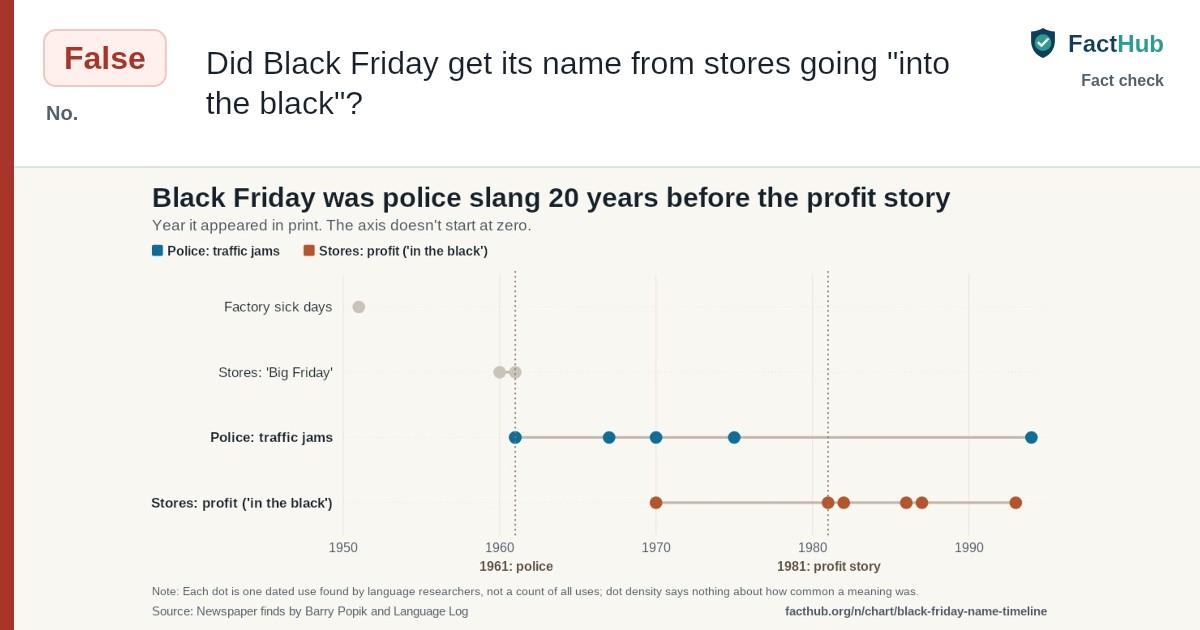
False. Philadelphia police used the name for traffic jams by 1961; stores' profit was first given as the reason in 1981. Dated newspaper uses show Philadelphia police calling the day after Thanksgiving Black Friday for its traffic by 1961, while stores pushed "Big Friday." The profit explanation first appears in 1981 and spread as the name went national.
Quote or cite this fact-check
FactHub rates the claim “Black Friday got its name because it is the day stores finally turn a profit, or go "into the black."” False (high confidence): Philadelphia police used the name for traffic jams by 1961; stores' profit was first given as the reason in 1981. Reviewed November 17, 2026. https://facthub.org/n/article/black-friday-name-in-the-black/1
Key points
What the evidence establishes
- Established. Philadelphia police called the day after Thanksgiving "Black Friday" for its traffic jams by 1961, a newsletter reported that December.
- Established. Philadelphia merchants disliked the name; a city official advised them to promote "Big Friday" instead.
- Established. The first printed claim that the name comes from store profits is from 1981, 20 years after the police use.
- Context. As the name spread beyond Philadelphia in the 1970s and 1980s, retailers often explained it as the day they move into the black.
- Context. Merriam-Webster calls the origin uncertain and lists both the traffic and the profit explanations.
- Context. The phrase is much older than the shopping day: it named bad days such as the 1869 New York gold-market crash.
The evidence
The conclusion rests on the combined record. Expand each item to see its role and limitations.
| Method | Institution / country | Year(s) | What it shows | Key limitation | Primary links |
|---|---|---|---|---|---|
| Read dated newspaper and trade-press quotes transcribed by two language researchers, and the Merriam-Webster entry, on November 16, 2026 | Public Relations News, New York Times, Merriam-Webster United States | 1961, 1967, 1975 | In December 1961, the newsletter Public Relations News reported that traffic jams after Thanksgiving were "an irksome problem" for Philadelphia police, and that officers called the days Black Friday and Black Saturday. Rochester, New York, police used the name that year too. In 1975 the New York Times wrote that Philadelphia police and bus drivers called the day Black Friday. Merriam-Webster dates the first known use of the shopping-day sense to 1961. | We read these quotes in transcriptions by Barry Popik, Ben Zimmer and Mark Liberman, not in the paywalled originals. Popik and Zimmer each transcribe the 1961 item, and their texts match. Earlier uses may exist that no one has found yet. | Barry Popik, The Big Apple Vocabulary.com (Word Routes) FactHub Language Log (University of Pennsylvania) Merriam-Webster |
| Read the 1961 Public Relations News item and 1960s Philadelphia Inquirer uses as transcribed by Barry Popik | Public Relations News, Philadelphia Inquirer United States | 1960, 1961 | Philadelphia merchants saw the police name as bad for business. The 1961 newsletter said a city official advised them to turn Black Friday and Black Saturday into "Big Friday and Big Saturday." The Philadelphia Inquirer was already using "Big Friday" in 1960. If the name had meant profits, stores would have had little reason to fight it. | The last sentence is our reading, not something the sources say. The record shows the rename push, not every merchant's view. | Barry Popik, The Big Apple FactHub |
| Compared the dates of the earliest police-traffic and store-profit explanations in our table of dated uses, built from two researchers' archive searches | Philadelphia Inquirer, University of Pennsylvania (Language Log) United States | 1970, 1981, 1987, 1993 | The first printed use we found linking the name to profit is a 1970 joke: a store publicist said the only black thing about the day was the ink in the ledgers. The first printed claim that profit is why the day has the name came in 1981, when the Philadelphia Inquirer quoted a mall official: "Because it is a day retailers make profits—black ink." The name spread to other cities in the 1970s and 1980s, and by 1987 a California paper quoted a store owner giving the profit explanation. | These are the earliest uses researchers have found, not proof that no earlier one exists. The 1981 quote is Popik's transcription; Zimmer, citing Taylor-Blake, separately dates the profit story to the 1980s. Liberman calls his own spread dates a quick search. | FactHub Barry Popik, The Big Apple Vocabulary.com (Word Routes) Language Log (University of Pennsylvania) |
| Read an 1869 newspaper page in the Library of Congress archive and the 1870 House report on the gold panic | Library of Congress, U.S. House of Representatives United States | 1869, 1870 | Long before shopping, "Black Friday" named bad days; Ben Zimmer traces one to 1745 in London. On September 24, 1869, the gold market collapsed in New York. A Charleston paper ran the headline "The Gold Gambling on Black Friday" that month, and a witness told a House investigation he met someone "before what was called black Friday." | These show the phrase was in use, not that the 1960s shopping name came from the crash; we found no link between the two. | Vocabulary.com (Word Routes) Library of Congress, Chronicling America U.S. House of Representatives (scan on Internet Archive) |
| Read the Merriam-Webster entry and compared it with the dated uses | Merriam-Webster United States | 2026 | Merriam-Webster says the origin "is not known for certain" and lists both the traffic and the profit explanations. It does not say which came first. The dated record answers that: traffic in 1961, profit in 1981. | A dictionary note is a short summary, and it does not cite the dated uses it rests on. | Merriam-Webster |
| Read ShopperTrak's 2014 and 2024 releases, Adobe's 2020-2025 Cyber Week figures and a 2019 Customer Growth Partners estimate | Sensormatic Solutions (ShopperTrak), Adobe, Customer Growth Partners United States | 2014, 2019, 2024, 2025 | ShopperTrak, which counts store visits, found Black Friday was the busiest in-store day of the 2024 season and said in 2014 it had led since 2005. Online, Adobe counted $14.25 billion on Cyber Monday 2025, against $11.8 billion on Black Friday, and Cyber Monday led every year from 2020 to 2025. One research firm estimated the last Saturday before Christmas 2019 beat Black Friday in total sales by 10%. | No government agency publishes sales by day, so these are private estimates. ShopperTrak counts visits, not dollars, and Adobe counts only online sales. | Sensormatic Solutions (ShopperTrak) ShopperTrak Adobe FactHub PYMNTS |
1. By 1961, police called it Black Friday for the traffic Read dated newspaper and trade-press quotes transcribed by two language researchers, and the Merriam-Webster entry, on November 16, 2026
In December 1961, the newsletter Public Relations News reported that traffic jams after Thanksgiving were "an irksome problem" for Philadelphia police, and that officers called the days Black Friday and Black Saturday. Rochester, New York, police used the name that year too. In 1975 the New York Times wrote that Philadelphia police and bus drivers called the day Black Friday. Merriam-Webster dates the first known use of the shopping-day sense to 1961.
Limit: We read these quotes in transcriptions by Barry Popik, Ben Zimmer and Mark Liberman, not in the paywalled originals. Popik and Zimmer each transcribe the 1961 item, and their texts match. Earlier uses may exist that no one has found yet.
Verify: Black Friday (Big Friday) Ben Zimmer, "The Origins of 'Black Friday'" Black Friday: how the name changed meaning, and how big the day is: Meanings of 'Black Friday', 1951-1994 Mark Liberman, "Black Friday" (November 22, 2012) Black Friday (dictionary entry)
- A December 1961 public-relations newsletter reported that Philadelphia police called the days after Thanksgiving Black Friday and Black Saturday because of traffic jams. Barry Popik, The Big Apple
- Zimmer's transcription of the 1961 Public Relations News item matches Popik's: Philadelphia officers called the post-Thanksgiving days Black Friday and Black Saturday because of traffic jams. Vocabulary.com (Word Routes)
- Rochester, New York, police also called the day Black Friday in 1961; in 1967 a Rochester paper said police used the name because their job was to keep traffic moving. FactHub
- In 1975 the New York Times wrote that Philadelphia police and bus drivers called the day Black Friday. Language Log (University of Pennsylvania)
- Merriam-Webster dates the first known use of the shopping-day sense to 1961. Merriam-Webster
- A former police reporter wrote in 1994 that the term came from the Philadelphia Police Department's traffic squad. Barry Popik, The Big Apple
2. Stores disliked the name and pushed "Big Friday" Read the 1961 Public Relations News item and 1960s Philadelphia Inquirer uses as transcribed by Barry Popik
Philadelphia merchants saw the police name as bad for business. The 1961 newsletter said a city official advised them to turn Black Friday and Black Saturday into "Big Friday and Big Saturday." The Philadelphia Inquirer was already using "Big Friday" in 1960. If the name had meant profits, stores would have had little reason to fight it.
Limit: The last sentence is our reading, not something the sources say. The record shows the rename push, not every merchant's view.
Verify: Black Friday (Big Friday) Black Friday: how the name changed meaning, and how big the day is: Earliest use we found for each meaning
- The same item said a city official advised merchants to turn Black Friday and Black Saturday into Big Friday and Big Saturday. Barry Popik, The Big Apple
- The earliest uses in our table: gold crash 1869; factory sick days 1951; 'Big Friday' 1960; police traffic 1961; a ledger-ink joke 1970; profit given as the reason 1981. FactHub
3. The "in the black" explanation shows up 20 years later Compared the dates of the earliest police-traffic and store-profit explanations in our table of dated uses, built from two researchers' archive searches
The first printed use we found linking the name to profit is a 1970 joke: a store publicist said the only black thing about the day was the ink in the ledgers. The first printed claim that profit is why the day has the name came in 1981, when the Philadelphia Inquirer quoted a mall official: "Because it is a day retailers make profits—black ink." The name spread to other cities in the 1970s and 1980s, and by 1987 a California paper quoted a store owner giving the profit explanation.
Limit: These are the earliest uses researchers have found, not proof that no earlier one exists. The 1981 quote is Popik's transcription; Zimmer, citing Taylor-Blake, separately dates the profit story to the 1980s. Liberman calls his own spread dates a quick search.
Verify: Black Friday: how the name changed meaning, and how big the day is: Meanings of 'Black Friday', 1951-1994 Black Friday (Big Friday) Ben Zimmer, "The Origins of 'Black Friday'" Mark Liberman, "Black Friday" (November 22, 2012)
- In 1970 a Philadelphia store publicist joked that the only black thing about the day was the ink in store ledgers. FactHub · Qualifies
- In 1981 the Philadelphia Inquirer quoted a mall official saying the day is called Black Friday because retailers make profits, or black ink. Barry Popik, The Big Apple
- Citing Taylor-Blake's research, Zimmer reports that the 'back in the black' story does not appear until the 1980s. Vocabulary.com (Word Routes)
- Zimmer writes that the name spread from Philadelphia to other cities in the 1970s and 1980s. Vocabulary.com (Word Routes) · Qualifies
- Liberman's informal search of newspaper archives suggests the term began spreading outside Philadelphia in 1987 and was accepted nationwide by the mid-1990s. Language Log (University of Pennsylvania)
- In 1987 a California newspaper quoted a store owner saying retailers call the day Black Friday because they move from red ink into the black. Language Log (University of Pennsylvania) · Qualifies
- By 1993 the Washington Post described the profit explanation as what retailers said. Language Log (University of Pennsylvania) · Qualifies
4. The phrase named earlier disasters, like an 1869 gold crash Read an 1869 newspaper page in the Library of Congress archive and the 1870 House report on the gold panic
Long before shopping, "Black Friday" named bad days; Ben Zimmer traces one to 1745 in London. On September 24, 1869, the gold market collapsed in New York. A Charleston paper ran the headline "The Gold Gambling on Black Friday" that month, and a witness told a House investigation he met someone "before what was called black Friday."
Limit: These show the phrase was in use, not that the 1960s shopping name came from the crash; we found no link between the two.
Verify: Ben Zimmer, "The Origins of 'Black Friday'" The Charleston Daily News, September 29, 1869, page 2 Investigation into the Causes of the Gold Panic, House Report No. 31, 41st Congress, 2d Session (1870)
- Zimmer notes earlier 'Black Fridays' unrelated to shopping: a December 6, 1745 scare in London, and financial panics in 1869 and 1873. Vocabulary.com (Word Routes) · Qualifies
- An 1869 newspaper headline called the day of the gold-market crash Black Friday. Library of Congress, Chronicling America
- Witnesses before Congress in 1869-70 already called the gold-panic day black Friday. U.S. House of Representatives (scan on Internet Archive)
5. The dictionary hedges, but the dates don't Read the Merriam-Webster entry and compared it with the dated uses
Merriam-Webster says the origin "is not known for certain" and lists both the traffic and the profit explanations. It does not say which came first. The dated record answers that: traffic in 1961, profit in 1981.
Limit: A dictionary note is a short summary, and it does not cite the dated uses it rests on.
Verify: Black Friday (dictionary entry)
6. Biggest shopping day? In stores yes; online no Read ShopperTrak's 2014 and 2024 releases, Adobe's 2020-2025 Cyber Week figures and a 2019 Customer Growth Partners estimate
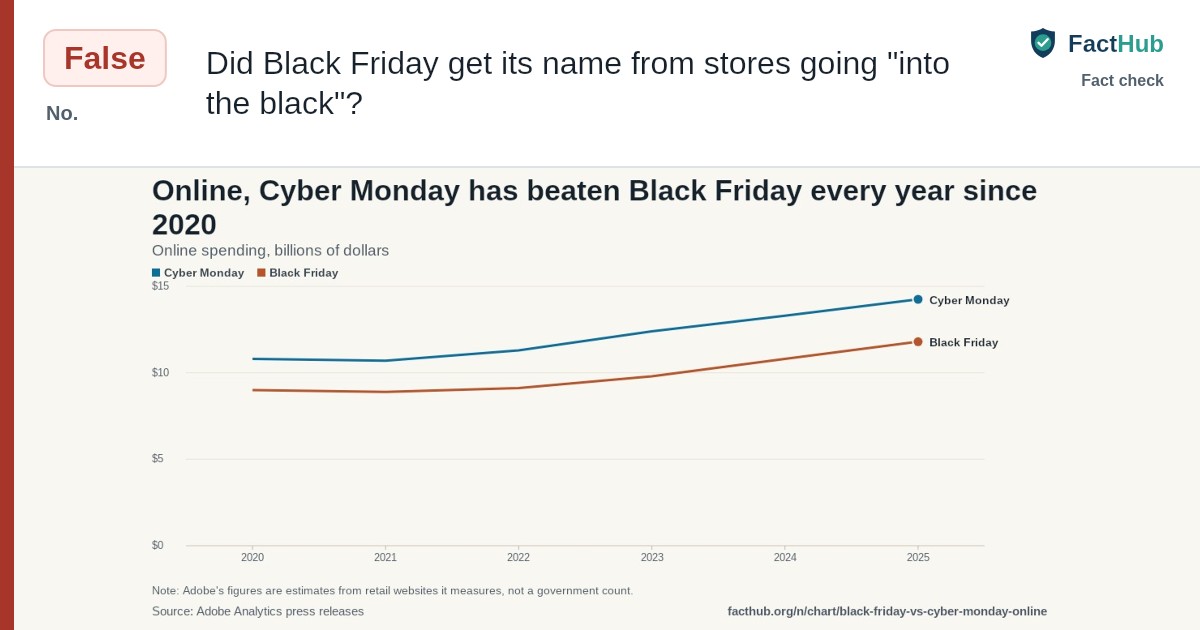
ShopperTrak, which counts store visits, found Black Friday was the busiest in-store day of the 2024 season and said in 2014 it had led since 2005. Online, Adobe counted $14.25 billion on Cyber Monday 2025, against $11.8 billion on Black Friday, and Cyber Monday led every year from 2020 to 2025. One research firm estimated the last Saturday before Christmas 2019 beat Black Friday in total sales by 10%.
Limit: No government agency publishes sales by day, so these are private estimates. ShopperTrak counts visits, not dollars, and Adobe counts only online sales.
Verify: Holiday 2024 recap (January 17, 2025) Super Saturday Expected to Take Top Spot this Holiday Season (October 31, 2014) Adobe: Cyber Monday Hits Record $14.25 Billion in Online Spending (December 2, 2025) Black Friday: how the name changed meaning, and how big the day is: Online spending: Black Friday vs Cyber Monday, 2020-2025 Super Saturday Pulls In Record-Breaking $34.4B In Retail Sales (December 24, 2019)
- ShopperTrak found Black Friday was the busiest in-store shopping day of the 2024 season. Sensormatic Solutions (ShopperTrak) · Qualifies
- ShopperTrak said in 2014 that Black Friday had led holiday-season store visits and sales since 2005. ShopperTrak · Qualifies
- ShopperTrak forecast that the last Saturday before Christmas would edge out Black Friday in 2014. ShopperTrak
- Adobe counted $14.25 billion in U.S. online spending on Cyber Monday 2025. Adobe
- Adobe counted $11.8 billion in online spending on Black Friday 2025. Adobe
- Adobe calls Cyber Monday the biggest online shopping day of all time. Adobe
- In Adobe's figures, Cyber Monday beat Black Friday online every year from 2020 to 2025. FactHub
- Customer Growth Partners estimated shoppers spent $34.4 billion on Super Saturday 2019, 10% more than on Black Friday 2019. PYMNTS
Common questions 8
“Was "Black Friday" first the name of a shopping day?”
Short answer: No: it named disasters first
No. "Black Friday" named bad days long before shopping, such as a 1745 scare in London and the 1869 gold-market crash in New York. We found no link between those and the shopping-day name, which is in print by 1961.
- Zimmer notes earlier 'Black Fridays' unrelated to shopping: a December 6, 1745 scare in London, and financial panics in 1869 and 1873. Vocabulary.com (Word Routes) · Qualifies
- An 1869 newspaper headline called the day of the gold-market crash Black Friday. Library of Congress, Chronicling America
- Witnesses before Congress in 1869-70 already called the gold-panic day black Friday. U.S. House of Representatives (scan on Internet Archive)
- The earliest uses in our table: gold crash 1869; factory sick days 1951; 'Big Friday' 1960; police traffic 1961; a ledger-ink joke 1970; profit given as the reason 1981. FactHub
See the evidence: The phrase named earlier disasters, like an 1869 gold crash
“Is Black Friday the biggest shopping day of the year?”
Short answer: In stores, yes; online, no
In stores, yes in most years: ShopperTrak, which counts store visits, ranked it the busiest day of the 2024 season. Online, no: Adobe counted $14.25 billion on Cyber Monday 2025 against $11.8 billion on Black Friday. One firm estimated the last Saturday before Christmas 2019 topped Black Friday in total sales by 10%.
- ShopperTrak found Black Friday was the busiest in-store shopping day of the 2024 season. Sensormatic Solutions (ShopperTrak) · Qualifies
- ShopperTrak said in 2014 that Black Friday had led holiday-season store visits and sales since 2005. ShopperTrak · Qualifies
- Adobe counted $14.25 billion in U.S. online spending on Cyber Monday 2025. Adobe
- Adobe counted $11.8 billion in online spending on Black Friday 2025. Adobe
- Customer Growth Partners estimated shoppers spent $34.4 billion on Super Saturday 2019, 10% more than on Black Friday 2019. PYMNTS
See the evidence: Biggest shopping day? In stores yes; online no
“Do shoppers spend more online on Black Friday than on Cyber Monday?”
Short answer: No: $11.8B vs $14.25B (2025)
No. In 2025 Adobe counted $14.25 billion in U.S. online spending on Cyber Monday, against $11.8 billion on Black Friday. Cyber Monday led every year from 2020 to 2025, and Adobe calls it the biggest online shopping day ever.
- Adobe counted $14.25 billion in U.S. online spending on Cyber Monday 2025. Adobe
- Adobe counted $11.8 billion in online spending on Black Friday 2025. Adobe
- In Adobe's figures, Cyber Monday beat Black Friday online every year from 2020 to 2025. FactHub
- Adobe calls Cyber Monday the biggest online shopping day of all time. Adobe
See the evidence: Biggest shopping day? In stores yes; online no
“Did Philadelphia stores like the name Black Friday?”
Short answer: No: they pushed "Big Friday"
No: in 1961 a city official advised Philadelphia merchants to rename the days "Big Friday and Big Saturday." The Philadelphia Inquirer used "Big Friday" from 1960. Researchers date the name's spread to other cities to the 1970s and 1980s.
- The same item said a city official advised merchants to turn Black Friday and Black Saturday into Big Friday and Big Saturday. Barry Popik, The Big Apple
- The earliest uses in our table: gold crash 1869; factory sick days 1951; 'Big Friday' 1960; police traffic 1961; a ledger-ink joke 1970; profit given as the reason 1981. FactHub
- Zimmer writes that the name spread from Philadelphia to other cities in the 1970s and 1980s. Vocabulary.com (Word Routes) · Qualifies
See the evidence: Stores disliked the name and pushed "Big Friday"
“Doesn't the dictionary say nobody knows the origin?”
Short answer: Yes, but the dates settle the order
Merriam-Webster calls the origin uncertain and lists both explanations. But the record puts the police and traffic use in print by 1961 and the profit explanation in 1981. So profit is not how the name started, though it may explain why stores later embraced it.
- Merriam-Webster says the origin is not known for certain and lists both the traffic and the profit explanations. Merriam-Webster · Qualifies
- Merriam-Webster dates the first known use of the shopping-day sense to 1961. Merriam-Webster
- A December 1961 public-relations newsletter reported that Philadelphia police called the days after Thanksgiving Black Friday and Black Saturday because of traffic jams. Barry Popik, The Big Apple
- In 1981 the Philadelphia Inquirer quoted a mall official saying the day is called Black Friday because retailers make profits, or black ink. Barry Popik, The Big Apple
- In 1987 a California newspaper quoted a store owner saying retailers call the day Black Friday because they move from red ink into the black. Language Log (University of Pennsylvania) · Qualifies
See the evidence: By 1961, police called it Black Friday for the traffic
“Did Black Friday get its name from slave sales?”
Short answer: No evidence
No known record supports it. Word researcher Barry Popik found no documentary evidence for the story, which he says has circulated on Twitter since 2008. The earliest uses tie the name to an 1869 gold crash and to 1960s traffic.
- Popik found no documentary evidence for the story that Black Friday comes from discounted slave sales, which he says has circulated on Twitter since 2008. Barry Popik, The Big Apple
- The earliest uses in our table: gold crash 1869; factory sick days 1951; 'Big Friday' 1960; police traffic 1961; a ledger-ink joke 1970; profit given as the reason 1981. FactHub
See the evidence: Stores disliked the name and pushed "Big Friday"
“Did factory bosses coin the name in 1951?”
Short answer: Earliest use, different meaning
A 1951 factory-management journal used "Black Friday" for the day after Thanksgiving, when many workers called in sick. It is the earliest such use found, but it is about missing workers, not shoppers or profits, and we found no line from it to the police name.
- A 1951 factory-management journal used Black Friday for the day after Thanksgiving, when many workers called in sick. FactHub · Qualifies
- The earliest uses in our table: gold crash 1869; factory sick days 1951; 'Big Friday' 1960; police traffic 1961; a ledger-ink joke 1970; profit given as the reason 1981. FactHub
See the evidence: Stores disliked the name and pushed "Big Friday"
“Was Black Friday only a Philadelphia name?”
Short answer: Rochester police used it too
Mostly Philadelphia, but not only. Rochester, New York, police also called the day Black Friday in 1961, and a 1967 Rochester paper said they did because their job was to keep traffic moving. Researchers date its spread to other cities to the 1970s and 1980s.
- Rochester, New York, police also called the day Black Friday in 1961; in 1967 a Rochester paper said police used the name because their job was to keep traffic moving. FactHub
- Zimmer writes that the name spread from Philadelphia to other cities in the 1970s and 1980s. Vocabulary.com (Word Routes) · Qualifies
- Liberman's informal search of newspaper archives suggests the term began spreading outside Philadelphia in 1987 and was accepted nationwide by the mid-1990s. Language Log (University of Pennsylvania)
See the evidence: The "in the black" explanation shows up 20 years later
Conclusion
The claim gets the order backward. The name came first, from people who dreaded the day, and the flattering explanation came later.
The earliest uses of Black Friday for the shopping crowds come from police. In December 1961, a public-relations newsletter reported that Philadelphia officers called the days after Thanksgiving Black Friday and Black Saturday because of the traffic jams. Rochester police used the name the same year. Merchants disliked it, and Philadelphia's city government advised them to promote "Big Friday" instead.
The profit story appears much later. In 1970 a store publicist joked that the only black thing about the day was the ink in the ledgers. The first printed claim that the name means profit came in 1981, 20 years after the police use. As the name spread to other cities in the 1970s and 1980s, retailers often told it with the profit story. That likely helped a once-unwelcome name catch on, though that is our reading.
We rate the claim False with high confidence. The evidence is the order of dated uses. Barry Popik and Ben Zimmer each transcribe the 1961 newsletter item, and Merriam-Webster's 1961 date probably rests on it too. Other police uses back it up: Rochester in 1961 and 1967, the New York Times in 1975, and a former police reporter's 1994 account. The main limit is that the quotes are transcriptions of paywalled papers, and an earlier use could still turn up. But a profit explanation would have to predate 1961 to change the finding, and none has been found.
The day's size is a separate question. In stores, Black Friday is usually the busiest day by visits. Online, Cyber Monday is bigger, and one estimate put the last Saturday before Christmas ahead in total sales in 2019.
How we checked
- We defined the claim as: the name Black Friday for the day after Thanksgiving originated from stores turning a profit that day.
- We gathered the earliest dated uses of Black Friday and Big Friday from word researchers' transcriptions of newspaper archives (Barry Popik; Ben Zimmer; Mark Liberman at Language Log), plus an 1869 newspaper in the Library of Congress archive and the 1870 House gold-panic report.
- We recorded each use's date, publication, quote and the reason it gave for the name in a FactHub dataset, and compared when each explanation first appeared.
- We checked the Merriam-Webster entry for its origin note and first known use.
- For the related question of the biggest shopping day, we read ShopperTrak's store-traffic releases, Adobe's online sales releases for 2020-2025 and a 2019 private estimate of total sales.
- We recorded limits in each evidence item, chiefly that the 1951-1994 quotes are transcriptions of paywalled newspaper archives.
Editorial note: This check covers where the shopping-day name came from. It does not test whether stores actually turn a profit on Black Friday. The 1951-1994 newspaper quotes come from researchers' transcriptions with page numbers; the originals, such as Public Relations News of December 18, 1961, and the Philadelphia Inquirer of November 28, 1981, are in paywalled archives we could not open. The 2019 total-sales estimate is from a news report of a private firm's figures. No external specialist review has been recorded.
Expert-review status
No external specialist review has been recorded.
Funding and conflicts
Funding: No external funding for this piece.
Ownership: Published by the FactHub Research Team.
Conflicts: None known.
Sources 13
Sources are labeled by kind, with what this fact check takes from each, so readers can check the evidence independently.
-
Government
Library of Congress, Chronicling America.
The Charleston Daily News, September 29, 1869, page 2
A South Carolina newspaper page reporting on the September 24, 1869 gold panic in New York.
Reliability: A scanned 1869 newspaper page in the Library of Congress's free newspaper archive. The searchable text is machine-read from the scan.
-
An 1869 newspaper headline called the day of the gold-market crash Black Friday.
What the source says
The Gold Gambling on Black Friday
Page 2, headlineNot yet checked
-
-
Government
U.S. House of Representatives (scan on Internet Archive).
Investigation into the Causes of the Gold Panic, House Report No. 31, 41st Congress, 2d Session (1870)
The House committee report, chaired by James A. Garfield, on the September 1869 gold panic, with witness testimony.
Reliability: Official congressional report with sworn testimony. The Internet Archive copy is a scan of a library volume.
-
Witnesses before Congress in 1869-70 already called the gold-panic day black Friday.
What the source says
I do not think I saw him until the Tuesday, if I remember right, before what was called black Friday.
Testimony of James Fisk Jr., p. 169 · James Fisk Jr., financier and witnessNot yet checked
-
-
Other
Barry Popik, The Big Apple.
Black Friday (Big Friday)
An etymology entry that transcribes dated uses of Black Friday and Big Friday from 1951 to 1994 with page numbers, including Public Relations News (December 18, 1961, p. 2) and the Philadelphia Inquirer (November 28, 1981, p. 7-B). The originals are in paywalled archives.
Reliability: Barry Popik is an independent word researcher whose finds are cited by the Oxford English Dictionary and the Yale Book of Quotations. He transcribes each source with date, page and column; most originals are in paywalled newspaper archives we did not open.
-
A December 1961 public-relations newsletter reported that Philadelphia police called the days after Thanksgiving Black Friday and Black Saturday because of traffic jams.
What the source says
Resulting traffic jams are an irksome problem to the police and, in Philadelphia, it became customary for officers to refer to the post-Thanksgiving days as Black Friday and Black Saturday.
Public Relations News, December 18, 1961, p. 2Not yet checked
-
The same item said a city official advised merchants to turn Black Friday and Black Saturday into Big Friday and Big Saturday.
What the source says
He recommended adoption of a positive approach which would convert Black Friday and Black Saturday to Big Friday and Big Saturday.
Public Relations News, December 18, 1961, p. 2Not yet checked
-
In 1981 the Philadelphia Inquirer quoted a mall official saying the day is called Black Friday because retailers make profits, or black ink.
What the source says
Because it is a day retailers make profits—black ink, said Grace McFeeley of Cherry Hill Mall.
Philadelphia Inquirer, November 28, 1981, p. 7-B, col. 6Not yet checked
-
A former police reporter wrote in 1994 that the term came from the Philadelphia Police Department's traffic squad.
What the source says
The term “Black Friday” came out of the old Philadelphia Police Department’s traffic squad.
Philadelphia Daily News, November 25, 1994, p. 80, col. 4 · Joseph Barrett, former Philadelphia Evening Bulletin police reporterNot yet checked
-
Popik found no documentary evidence for the story that Black Friday comes from discounted slave sales, which he says has circulated on Twitter since 2008.
What the source says
This false etymology—a pre-dating of 100 years, but without any documentary evidence whatsoever—has been told on Twitter since 2008.
Commentary after the 1994 entriesNot yet checked
-
-
Other
Vocabulary.com (Word Routes).
Ben Zimmer, "The Origins of 'Black Friday'"
A language columnist's account of the name's origin, quoting the 1961 Public Relations News item in full and summarizing Bonnie Taylor-Blake's archive research.
Reliability: Ben Zimmer is a linguist and language columnist for The Wall Street Journal. His transcription of the 1961 item is separate from Barry Popik's, and he credits researcher Bonnie Taylor-Blake for the dates.
-
Zimmer's transcription of the 1961 Public Relations News item matches Popik's: Philadelphia officers called the post-Thanksgiving days Black Friday and Black Saturday because of traffic jams.
What the source says
Resulting traffic jams are an irksome problem to the police and, in Philadelphia, it became customary for officers to refer to the post-Thanksgiving days as Black Friday and Black Saturday.
Quoting Public Relations News, Dec. 18, 1961, p. 2Not yet checked
-
Citing Taylor-Blake's research, Zimmer reports that the 'back in the black' story does not appear until the 1980s.
What the source says
According to Taylor-Blake, the story of businesses getting "back in the black" on Black Friday doesn't start appearing until the 1980s.
Paragraph on the profit explanationNot yet checked
-
Qualifies: Zimmer notes earlier 'Black Fridays' unrelated to shopping: a December 6, 1745 scare in London, and financial panics in 1869 and 1873.
What the source says
One early "Black Friday" was on Dec. 6, 1745, when news of the landing in Scotland of Charles Edward Stuart, pretender to the throne, was publicized in London. "Black Friday" was also used to describe financial panics of 1869 and 1873.
Paragraph on historical predecessorsNot yet checked
-
Qualifies: Zimmer writes that the name spread from Philadelphia to other cities in the 1970s and 1980s.
What the source says
That effort failed, of course, and "Black Friday" caught on, spreading to other cities in the 1970s and '80s.
Paragraph after the 1994 quoteNot yet checked
-
-
Academic
Language Log (University of Pennsylvania).
Mark Liberman, "Black Friday" (November 22, 2012)
A linguist's search of newspaper archives for when Black Friday spread beyond Philadelphia, with dated quotes.
Reliability: Blog by University of Pennsylvania linguist Mark Liberman; quotes come from his searches of the New York Times, Washington Post and other newspaper archives.
-
In 1975 the New York Times wrote that Philadelphia police and bus drivers called the day Black Friday.
What the source says
Philadelphia police and bus drivers call it "Black Friday" that day each year between Thanksgiving Day and the Army-Navy game.
Quoting Gordon S. White, New York Times, November 29, 1975Not yet checked
-
Liberman's informal search of newspaper archives suggests the term began spreading outside Philadelphia in 1987 and was accepted nationwide by the mid-1990s.
What the source says
a bit of poking around in newpaper archives suggests that the term didn't start to spread outside of Philadelphia until 1987, and didn't really become accepted nation-wide until the mid-1990s.
Paragraph after the opening quoteNot yet checked
-
Qualifies: In 1987 a California newspaper quoted a store owner saying retailers call the day Black Friday because they move from red ink into the black.
What the source says
The day after Thanksgiving is lovingly called Black Friday by retailers because that's the day they move from red ink into the black.
Quoting Jan Norman, Orange County Register, December 1, 1987 · Holly Hefter, store ownerNot yet checked
-
Qualifies: By 1993 the Washington Post described the profit explanation as what retailers said.
What the source says
the day known by retailers as Black Friday because it shifts their balance sheets into the black
Quoting Kirstin Downey-Grimsley, Washington Post, November 27, 1993Not yet checked
-
-
Reference work
Merriam-Webster.
Black Friday (dictionary entry)
The dictionary's entry for Black Friday as the day after Thanksgiving, with a note on the origin and the first known use.
Reliability: An edited American dictionary. Its etymology note is a short summary, not a full study.
-
Qualifies: Merriam-Webster says the origin is not known for certain and lists both the traffic and the profit explanations.
What the source says
The origin of Black Friday in this sense is not known for certain. The day was allegedly so named either in reference to traffic congestion in central cities on the day after Thanksgiving or to the supposed fact that retailers' accounts shifted from red to black
Note under the definitionNot yet checked
-
Merriam-Webster dates the first known use of the shopping-day sense to 1961.
What the source says
First Known Use 1961, in the meaning defined above
Word HistoryNot yet checked
-
-
Industry
Sensormatic Solutions (ShopperTrak).
Holiday 2024 recap (January 17, 2025)
The store-traffic counter's review of the 2024 holiday season.
Reliability: ShopperTrak counts people entering its clients' stores with door sensors and projects national traffic; it sells the data to retailers. It counts visits, not dollars.
-
Qualifies: ShopperTrak found Black Friday was the busiest in-store shopping day of the 2024 season.
What the source says
This year, as predicted, Black Friday was the busiest shopping day of the season.
Paragraph on Black FridayNot yet checked
-
-
Industry
ShopperTrak.
Super Saturday Expected to Take Top Spot this Holiday Season (October 31, 2014)
ShopperTrak's 2014 forecast release, with its history of the top shopping day.
Reliability: Press release from the store-traffic counter; the 2014 part is a forecast.
-
Qualifies: ShopperTrak said in 2014 that Black Friday had led holiday-season store visits and sales since 2005.
What the source says
Since 2005, Black Friday has reigned supreme in both shopper visits and sales for the holiday season.
Third paragraphNot yet checked
-
ShopperTrak forecast that the last Saturday before Christmas would edge out Black Friday in 2014.
What the source says
Super Saturday – the last Saturday before Christmas – will edge it out this year.
Third paragraphNot yet checked
-
-
Industry
Adobe.
Adobe: Cyber Monday Hits Record $14.25 Billion in Online Spending (December 2, 2025)
Adobe Analytics' 2025 Cyber Week results.
Reliability: Adobe measures sales on retail websites that use its analytics software; it sells that software to retailers.
-
Adobe counted $14.25 billion in U.S. online spending on Cyber Monday 2025.
What the source says
Consumers spent a total of $14.25 billion online for Cyber Monday, up 7.1% YoY
Second paragraphNot yet checked
-
Adobe counted $11.8 billion in online spending on Black Friday 2025.
What the source says
record spend online during Black Friday ($11.8 billion, up 9.1% YoY)
Cyber Week paragraphNot yet checked
-
Adobe calls Cyber Monday the biggest online shopping day of all time.
What the source says
Cyber Monday remains the biggest online shopping day of all time
Second paragraphNot yet checked
-
-
News report
PYMNTS.
Super Saturday Pulls In Record-Breaking $34.4B In Retail Sales (December 24, 2019)
News report on a retail research firm's estimate of total sales on the last Saturday before Christmas 2019.
Reliability: Trade news site reporting an estimate by Customer Growth Partners, a private retail research firm; the firm's method is not published in the story.
-
Customer Growth Partners estimated shoppers spent $34.4 billion on Super Saturday 2019, 10% more than on Black Friday 2019.
What the source says
According to retail research firm Customer Growth Partners, consumers on Super Saturday spent a total of $34.4 billion and that exceeded 2019 Black Friday sales by 10 percent.
First paragraphNot yet checked
-
-
FactHub record
FactHub.
Black Friday: how the name changed meaning, and how big the day is: Earliest use we found for each meaning
Dated uses of the phrase 'Black Friday', from the 1869 gold crash to the 1990s, showing when the police-traffic and store-profit explanations first appeared. Also Adobe's online spending for Black Friday and Cyber Monday and ShopperTrak's busiest store days.
-
The earliest uses in our table: gold crash 1869; factory sick days 1951; 'Big Friday' 1960; police traffic 1961; a ledger-ink joke 1970; profit given as the reason 1981.
Not yet checked
-
-
FactHub record
FactHub.
Black Friday: how the name changed meaning, and how big the day is: Meanings of 'Black Friday', 1951-1994
Dated uses of the phrase 'Black Friday', from the 1869 gold crash to the 1990s, showing when the police-traffic and store-profit explanations first appeared. Also Adobe's online spending for Black Friday and Cyber Monday and ShopperTrak's busiest store days.
-
Rochester, New York, police also called the day Black Friday in 1961; in 1967 a Rochester paper said police used the name because their job was to keep traffic moving.
Not yet checked
-
Qualifies: A 1951 factory-management journal used Black Friday for the day after Thanksgiving, when many workers called in sick.
Not yet checked
-
Qualifies: In 1970 a Philadelphia store publicist joked that the only black thing about the day was the ink in store ledgers.
Not yet checked
-
-
FactHub record
FactHub.
Black Friday: how the name changed meaning, and how big the day is: Online spending: Black Friday vs Cyber Monday, 2020-2025
Dated uses of the phrase 'Black Friday', from the 1869 gold crash to the 1990s, showing when the police-traffic and store-profit explanations first appeared. Also Adobe's online spending for Black Friday and Cyber Monday and ShopperTrak's busiest store days.
-
In Adobe's figures, Cyber Monday beat Black Friday online every year from 2020 to 2025.
Not yet checked
-
-
FactHub dataset
Black Friday: how the name changed meaning, and how big the day is
-
Tables: attestations
Saved analysis timeline-1951-1994
-
Tables: attestations
Saved analysis first-use-by-meaning
-
Tables: online-spend
Saved analysis online-bf-vs-cm
-
- FactHub chart black-friday-name-timeline
- FactHub chart black-friday-vs-cyber-monday-online
Update history 1 change, last
- First version.
Cited by
For developers: ClaimReview data
This page includes standardized ClaimReview metadata describing the exact claim, FactHub's finding, publisher, and review dates. You can inspect the record below and confirm that it matches the article you just read.
View ClaimReview JSON
{"@context":"https://schema.org","@type":"ClaimReview","url":"https://facthub.org/n/article/black-friday-name-in-the-black","datePublished":"2026-11-17","dateModified":"2026-11-17","author":{"@type":"Organization","name":"FactHub","url":"https://facthub.org/"},"claimReviewed":"Black Friday got its name because it is the day stores finally turn a profit, or go \u0022into the black.\u0022","reviewRating":{"@type":"Rating","alternateName":"False"},"image":"https://facthub.org/node-assets-v2/article/black-friday-name-in-the-black/1/img-rush/social-1200x630.jpg"}This metadata helps machines discover the fact-check. It does not prove the conclusion or guarantee special treatment by a search engine.
Challenge this fact-check
Every source above is linked so you can check it yourself. Identify the specific conclusion you dispute and provide verifiable evidence that could change it. Credible challenges deserve review and a visible response.
Submit evidence Send general feedback insteadTechnical details: node handle article:black-friday-name-in-the-black:1