


The short version
Claim we investigated
Abraham Lincoln made Thanksgiving a yearly national holiday.
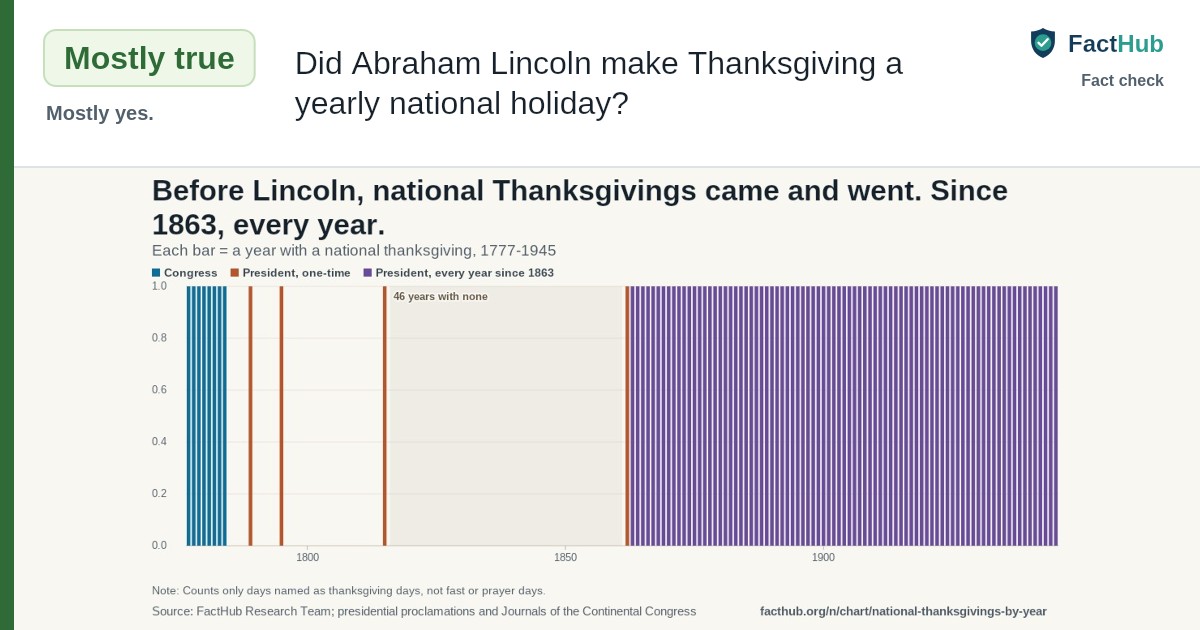
Mostly true. His 1863 proclamation started the unbroken yearly run, but presidents picked each date until a 1941 law fixed it. Presidents proclaimed national thanksgivings in only 4 of the 74 years before 1863, then in all 83 years from 1863 to 1945. Until a 1941 law, each president chose the date, which let Franklin Roosevelt move it.
Quote or cite this fact-check
FactHub rates the claim “Abraham Lincoln made Thanksgiving a yearly national holiday” Mostly true (high confidence): His 1863 proclamation started the unbroken yearly run, but presidents picked each date until a 1941 law fixed it. Reviewed November 17, 2026. https://facthub.org/n/article/lincoln-thanksgiving-national-holiday/1
Key points
What the evidence establishes
- Established. From 1863 through 1945, a president proclaimed a national Thanksgiving every year, 83 years in a row.
- Established. Before that, presidents proclaimed one in only 4 of 74 years (1789-1862), with none from 1816 through 1861.
- Context. Lincoln didn't start it: the Continental Congress proclaimed thanksgivings every year from 1777 to 1784, and Washington proclaimed one in 1789.
- Established. Each president chose the date until 1941. Andrew Johnson picked December 7 in 1865, and Franklin Roosevelt moved it a week earlier in 1939.
- Context. By editor Sarah Josepha Hale's count, 30 states shared a Thanksgiving day in 1859. She urged Lincoln to make it national in 1863.
- Context. We read "national holiday" as a nationwide day the president names, as Lincoln did. As a legal holiday, it came from Congress, in 1870 for Washington, D.C., and in 1941.
The evidence
The conclusion rests on the combined record. Expand each item to see its role and limitations.
| Method | Institution / country | Year(s) | What it shows | Key limitation | Primary links |
|---|---|---|---|---|---|
| Read the Continental Congress journals for 1777-1784 and Washington's 1789 proclamation, with the National Archives' account of the 1789 congressional resolution. | Library of Congress, American Presidency Project (UC Santa Barbara), National Archives United States | 1777, 1789 | The Continental Congress named a day of thanksgiving in 1777, after the victory at Saratoga, and did so every year through 1784. In 1789 both houses of the new Congress asked President George Washington to recommend a day of thanks, and he set Thursday, November 26, 1789. These were national days, but each was a one-time call. | These were recommendations to the public, not laws or days off work. The 1777 quote comes from machine-read text of a scanned volume. | Library of Congress (Journals of the Continental Congress, vol. 9), via Internet Archive The American Presidency Project |
| Compiled every national thanksgiving proclamation, 1777-1945, from the American Presidency Project and the Continental Congress journals into a FactHub dataset, and counted years with one. | FactHub Research Team, American Presidency Project (UC Santa Barbara), National Archives (Founders Online) United States | 1789, 1795, 1815, 1862 | We listed every presidential proclamation naming a day of thanksgiving from 1789 to 1945. Before Lincoln's yearly series, presidents proclaimed one in only 4 of 74 years: 1789, 1795, 1815 and 1862. None was proclaimed from 1816 through 1861. Thomas Jefferson refused to proclaim religious days at all, saying the office had no authority over religious exercises. | The count leaves out fast and prayer days, such as those John Adams and James Madison proclaimed. It counts Lincoln's April 1862 call, which asked churches to give thanks at their next service rather than naming a day. State thanksgivings are not counted. | FactHub FactHub National Archives, Founders Online |
| Read Hale's 1863 letter in the Library of Congress's Lincoln Papers and her Godey's Lady's Book editorials of 1857-1860. | Library of Congress, University of Vermont United States | 1859, 1863 | Before 1863, Thanksgiving was mainly a state custom. Sarah Josepha Hale, editor of Godey's Lady's Book, counted 30 states and 3 territories holding it on the same day in 1859. On September 28, 1863, she wrote Lincoln asking for a national, fixed Thanksgiving on the last Thursday of November. She said she had urged the idea in her magazine for fifteen years. | The 1859 count is Hale's own, made while she was campaigning for a national day; we found no independent count. Her magazine quotes come from a transcription, not a page scan. | Library of Congress, Abraham Lincoln Papers University of Vermont (transcription by Hope Greenberg) |
| Read the National Archives transcription of the signed proclamation and the October 3, 1863 entry in Welles's published diary. | National Archives, Houghton Mifflin (Diary of Gideon Welles, 1911) United States | 1863 | Five days after Hale's letter, Lincoln invited Americans everywhere to observe the last Thursday of November 1863 as a day of thanksgiving and praise. Navy Secretary Gideon Welles wrote that Secretary of State William Seward read him the draft that morning. Seward said he wanted to end the claim that Thanksgiving belonged to the states and make such days national. | The proclamation covered 1863 only; it set no rule for later years. Welles's diary shows Seward had and read the draft, but does not say in so many words that he wrote it. Welles believed a president could only recommend the day. | National Archives (DocsTeach) Gideon Welles (Houghton Mifflin, 1911), via Internet Archive |
| Checked each yearly proclamation's text in the American Presidency Project for the date named, and computed which Thursday of the month it was. | American Presidency Project (UC Santa Barbara), National Archives United States | 1863, 1945 | A president proclaimed a national Thanksgiving every year from 1863 through 1945, 83 years in a row. The National Archives likewise dates the yearly holiday to Lincoln's 1863 proclamation. Each date was the president's choice. From 1863 to 1938, 74 of 76 fell on November's last Thursday. Andrew Johnson picked the first Thursday of December in 1865, and Ulysses Grant picked November 18 in 1869. | Our compiled list stops in 1945; later years rest on the 1941 law. A yearly proclamation shows the day was named, not how widely people observed it. | FactHub The American Presidency Project National Archives, Center for Legislative Archives |
| Read Roosevelt's 1939 proclamation, his press-conference remarks as quoted in Prologue, and Prologue's state-by-state list, which we coded in the FactHub dataset; compared with the National Archives' legislative history page. | National Archives, American Presidency Project (UC Santa Barbara), FactHub Research Team United States | 1939, 1940 | In 1939 November had five Thursdays, so the last one fell on November 30. Franklin Roosevelt set November 23 instead, saying retailers wanted it moved away from Christmas and that the date had "nothing sacred about it." Governors had to choose. By one count, 22 states used November 23, 23 kept November 30, and Colorado, Mississippi and Texas held both. Most Democratic governors followed him; most Republican governors did not. | The state count is a 1990 National Archives magazine article's transcription of two New York Times tallies. A separate National Archives page says 32 states followed and 16 refused, without naming states or a year; that matches the magazine's count for 1940 (16 holdouts). We did not read the 1939 New York Times pages themselves, which are in the paper's subscription archive. | National Archives, Center for Legislative Archives The American Presidency Project National Archives, Prologue magazine FactHub |
| Read the 1870 act and the 1941 joint resolution in the Statutes at Large, the current U.S. Code section on holidays, and the National Archives' account of the 1941 vote. | U.S. Government Publishing Office, Library of Congress, National Archives United States | 1870, 1941 | Lincoln's proclamation was an invitation, not a law. In 1870 Congress made any thanksgiving day the president named a holiday in Washington, D.C., for bills and notes. On December 26, 1941, Congress made the fourth Thursday of November a legal public holiday from 1942 on. The Senate chose the fourth Thursday, not the last, to cover Novembers with five Thursdays. Federal law still lists it that way. | The 1870 act covered only the District of Columbia and only commercial paper such as checks and notes; it did not mention federal workers. | U.S. Government Publishing Office (govinfo) Library of Congress (U.S. Statutes at Large, vol. 55) National Archives, Center for Legislative Archives U.S. Government Publishing Office (govinfo) |
1. Congress and Washington proclaimed national thanksgivings first Read the Continental Congress journals for 1777-1784 and Washington's 1789 proclamation, with the National Archives' account of the 1789 congressional resolution.
The Continental Congress named a day of thanksgiving in 1777, after the victory at Saratoga, and did so every year through 1784. In 1789 both houses of the new Congress asked President George Washington to recommend a day of thanks, and he set Thursday, November 26, 1789. These were national days, but each was a one-time call.
Limit: These were recommendations to the public, not laws or days off work. The 1777 quote comes from machine-read text of a scanned volume.
Verify: Journals of the Continental Congress, 1774-1789, vol. 9 (Oct. 3 - Dec. 31, 1777) George Washington, Proclamation: Day of National Thanksgiving, October 3, 1789
- In 1777 the Continental Congress set December 18 as a day of thanksgiving. Library of Congress (Journals of the Continental Congress, vol. 9), via Internet Archive
- Washington set Thursday, November 26, 1789, as a national day of thanks. The American Presidency Project
- Both houses of Congress asked Washington to recommend a day of public thanksgiving. The American Presidency Project
2. Before 1863, presidential thanksgivings were rare Compiled every national thanksgiving proclamation, 1777-1945, from the American Presidency Project and the Continental Congress journals into a FactHub dataset, and counted years with one.
We listed every presidential proclamation naming a day of thanksgiving from 1789 to 1945. Before Lincoln's yearly series, presidents proclaimed one in only 4 of 74 years: 1789, 1795, 1815 and 1862. None was proclaimed from 1816 through 1861. Thomas Jefferson refused to proclaim religious days at all, saying the office had no authority over religious exercises.
Limit: The count leaves out fast and prayer days, such as those John Adams and James Madison proclaimed. It counts Lincoln's April 1862 call, which asked churches to give thanks at their next service rather than naming a day. State thanksgivings are not counted.
Verify: U.S. national days of thanksgiving, 1777-1945, and the 1939 state split: Years with a national thanksgiving, by period U.S. national days of thanksgiving, 1777-1945, and the 1939 state split: Years with a national thanksgiving, 1777-1945, one row per year From Thomas Jefferson to Samuel Miller, 23 January 1808
- National thanksgivings were proclaimed in 8 of 8 years in 1777-1784, 0 of 4 in 1785-1788, 4 of 74 in 1789-1862, and 83 of 83 in 1863-1945. FactHub
- Presidents proclaimed thanksgivings in 1789, 1795, 1815 and 1862, none from 1816 through 1861, then every year from 1863 to 1945. FactHub
- Jefferson declined to proclaim religious days, saying the President had no authority over religious exercises. National Archives, Founders Online
3. States already held Thanksgiving, and Sarah Josepha Hale pushed for one national day Read Hale's 1863 letter in the Library of Congress's Lincoln Papers and her Godey's Lady's Book editorials of 1857-1860.
Before 1863, Thanksgiving was mainly a state custom. Sarah Josepha Hale, editor of Godey's Lady's Book, counted 30 states and 3 territories holding it on the same day in 1859. On September 28, 1863, she wrote Lincoln asking for a national, fixed Thanksgiving on the last Thursday of November. She said she had urged the idea in her magazine for fifteen years.
Limit: The 1859 count is Hale's own, made while she was campaigning for a national day; we found no independent count. Her magazine quotes come from a transcription, not a page scan.
Verify: Sarah J. Hale to Abraham Lincoln, Monday, September 28, 1863 (Thanksgiving) Godey's Lady's Book, Editor's Table, September 1860: "Thanksgiving--the new National Holiday"
- Hale asked Lincoln to make the annual Thanksgiving a national, fixed holiday. Library of Congress, Abraham Lincoln Papers
- Hale wrote that she had promoted the idea in her magazine for fifteen years and sent it to every governor. Library of Congress, Abraham Lincoln Papers
- Hale said states were already moving toward one common Thanksgiving day and needed national recognition. Library of Congress, Abraham Lincoln Papers · Qualifies
- Hale asked for the last Thursday in November, which in 1863 fell on the 26th. Library of Congress, Abraham Lincoln Papers
- Hale counted 30 states and 3 territories holding Thanksgiving on the same day in 1859. University of Vermont (transcription by Hope Greenberg) · Qualifies
4. Lincoln's October 3, 1863 proclamation, drafted by Seward Read the National Archives transcription of the signed proclamation and the October 3, 1863 entry in Welles's published diary.
Five days after Hale's letter, Lincoln invited Americans everywhere to observe the last Thursday of November 1863 as a day of thanksgiving and praise. Navy Secretary Gideon Welles wrote that Secretary of State William Seward read him the draft that morning. Seward said he wanted to end the claim that Thanksgiving belonged to the states and make such days national.
Limit: The proclamation covered 1863 only; it set no rule for later years. Welles's diary shows Seward had and read the draft, but does not say in so many words that he wrote it. Welles believed a president could only recommend the day.
Verify: President Abraham Lincoln's Thanksgiving Proclamation, October 3, 1863 (Presidential Proclamation 106) Diary of Gideon Welles, Secretary of the Navy under Lincoln and Johnson, vol. 1
- Lincoln invited all Americans to observe the last Thursday of November 1863 as a day of thanksgiving. National Archives (DocsTeach)
- Lincoln signed the proclamation on October 3, 1863. National Archives (DocsTeach)
- On the day of the proclamation, Secretary of State Seward read Welles the draft, and Welles credited Seward's talent for such papers. Gideon Welles (Houghton Mifflin, 1911), via Internet Archive
- Seward said he wanted to end the claim that Thanksgiving was a state matter and make such days national. Gideon Welles (Houghton Mifflin, 1911), via Internet Archive
- Welles thought a president could only recommend the day, and that observance was voluntary. Gideon Welles (Houghton Mifflin, 1911), via Internet Archive · Qualifies
5. Every president after Lincoln kept it going, but chose the date Checked each yearly proclamation's text in the American Presidency Project for the date named, and computed which Thursday of the month it was.
A president proclaimed a national Thanksgiving every year from 1863 through 1945, 83 years in a row. The National Archives likewise dates the yearly holiday to Lincoln's 1863 proclamation. Each date was the president's choice. From 1863 to 1938, 74 of 76 fell on November's last Thursday. Andrew Johnson picked the first Thursday of December in 1865, and Ulysses Grant picked November 18 in 1869.
Limit: Our compiled list stops in 1945; later years rest on the 1941 law. A yearly proclamation shows the day was named, not how widely people observed it.
Verify: U.S. national days of thanksgiving, 1777-1945, and the 1939 state split: Yearly Thanksgivings not held on the last Thursday of November, 1863-1945 Andrew Johnson, Proclamation 147: Thanksgiving Day, 1865 Congress Establishes Thanksgiving
- From 1863 to 1938, 74 of 76 yearly Thanksgivings fell on November's last Thursday; the exceptions were 1865 (December 7) and 1869 (November 18). Roosevelt's 1939-41 dates were earlier, and 1944-45 fell on the fourth of five Thursdays. FactHub · Qualifies
- Andrew Johnson set Thanksgiving 1865 on the first Thursday of December. The American Presidency Project · Qualifies
- The Archives says Thanksgiving was first held regularly each year after Lincoln's 1863 proclamation. National Archives, Center for Legislative Archives
6. Roosevelt moved it for shoppers, and the states split Read Roosevelt's 1939 proclamation, his press-conference remarks as quoted in Prologue, and Prologue's state-by-state list, which we coded in the FactHub dataset; compared with the National Archives' legislative history page.
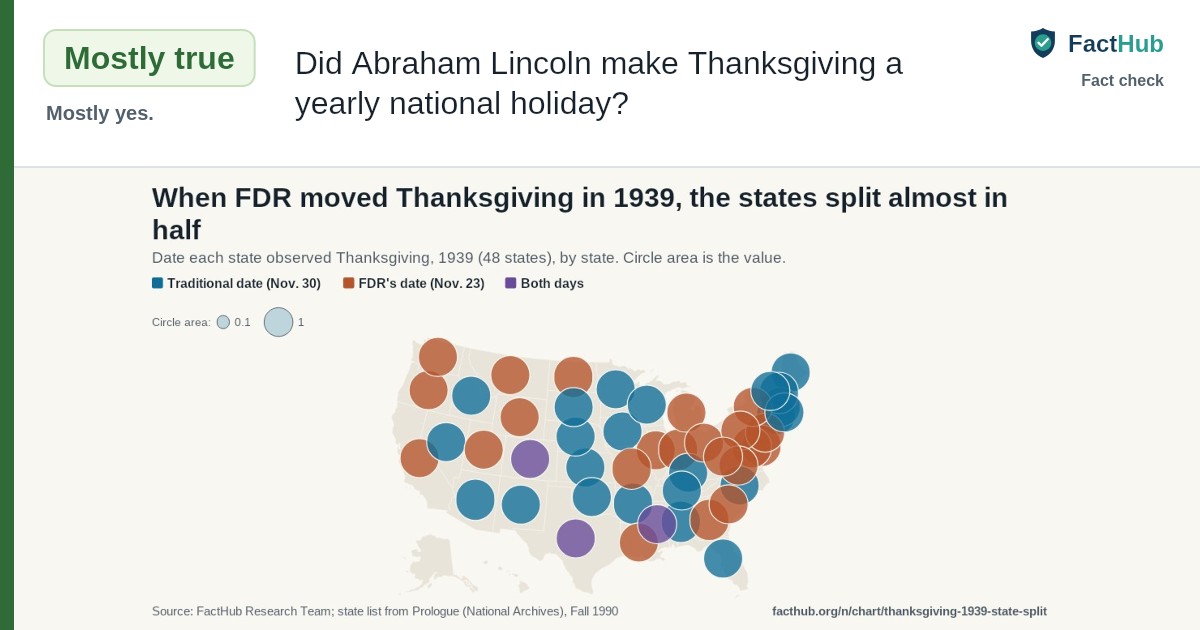
In 1939 November had five Thursdays, so the last one fell on November 30. Franklin Roosevelt set November 23 instead, saying retailers wanted it moved away from Christmas and that the date had "nothing sacred about it." Governors had to choose. By one count, 22 states used November 23, 23 kept November 30, and Colorado, Mississippi and Texas held both. Most Democratic governors followed him; most Republican governors did not.
Limit: The state count is a 1990 National Archives magazine article's transcription of two New York Times tallies. A separate National Archives page says 32 states followed and 16 refused, without naming states or a year; that matches the magazine's count for 1940 (16 holdouts). We did not read the 1939 New York Times pages themselves, which are in the paper's subscription archive.
Verify: Congress Establishes Thanksgiving Franklin D. Roosevelt, Proclamation 2373: Thanksgiving Day, October 31, 1939 G. Wallace Chessman, "Thanksgiving: Another FDR Experiment," Prologue, Fall 1990 U.S. national days of thanksgiving, 1777-1945, and the 1939 state split: States by date observed in 1939, with governors' party
- In 1939 the last Thursday of November fell on November 30, the last day of the month. National Archives, Center for Legislative Archives
- Roosevelt set Thanksgiving 1939 on Thursday, November 23. The American Presidency Project · Qualifies
- Roosevelt said retailers wanted Thanksgiving moved earlier, away from Christmas. National Archives, Prologue magazine
- Roosevelt said the last-Thursday date dated only from after the Civil War, so he would move it a week earlier. National Archives, Prologue magazine
- In 1939, 22 states observed November 23 only, 23 kept November 30, and 3 observed both. Democratic governors split 17 for November 23, 11 for November 30 and 2 both; Republican governors 5, 12 and 1. FactHub · Qualifies
- In 1939 the governors of Mississippi, Texas and Colorado observed both dates. National Archives, Prologue magazine
- The Archives says Roosevelt moved the date out of concern that a short Christmas shopping season would slow the recovery. National Archives, Center for Legislative Archives
- The Archives page gives a different count: 32 states followed the change and 16 refused. National Archives, Center for Legislative Archives · Qualifies
- By 1940, only 16 states still held the traditional date. National Archives, Prologue magazine
7. Congress, not Lincoln, made it law Read the 1870 act and the 1941 joint resolution in the Statutes at Large, the current U.S. Code section on holidays, and the National Archives' account of the 1941 vote.
Lincoln's proclamation was an invitation, not a law. In 1870 Congress made any thanksgiving day the president named a holiday in Washington, D.C., for bills and notes. On December 26, 1941, Congress made the fourth Thursday of November a legal public holiday from 1942 on. The Senate chose the fourth Thursday, not the last, to cover Novembers with five Thursdays. Federal law still lists it that way.
Limit: The 1870 act covered only the District of Columbia and only commercial paper such as checks and notes; it did not mention federal workers.
Verify: 16 Stat. 168, ch. 167: An Act making ... Thanksgiving Day, Holidays, within the District of Columbia (June 28, 1870) 55 Stat. 862, ch. 631 (H.J. Res. 41, Public Law 77-379): Joint resolution making the fourth Thursday in November a legal holiday, December 26, 1941 Congress Establishes Thanksgiving United States Code, 2024 edition, Title 5, Section 6103: Holidays
- An 1870 act made any day of thanksgiving the president named a holiday in Washington, D.C., for commercial paper. U.S. Government Publishing Office (govinfo) · Qualifies
- Congress made the fourth Thursday of November a legal holiday called Thanksgiving Day, starting after 1941. Library of Congress (U.S. Statutes at Large, vol. 55) · Qualifies
- The Senate changed the 1941 resolution from the last to the fourth Thursday, to cover Novembers with five Thursdays. National Archives, Center for Legislative Archives
- Federal law today lists Thanksgiving Day, the fourth Thursday in November, as a legal public holiday. U.S. Government Publishing Office (govinfo)
Common questions 9
“Lincoln proclaimed the first national Thanksgiving.”
Short answer: No: Congress in 1777, Washington in 1789
No. The Continental Congress proclaimed a thanksgiving every year from 1777 to 1784, and George Washington set one for November 26, 1789, at Congress's request. Lincoln's 1863 proclamation was the first of an unbroken yearly series, not the first national Thanksgiving.
- In 1777 the Continental Congress set December 18 as a day of thanksgiving. Library of Congress (Journals of the Continental Congress, vol. 9), via Internet Archive
- Washington set Thursday, November 26, 1789, as a national day of thanks. The American Presidency Project
- Both houses of Congress asked Washington to recommend a day of public thanksgiving. The American Presidency Project
- National thanksgivings were proclaimed in 8 of 8 years in 1777-1784, 0 of 4 in 1785-1788, 4 of 74 in 1789-1862, and 83 of 83 in 1863-1945. FactHub
See the evidence: Congress and Washington proclaimed national thanksgivings first
“Franklin Roosevelt moved Thanksgiving to give stores a longer Christmas shopping season.”
Short answer: Yes, a week earlier
Yes. In 1939 Roosevelt moved Thanksgiving a week earlier, to November 23, saying retailers wanted it farther from Christmas. He kept the earlier date in 1940 and 1941. In 1941 Congress fixed the holiday on the fourth Thursday of November, starting in 1942.
- Roosevelt set Thanksgiving 1939 on Thursday, November 23. The American Presidency Project · Qualifies
- Roosevelt said retailers wanted Thanksgiving moved earlier, away from Christmas. National Archives, Prologue magazine
- The Archives says Roosevelt moved the date out of concern that a short Christmas shopping season would slow the recovery. National Archives, Center for Legislative Archives
- From 1863 to 1938, 74 of 76 yearly Thanksgivings fell on November's last Thursday; the exceptions were 1865 (December 7) and 1869 (November 18). Roosevelt's 1939-41 dates were earlier, and 1944-45 fell on the fourth of five Thursdays. FactHub · Qualifies
- Congress made the fourth Thursday of November a legal holiday called Thanksgiving Day, starting after 1941. Library of Congress (U.S. Statutes at Large, vol. 55) · Qualifies
See the evidence: Roosevelt moved it for shoppers, and the states split
“A magazine editor urged a national Thanksgiving for years before Lincoln's 1863 proclamation.”
Short answer: Yes, Sarah Josepha Hale
Yes. Sarah Josepha Hale, editor of Godey's Lady's Book, wrote Lincoln on September 28, 1863, saying she had urged a national Thanksgiving for fifteen years. Lincoln proclaimed one five days later, on the last Thursday of November, the date she asked for.
- Hale asked Lincoln to make the annual Thanksgiving a national, fixed holiday. Library of Congress, Abraham Lincoln Papers
- Hale wrote that she had promoted the idea in her magazine for fifteen years and sent it to every governor. Library of Congress, Abraham Lincoln Papers
- Hale asked for the last Thursday in November, which in 1863 fell on the 26th. Library of Congress, Abraham Lincoln Papers
- Lincoln signed the proclamation on October 3, 1863. National Archives (DocsTeach)
“Did every state go along with Roosevelt's earlier date?”
Short answer: No, a third to half refused
No. By a 1990 National Archives magazine count, 22 states observed November 23 in 1939, 23 kept November 30, and Colorado, Mississippi and Texas held both. Another National Archives page counts 32 states for the change and 16 against. Either way, the country celebrated on two dates.
- In 1939, 22 states observed November 23 only, 23 kept November 30, and 3 observed both. Democratic governors split 17 for November 23, 11 for November 30 and 2 both; Republican governors 5, 12 and 1. FactHub · Qualifies
- In 1939 the governors of Mississippi, Texas and Colorado observed both dates. National Archives, Prologue magazine
- The Archives page gives a different count: 32 states followed the change and 16 refused. National Archives, Center for Legislative Archives · Qualifies
- By 1940, only 16 states still held the traditional date. National Archives, Prologue magazine
See the evidence: Roosevelt moved it for shoppers, and the states split
“Did Lincoln write the 1863 proclamation himself?”
Short answer: Likely drafted by Secretary Seward
Probably not. Navy Secretary Gideon Welles wrote that Secretary of State William Seward read him the draft on the morning it was issued and praised Seward's talent for such papers. Lincoln signed it.
- On the day of the proclamation, Secretary of State Seward read Welles the draft, and Welles credited Seward's talent for such papers. Gideon Welles (Houghton Mifflin, 1911), via Internet Archive
- Seward said he wanted to end the claim that Thanksgiving was a state matter and make such days national. Gideon Welles (Houghton Mifflin, 1911), via Internet Archive
- Lincoln signed the proclamation on October 3, 1863. National Archives (DocsTeach)
See the evidence: Lincoln's October 3, 1863 proclamation, drafted by Seward
“Was Lincoln's Thanksgiving a legal holiday?”
Short answer: Not until Congress acted
No. Lincoln's proclamation invited people to observe the day; it was not a law. An 1870 act made presidential thanksgiving days holidays in Washington, D.C., for bills and notes, and the 1941 joint resolution made the fourth Thursday of November a legal public holiday.
- Lincoln invited all Americans to observe the last Thursday of November 1863 as a day of thanksgiving. National Archives (DocsTeach)
- Welles thought a president could only recommend the day, and that observance was voluntary. Gideon Welles (Houghton Mifflin, 1911), via Internet Archive · Qualifies
- An 1870 act made any day of thanksgiving the president named a holiday in Washington, D.C., for commercial paper. U.S. Government Publishing Office (govinfo) · Qualifies
- Congress made the fourth Thursday of November a legal holiday called Thanksgiving Day, starting after 1941. Library of Congress (U.S. Statutes at Large, vol. 55) · Qualifies
- Federal law today lists Thanksgiving Day, the fourth Thursday in November, as a legal public holiday. U.S. Government Publishing Office (govinfo)
“Has Thanksgiving always been the fourth Thursday of November?”
Short answer: No, the last Thursday until 1939
No. From 1863 to 1938, presidents chose November's last Thursday in 74 of 76 years. The fourth Thursday became law in 1941. The two differ only when November has five Thursdays, as in 1944 and 1945, when Thanksgiving fell on the fourth, not the last.
- From 1863 to 1938, 74 of 76 yearly Thanksgivings fell on November's last Thursday; the exceptions were 1865 (December 7) and 1869 (November 18). Roosevelt's 1939-41 dates were earlier, and 1944-45 fell on the fourth of five Thursdays. FactHub · Qualifies
- The Senate changed the 1941 resolution from the last to the fourth Thursday, to cover Novembers with five Thursdays. National Archives, Center for Legislative Archives
- Congress made the fourth Thursday of November a legal holiday called Thanksgiving Day, starting after 1941. Library of Congress (U.S. Statutes at Large, vol. 55) · Qualifies
“Was Lincoln's 1863 Thanksgiving kept in the South?”
Short answer: Unclear; it came mid-war
Unclear. Lincoln issued it "in the midst of a civil war," while much of the South was fighting the Union, and we did not check whether Confederate states observed it. Andrew Johnson's 1865 proclamation, the first yearly one after the fighting, gave thanks for relief "from the fearful scourge of civil war."
- Lincoln issued the proclamation in the middle of the Civil War. The American Presidency Project · Qualifies
- Johnson's 1865 proclamation gave thanks that the country had been relieved of the civil war. The American Presidency Project · Qualifies
- Andrew Johnson set Thanksgiving 1865 on the first Thursday of December. The American Presidency Project · Qualifies
See the evidence: Every president after Lincoln kept it going, but chose the date
“Didn't Thanksgiving start with the Pilgrims in 1621?”
Short answer: Harvest feast, not called thanksgiving
Partly. Plymouth colonist Edward Winslow described a three-day harvest feast in 1621 with the Native leader Massasoit and about 90 of his men. His letter does not call it a thanksgiving. The national holiday grew from later proclamations by states, Congress and presidents.
- Winslow described a three-day harvest feast in 1621 with Massasoit and about 90 of his men, without calling it a thanksgiving. Cornell University Library, via Internet Archive · Qualifies
- In 1777 the Continental Congress set December 18 as a day of thanksgiving. Library of Congress (Journals of the Continental Congress, vol. 9), via Internet Archive
- Hale said states were already moving toward one common Thanksgiving day and needed national recognition. Library of Congress, Abraham Lincoln Papers · Qualifies
See the evidence: Congress and Washington proclaimed national thanksgivings first
Conclusion
The claim gets the main point right. Before 1863, national thanksgivings were occasional. The Continental Congress called one each year during the Revolution, and Washington called one in 1789. After that, presidents called them only in 1795, 1815 and 1862, and not at all for 46 years. Many states held their own Thanksgivings. Lincoln's proclamation of October 3, 1863 changed that. Every president after him named a national day each fall, and the run never broke.
The catch is what "made" means. Lincoln's proclamation covered one year and invited Americans to take part; it bound no one, including his successors. The yearly holiday lasted because later presidents chose to keep it, and each one picked the date. Johnson moved it into December in 1865. Roosevelt moved it a week earlier in 1939 to lengthen the shopping season, and by different counts a third to half of the states kept the old date. Congress ended that in 1941 by fixing the fourth Thursday in law. That is why we rate the claim Mostly true rather than True.
Credit is also shared. Sarah Josepha Hale campaigned for a national day for years and asked Lincoln for the exact date he chose. A cabinet member's diary shows Secretary of State William Seward had the draft in hand that morning and wanted to make such days national. Lincoln signed it.
The stronger claim, that Lincoln created Thanksgiving itself, is wrong. Days of thanks were old customs in the colonies and states, and earlier national leaders proclaimed them. We rate the claim with high confidence because it rests on the proclamations, letters and laws themselves. The one open point is the 1939 state count, where two National Archives sources disagree.
How we checked
- We defined the claim as people usually mean it: that Lincoln began Thanksgiving as a holiday held nationwide every year. We also checked the literal version, that he created Thanksgiving.
- We listed every national thanksgiving proclaimed by the Continental Congress (1777-1784) and by presidents (1789-1945) from the American Presidency Project and the Continental Congress journals, quoting the date from each text, and published the list as a FactHub dataset.
- We read Sarah Josepha Hale's 1863 letter in the Library of Congress, her Godey's Lady's Book editorials, Lincoln's signed proclamation in the National Archives, and Gideon Welles's diary entry for October 3, 1863.
- We read Franklin Roosevelt's 1939 proclamation, his press-conference remarks as quoted in the National Archives' Prologue magazine, and Prologue's state-by-state list, and compared it with the National Archives' legislative history page.
- We read the 1870 act, the 1941 joint resolution and the current U.S. Code section on federal holidays.
- We relied on documents from different institutions and decades rather than any single history, and recorded where sources disagree.
Editorial note: This check covers who made Thanksgiving a yearly national holiday and how its date was set, from 1777 to 1941. It does not cover the history of the 1621 Plymouth harvest beyond what Edward Winslow's letter says. No external specialist review has been recorded.
Expert-review status
No external specialist review has been recorded.
Funding and conflicts
Funding: No external funding for this piece.
Ownership: Published by the FactHub Research Team.
Conflicts: None known.
Sources 20
Sources are labeled by kind, with what this fact check takes from each, so readers can check the evidence independently.
-
Academic
The American Presidency Project.
George Washington, Proclamation: Day of National Thanksgiving, October 3, 1789
Text of Washington's 1789 Thanksgiving proclamation.
Reliability: The American Presidency Project at UC Santa Barbara transcribes presidential documents from official compilations. It has no stake in the history of Thanksgiving.
-
Washington set Thursday, November 26, 1789, as a national day of thanks.
What the source says
Now, therefore, I do recommend and assign Thursday, the 26th day of November next, to be devoted by the people of these States to the service of that great and glorious Being
Paragraph 3Not yet checked
-
Both houses of Congress asked Washington to recommend a day of public thanksgiving.
What the source says
Whereas both Houses of Congress have, by their joint committee, requested me "to recommend to the people of the United States a day of public thanksgiving and prayer
Paragraph 2Not yet checked
-
-
Government
Library of Congress (Journals of the Continental Congress, vol. 9), via Internet Archive.
Journals of the Continental Congress, 1774-1789, vol. 9 (Oct. 3 - Dec. 31, 1777)
Congress's journal for late 1777, including its November 1 thanksgiving resolution.
Reliability: The official journal of the Continental Congress, edited and printed by the Library of Congress (1904-37). We read machine-read text of the scan.
-
In 1777 the Continental Congress set December 18 as a day of thanksgiving.
What the source says
to set apart Thursday, the eighteenth day of December next, for solemn thanksgiving and praise
Entry for November 1, 1777Not yet checked
-
-
Government
National Archives, Founders Online.
From Thomas Jefferson to Samuel Miller, 23 January 1808
Jefferson's letter declining to proclaim a national fast day.
Reliability: A transcription of Jefferson's letter published by the National Archives' Founders Online project (Early Access text).
-
Jefferson declined to proclaim religious days, saying the President had no authority over religious exercises.
What the source says
civil powers alone have been given to the President of the US. and no authority to direct the religious exercises of his constituents.
Letter text · Thomas Jefferson, President of the United StatesNot yet checked
-
-
Government
Library of Congress, Abraham Lincoln Papers.
Sarah J. Hale to Abraham Lincoln, Monday, September 28, 1863 (Thanksgiving)
Hale's letter asking Lincoln to proclaim a national Thanksgiving, with a transcription by the Lincoln Studies Center, Knox College.
Reliability: The original letter in the Library of Congress Manuscript Division. Hale was the editor of Godey's Lady's Book and the leading advocate of the change.
-
Hale asked Lincoln to make the annual Thanksgiving a national, fixed holiday.
What the source says
This subject is to have the day of our annual Thanksgiving made a National and fixed Union Festival.
Paragraph 1 · Sarah Josepha Hale, editor, Godey's Lady's BookNot yet checked
-
Hale wrote that she had promoted the idea in her magazine for fifteen years and sent it to every governor.
What the source says
For the last fifteen years I have set forth this idea in the "Lady's Book", and placed the papers before the Governors of all the States and Territories
Paragraph 4 · Sarah Josepha Hale, editor, Godey's Lady's BookNot yet checked
-
Qualifies: Hale said states were already moving toward one common Thanksgiving day and needed national recognition.
What the source says
there has been an increasing interest felt in our land to have the Thanksgiving held on the same day, in all the States; it now needs National recognition and authoritive fixation
Paragraph 2 · Sarah Josepha Hale, editor, Godey's Lady's BookNot yet checked
-
Hale asked for the last Thursday in November, which in 1863 fell on the 26th.
What the source says
to entreat President Lincoln to put forth his Proclamation, appointing the last Thursday in November (which falls this year on the 26th) as the National Thanksgiving
Paragraph 7 · Sarah Josepha Hale, editor, Godey's Lady's BookNot yet checked
-
-
Academic
University of Vermont (transcription by Hope Greenberg).
Godey's Lady's Book, Editor's Table, September 1860: "Thanksgiving--the new National Holiday"
Transcriptions of Hale's Thanksgiving editorials in Godey's Lady's Book.
Reliability: An academic transcription of the magazine, not a page scan. The count of states is Hale's own, and she was campaigning for a national day.
-
Qualifies: Hale counted 30 states and 3 territories holding Thanksgiving on the same day in 1859.
What the source says
thirty States and three Territories held Thanksgiving on the same day
September 1860, p. 271 · Sarah Josepha Hale, editor, Godey's Lady's BookNot yet checked
-
-
Government
National Archives (DocsTeach).
President Abraham Lincoln's Thanksgiving Proclamation, October 3, 1863 (Presidential Proclamation 106)
Transcription of the signed original in the National Archives (Identifier 299960).
Reliability: The signed original is held by the National Archives in Record Group 11.
-
Lincoln invited all Americans to observe the last Thursday of November 1863 as a day of thanksgiving.
What the source says
I do therefore invite my fellow citizens in every part of the United States, and also those who are at sea and those who are sojourning in foreign lands, to set apart and observe the last Thursday of November next, as a day of Thanksgiving and Praise
Page 2 of the originalNot yet checked
-
Lincoln signed the proclamation on October 3, 1863.
What the source says
Done at the City of Washington, this Third day of October, in the year of our Lord one thousand eight hundred and sixty-three
Page 3 of the originalNot yet checked
-
-
Other
Gideon Welles (Houghton Mifflin, 1911), via Internet Archive.
Diary of Gideon Welles, Secretary of the Navy under Lincoln and Johnson, vol. 1
The diary of Lincoln's Navy Secretary; the entry for October 3, 1863.
Reliability: A contemporary diary by a cabinet member, published in 1911. It records what Welles saw, not the drafting itself.
-
On the day of the proclamation, Secretary of State Seward read Welles the draft, and Welles credited Seward's talent for such papers.
What the source says
Mr. Seward called early this morning and read me the draft of a proclamation for Thanksgiving. I complimented the paper as very well done, and him for his talent in the preparation of such papers
October 3, 1863, pp. 449-450 · Gideon Welles, Secretary of the NavyNot yet checked
-
Seward said he wanted to end the claim that Thanksgiving was a state matter and make such days national.
What the source says
He said it had been formerly claimed that Thanksgivings were a State institution, a State prerogative; he thought it a good time and opportunity to extinguish that claim and make such days national.
p. 450 · Gideon Welles, Secretary of the NavyNot yet checked
-
Qualifies: Welles thought a president could only recommend the day, and that observance was voluntary.
What the source says
the most which could be done was recommendatory, and the practice was, I believed, now voluntary everywhere
p. 450 · Gideon Welles, Secretary of the NavyNot yet checked
-
-
Academic
The American Presidency Project.
Andrew Johnson, Proclamation 147: Thanksgiving Day, 1865
Johnson's 1865 Thanksgiving proclamation.
Reliability: The American Presidency Project at UC Santa Barbara transcribes presidential documents from official compilations. It has no stake in the history of Thanksgiving.
-
Qualifies: Andrew Johnson set Thanksgiving 1865 on the first Thursday of December.
What the source says
recommend to the people thereof that they do set apart and observe the first Thursday of December next as a day of national thanksgiving
Paragraph 2Not yet checked
-
Qualifies: Johnson's 1865 proclamation gave thanks that the country had been relieved of the civil war.
What the source says
from the fearful scourge of civil war
Paragraph 1Not yet checked
-
-
Academic
The American Presidency Project.
Abraham Lincoln, Proclamation 106: Thanksgiving Day, 1863
Text of Lincoln's 1863 Thanksgiving proclamation.
Reliability: The American Presidency Project at UC Santa Barbara transcribes presidential documents from official compilations. It has no stake in the history of Thanksgiving.
-
Qualifies: Lincoln issued the proclamation in the middle of the Civil War.
What the source says
In the midst of a civil war of unequaled magnitude and severity
Paragraph 2Not yet checked
-
-
Academic
The American Presidency Project.
Franklin D. Roosevelt, Proclamation 2373: Thanksgiving Day, October 31, 1939
Roosevelt's 1939 Thanksgiving proclamation.
Reliability: The American Presidency Project at UC Santa Barbara transcribes presidential documents from official compilations. It has no stake in the history of Thanksgiving.
-
Qualifies: Roosevelt set Thanksgiving 1939 on Thursday, November 23.
What the source says
do hereby designate Thursday, the twenty-third of November, 1939, as a day of general thanksgiving.
Paragraph 1Not yet checked
-
-
Government
National Archives, Prologue magazine.
G. Wallace Chessman, "Thanksgiving: Another FDR Experiment," Prologue, Fall 1990
A history of Roosevelt's date change, quoting his press conferences and listing states' responses.
Reliability: Published in the National Archives' magazine, which says articles don't necessarily represent the agency's views. It quotes FDR Library press-conference transcripts and New York Times state tallies.
-
Roosevelt said retailers wanted Thanksgiving moved earlier, away from Christmas.
What the source says
stores and people who work, retail people, etc., are very anxious to have it set forward
Text, quoting Press Conference #572, Aug. 14, 1939 · Franklin D. Roosevelt, PresidentNot yet checked
-
Roosevelt said the last-Thursday date dated only from after the Civil War, so he would move it a week earlier.
What the source says
it was not set as the last Thursday in November until after the Civil War, so there is nothing sacred about it, and as there seems to be so much desire to have it come a little earlier, I am going to step it up one week.
Text, quoting Press Conference #572 · Franklin D. Roosevelt, PresidentNot yet checked
-
In 1939 the governors of Mississippi, Texas and Colorado observed both dates.
What the source says
the governors of Mississippi (D), Texas (D), and Colorado (R) would agree to observance of both dates.
Text, 1939 sectionNot yet checked
-
By 1940, only 16 states still held the traditional date.
What the source says
leaving just sixteen states adhering to the fourth/last Thursday.
Text, 1940 sectionNot yet checked
-
-
Government
National Archives, Center for Legislative Archives.
Congress Establishes Thanksgiving
The National Archives' short history of the 1941 joint resolution.
Reliability: A National Archives feature that shows the House and Senate documents for the 1941 joint resolution. It does not list states for its 1939 count.
-
In 1939 the last Thursday of November fell on November 30, the last day of the month.
What the source says
In 1939, however, the last Thursday in November fell on the last day of the month.
Paragraph 2Not yet checked
-
The Archives says Thanksgiving was first held regularly each year after Lincoln's 1863 proclamation.
What the source says
It wasn't until President Abraham Lincoln's 1863 Proclamation that Thanksgiving was regularly commemorated each year on the last Thursday of November.
Paragraph 1Not yet checked
-
The Archives says Roosevelt moved the date out of concern that a short Christmas shopping season would slow the recovery.
What the source says
Concerned that the shortened Christmas shopping season might dampen the economic recovery, President Franklin D. Roosevelt issued a Presidential Proclamation moving Thanksgiving to the second to last Thursday of November.
Paragraph 2Not yet checked
-
Qualifies: The Archives page gives a different count: 32 states followed the change and 16 refused.
What the source says
As a result of the proclamation, 32 states issued similar proclamations while 16 states refused to accept the change and proclaimed Thanksgiving to be the last Thursday in November.
Paragraph 2Not yet checked
-
The Senate changed the 1941 resolution from the last to the fourth Thursday, to cover Novembers with five Thursdays.
What the source says
The Senate, however, amended the resolution establishing the holiday as the fourth Thursday, which would take into account those years when November has five Thursdays.
Paragraph 3Not yet checked
-
-
Government
U.S. Government Publishing Office (govinfo).
16 Stat. 168, ch. 167: An Act making ... Thanksgiving Day, Holidays, within the District of Columbia (June 28, 1870)
The 1870 act that made presidential thanksgiving days holidays in Washington, D.C.
Reliability: The official Statutes at Large, published by the Government Publishing Office.
-
Qualifies: An 1870 act made any day of thanksgiving the president named a holiday in Washington, D.C., for commercial paper.
What the source says
any day appointed or recommended by the President of the United States as a day of public fast or thanksgiving, shall be holidays within the District of Columbia, and shall, for all purposes of presenting for payment or acceptance for the maturity and protest, and giving notice of the dishonor of bills of exchange, bank checks and promissory notes or other negotiable or commercial paper, be treated and considered as is the first day of the week
p. 168Not yet checked
-
-
Government
Library of Congress (U.S. Statutes at Large, vol. 55).
55 Stat. 862, ch. 631 (H.J. Res. 41, Public Law 77-379): Joint resolution making the fourth Thursday in November a legal holiday, December 26, 1941
The law that fixed Thanksgiving on the fourth Thursday of November.
Reliability: The official Statutes at Large, scanned by the Library of Congress.
-
Qualifies: Congress made the fourth Thursday of November a legal holiday called Thanksgiving Day, starting after 1941.
What the source says
That the fourth Thursday of November in each year after the year 1941 be known as Thanksgiving Day, and is hereby made a legal public holiday to all intents and purposes
p. 862Not yet checked
-
-
Government
U.S. Government Publishing Office (govinfo).
United States Code, 2024 edition, Title 5, Section 6103: Holidays
Current federal law listing legal public holidays.
Reliability: The official U.S. Code, published by the Government Publishing Office.
-
Federal law today lists Thanksgiving Day, the fourth Thursday in November, as a legal public holiday.
What the source says
Thanksgiving Day, the fourth Thursday in November.
Section 6103(a)Not yet checked
-
-
Academic
Cornell University Library, via Internet Archive.
Mourt's Relation, or Journal of the Plantation at Plymouth (1622), ed. Henry Martyn Dexter (1865)
Reprint of the 1622 account, including Edward Winslow's letter of December 11, 1621.
Reliability: A 19th-century scholarly reprint of the 1622 text, with original page numbers. Winslow was a Plymouth colonist describing his own colony.
-
Qualifies: Winslow described a three-day harvest feast in 1621 with Massasoit and about 90 of his men, without calling it a thanksgiving.
What the source says
many of the Indians coming amongst us, and amongst the rest their greatest King Massasoyt, with some ninetie men, whom for three dayes we entertained and feasted
1865 ed. p. 133 (1622 ed. pp. 60-61) · Edward Winslow, Plymouth colonistNot yet checked
-
-
FactHub record
FactHub.
U.S. national days of thanksgiving, 1777-1945, and the 1939 state split: Years with a national thanksgiving, by period
Every national day of thanksgiving proclaimed by the Continental Congress (1777-1784) or a U.S. president (1789-1945), with the date named, and the date each state observed in 1939, when President Franklin Roosevelt moved Thanksgiving a week earlier.
-
National thanksgivings were proclaimed in 8 of 8 years in 1777-1784, 0 of 4 in 1785-1788, 4 of 74 in 1789-1862, and 83 of 83 in 1863-1945.
Not yet checked
-
-
FactHub record
FactHub.
U.S. national days of thanksgiving, 1777-1945, and the 1939 state split: Years with a national thanksgiving, 1777-1945, one row per year
Every national day of thanksgiving proclaimed by the Continental Congress (1777-1784) or a U.S. president (1789-1945), with the date named, and the date each state observed in 1939, when President Franklin Roosevelt moved Thanksgiving a week earlier.
-
Presidents proclaimed thanksgivings in 1789, 1795, 1815 and 1862, none from 1816 through 1861, then every year from 1863 to 1945.
Not yet checked
-
-
FactHub record
FactHub.
U.S. national days of thanksgiving, 1777-1945, and the 1939 state split: Yearly Thanksgivings not held on the last Thursday of November, 1863-1945
Every national day of thanksgiving proclaimed by the Continental Congress (1777-1784) or a U.S. president (1789-1945), with the date named, and the date each state observed in 1939, when President Franklin Roosevelt moved Thanksgiving a week earlier.
-
Qualifies: From 1863 to 1938, 74 of 76 yearly Thanksgivings fell on November's last Thursday; the exceptions were 1865 (December 7) and 1869 (November 18). Roosevelt's 1939-41 dates were earlier, and 1944-45 fell on the fourth of five Thursdays.
Not yet checked
-
-
FactHub record
FactHub.
U.S. national days of thanksgiving, 1777-1945, and the 1939 state split: States by date observed in 1939, with governors' party
Every national day of thanksgiving proclaimed by the Continental Congress (1777-1784) or a U.S. president (1789-1945), with the date named, and the date each state observed in 1939, when President Franklin Roosevelt moved Thanksgiving a week earlier.
-
Qualifies: In 1939, 22 states observed November 23 only, 23 kept November 30, and 3 observed both. Democratic governors split 17 for November 23, 11 for November 30 and 2 both; Republican governors 5, 12 and 1.
Not yet checked
-
-
FactHub dataset
U.S. national days of thanksgiving, 1777-1945, and the 1939 state split
-
Tables: proclamations
Table proclamations; analysis period-summary
-
Tables: states-1939
Table states-1939; analysis split-1939
-
- FactHub chart national-thanksgivings-by-year
- FactHub chart thanksgiving-1939-state-split
Update history 1 change, last
- First version.
Cited by
For developers: ClaimReview data
This page includes standardized ClaimReview metadata describing the exact claim, FactHub's finding, publisher, and review dates. You can inspect the record below and confirm that it matches the article you just read.
View ClaimReview JSON
{"@context":"https://schema.org","@type":"ClaimReview","url":"https://facthub.org/n/article/lincoln-thanksgiving-national-holiday","datePublished":"2026-11-17","dateModified":"2026-11-17","author":{"@type":"Organization","name":"FactHub","url":"https://facthub.org/"},"claimReviewed":"Abraham Lincoln made Thanksgiving a yearly national holiday.","reviewRating":{"@type":"Rating","alternateName":"Mostly true"},"image":"https://facthub.org/node-assets-v2/article/lincoln-thanksgiving-national-holiday/1/img-lincoln/social-1200x630.jpg"}This metadata helps machines discover the fact-check. It does not prove the conclusion or guarantee special treatment by a search engine.
Challenge this fact-check
Every source above is linked so you can check it yourself. Identify the specific conclusion you dispute and provide verifiable evidence that could change it. Credible challenges deserve review and a visible response.
Submit evidence Send general feedback insteadTechnical details: node handle article:lincoln-thanksgiving-national-holiday