


The short version
Claim we investigated
Billions of dollars in federal cuts are behind Washington's projected $4 billion budget shortfall.
Misleading. Federal cuts total billions, but most fall on hospitals and health programs, adding hundreds of millions to the state's gap. Federal cuts will cost Washington billions in federal health money. But the state's social services and Medicaid agencies tie $366 million of 2027-29 state costs to them. That is small next to the $4 billion gap, though no one has split the gap by cause.
Quote or cite this fact-check
FactHub rates the claim “Billions of dollars in federal cuts are behind Washington's projected $4 billion budget shortfall” Misleading (moderate confidence): Federal cuts total billions, but most fall on hospitals and health programs, adding hundreds of millions to the state's gap. Reviewed November 17, 2026.
Key points
What the evidence establishes
- Established. Federal cuts are real: the state's Medicaid agency expects billions of dollars less in federal funding through 2034.
- Established. The social services and Medicaid agencies tie $366 million of 2027-29 state costs to the 2025 federal law, against a $4 billion gap.
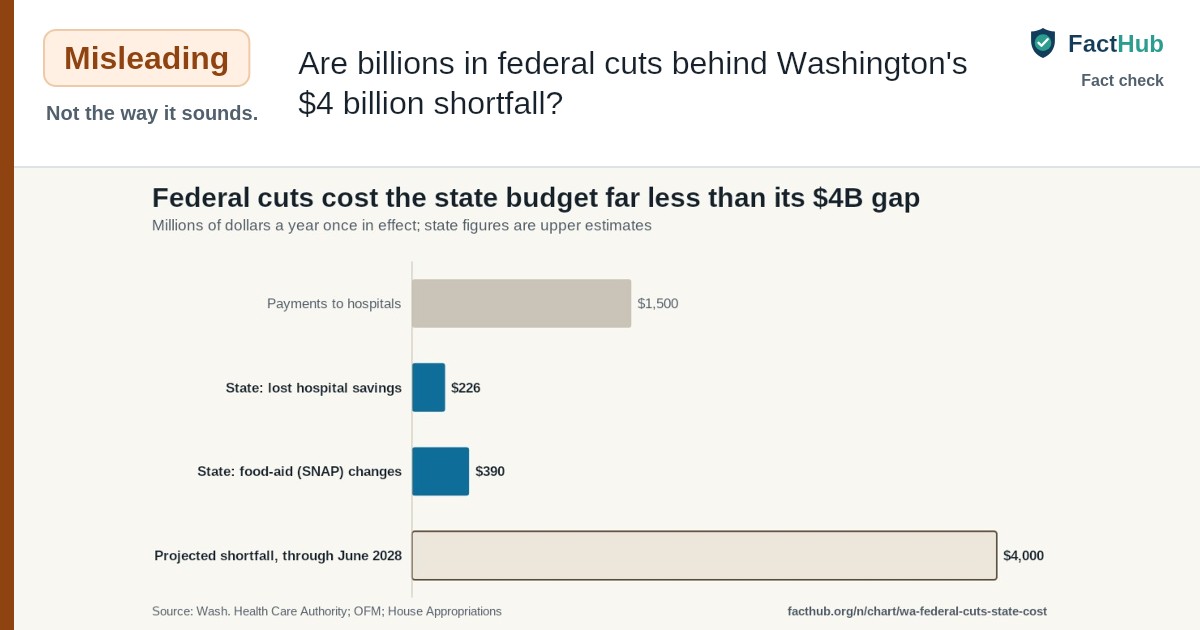
- Established. The largest federal losses hit hospitals: their payments fall over $1.5 billion a year once phased in; the state loses up to $226 million.
- Established. Tax collections are still growing: the state's November revenue forecast expects 7.93% more in 2027-29, a cut of just $75 million from September.
- Context. The $4 billion is the governor's budget office's estimate of keeping today's programs running, plus "critically necessary investments," through June 2028.
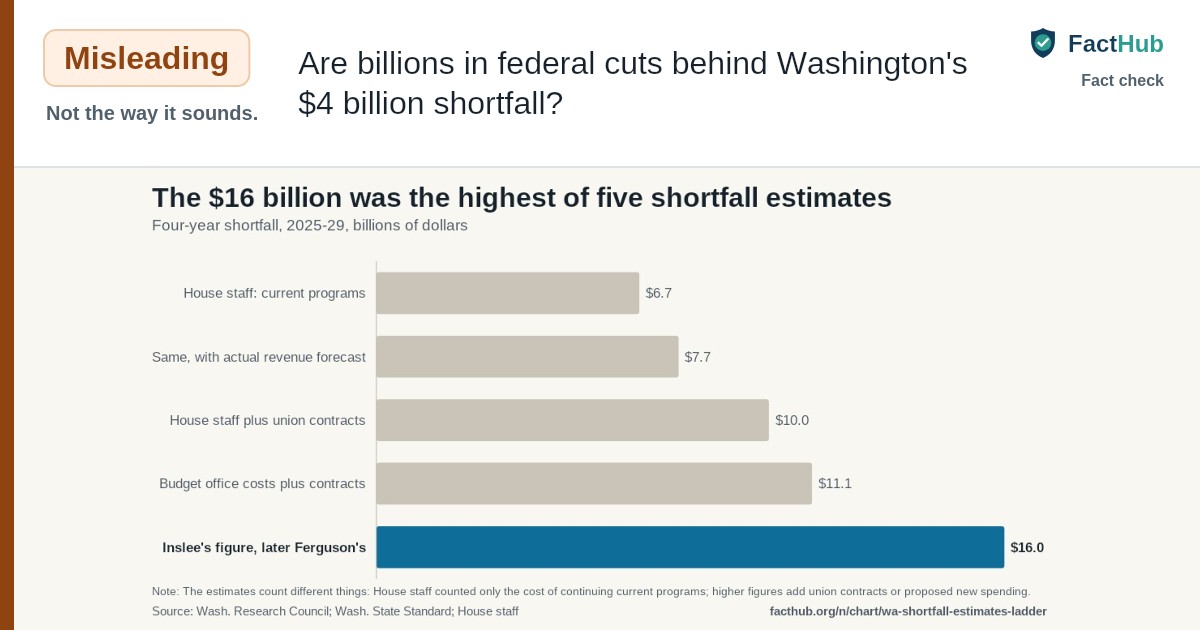
- Context. The "$16 billion" he says he inherited began with Gov. Jay Inslee and counted Inslee's proposed new spending; House staff estimated $6.7 billion.
The evidence
The conclusion rests on the combined record. Expand each item to see its role and limitations.
| Method | Institution / country | Year(s) | What it shows | Key limitation | Primary links |
|---|---|---|---|---|---|
| Read the Washington Research Council's tally of the 2027-29 requests from the Department of Social and Health Services and the Health Care Authority, checked its largest item against the department's own decision package, and compared it with the budget office's impact table, the social services department's testimony, and the governor's 2026 budget proposal. | Washington Research Council, Washington Office of Financial Management, Washington Department of Social and Health Services United States | 2025, 2026 | Agencies' 2027-29 budget requests tie $366 million of state costs to H.R. 1, the 2025 federal tax-and-spending law. The largest piece is $162.8 million for the new state share of food-aid (SNAP) benefits. The 2026 budget already spent $89.4 million on the law's changes. That total covers two years. The governor's $4 billion covers costs through June 2028. | These are agency requests, not an enacted budget. The $366 million total is a business-backed research group's tally. We confirmed its largest item, $162.8 million, in the social services department's own request; the Medicaid agency's request documents would not open when we checked. The food-aid cost depends on the state's payment error rate; the social services department estimates all the food-aid changes cost the state $190 million to $390 million a year. | Washington Research Council Washington Office of Financial Management, agency budget requests Washington Office of Financial Management Washington State Legislature, House Appropriations Committee Washington Office of Financial Management |
| Read the Health Care Authority's presentations to the Senate and House budget committees and the budget office's H.R. 1 impact table and federal funding page, separating state costs from federal money. | Washington Health Care Authority, Washington Office of Financial Management United States | 2025, 2026 | The state's Medicaid agency expects billions less in federal funding through 2034. Payments that support hospitals will fall by over $1.5 billion a year once fully phased in. The state's own loss from those hospital changes is up to $226 million a year, phasing in from 2028. Lower enrollment also saves the state money. Of a $460 million drop in Medicaid spending in the 2027 budget year, $46 million was state money. The budget office also counts $15 billion in promised federal money at risk over a decade. | Agency estimates mix federal and state dollars and give no single total. The budget office's impact table is dated Aug. 14, 2025, the latest it has posted. The $15 billion at risk includes grants still being fought over in court, and the timing of the hospital changes beyond 2029 is uncertain. | Washington Health Care Authority Washington Office of Financial Management Washington State Legislature, House Appropriations Committee Washington Office of Financial Management |
| Read the governor's statement and the budget office memo of the same day, the April 2026 official outlook, and the Research Council's and Policy Center's estimates; searched the forecast council's outlook page for a newer outlook. | Washington Office of Financial Management, Washington Economic and Revenue Forecast Council, Washington Research Council, Washington Policy Center United States | 2026 | The governor's budget office defines the gap as the cost of current services plus "critically necessary investments" through June 2028, above available money. That period includes the rest of the current budget year. The office lists rising costs, inflation, federal cuts, growing needs and flat or lower revenue forecasts as causes, without a dollar split. Other estimates differ. The April 2026 official outlook showed an $802 million deficit in the year starting July 2027; after two later forecasts, the Washington Research Council put it at about $604 million. The Washington Research Council puts the gap between spending and ongoing revenue that year at $1.59 billion. The free-market Washington Policy Center says the two-year gap could reach $6 billion to $7 billion if spending keeps growing. | The budget office published no breakdown, and we found no nonpartisan estimate made since the November forecast. The April outlook predates three revenue forecasts and new union contracts. | Office of the Governor of Washington Washington Office of Financial Management Washington Economic and Revenue Forecast Council Washington Research Council Washington Policy Center |
| Read the forecast council's November 2026 revenue review and news coverage quoting its chief economist. | Washington Economic and Revenue Forecast Council, Washington State Standard United States | 2026 | The November forecast expects $82.519 billion for the 2027-29 budget, 7.93% more than the current one. It lowered that by $75 million from September. The new income tax on high earners starts in January 2028, with first payments due in 2029. The state's chief economist expects $3.5 billion in its first year, which is why the budget office expects relief in 2029. | Forecasts change four times a year, and the income tax faces a court challenge. The growth figure covers two years, and most of it comes in the second year. | Washington Economic and Revenue Forecast Council Washington Office of Financial Management Washington State Standard |
| Traced the figure through the budget office's November 2024 memo, the House staff's December 2024 outlook, and the Research Council's comparisons of the estimates. | Washington Office of Financial Management, Washington House Office of Program Research, Washington Research Council United States | 2024, 2026 | All the shortfall estimates from late 2024 cover four years, the 2025-27 and 2027-29 budgets. The budget office first put the gap at $10 billion to $12 billion. Gov. Jay Inslee then said $16 billion over four years. The Washington Research Council says that figure counted all his proposed new spending and none of his proposed cuts. Nonpartisan House staff projected $6.7 billion, counting only the cost of continuing current programs. The Washington Research Council's estimates ran from $7.7 billion to $11.1 billion, the top end counting union contracts. | We found no budget office breakdown of the $16 billion as Ferguson used it from April 2025. The House staff's $6.7 billion appears in their slides only as an image, so we cite the Research Council's reading of it. Which costs count as must-do is a judgment: House staff say union contracts are policy choices, though they reflect the cost of employment. | Office of the Governor of Washington Washington Office of Financial Management Washington State Standard (via The Everett Herald) Washington Research Council Washington Research Council Washington House of Representatives, Office of Program Research |
| Compared the governor's statement and the Medicaid agency's priorities page with the Research Council's analyses. | Office of the Governor of Washington, Washington Health Care Authority, Washington Research Council United States | 2026 | The governor names rising costs and "billions of dollars in federal cuts" as the reasons for the first-year gap. The state's Medicaid agency lists federal funding cuts as one of four causes, with state costs, population growth and economic uncertainty. The Washington Research Council says federal actions may have deepened the shortfall but are not its main cause, and calls the law's state cost a very small part of state spending. | Both are interested parties: the agency works for the governor, and the council has long argued that spending growth drives the shortfall. Neither gives a dollar split of the $4 billion. | Office of the Governor of Washington Washington Health Care Authority Washington Research Council Washington Research Council |
1. State costs tied to the 2025 federal law: about $366 million over two years Read the Washington Research Council's tally of the 2027-29 requests from the Department of Social and Health Services and the Health Care Authority, checked its largest item against the department's own decision package, and compared it with the budget office's impact table, the social services department's testimony, and the governor's 2026 budget proposal.
Agencies' 2027-29 budget requests tie $366 million of state costs to H.R. 1, the 2025 federal tax-and-spending law. The largest piece is $162.8 million for the new state share of food-aid (SNAP) benefits. The 2026 budget already spent $89.4 million on the law's changes.
That total covers two years. The governor's $4 billion covers costs through June 2028.
Limit: These are agency requests, not an enacted budget. The $366 million total is a business-backed research group's tally. We confirmed its largest item, $162.8 million, in the social services department's own request; the Medicaid agency's request documents would not open when we checked. The food-aid cost depends on the state's payment error rate; the social services department estimates all the food-aid changes cost the state $190 million to $390 million a year.
Verify: Based on agency requests for 2027-29, the impact of H.R. 1 on the state budget will be small relative to overall state spending DSHS Economic Services Administration, 2027-29 maintenance level: HR1 - SNAP Benefit Match (decision package) H.R. 1 impacts to Washington (updated August 14, 2025) Federal changes: Health Care Authority and Department of Social and Health Services presentations, Dec. 4, 2025 Governor's proposed 2026 supplemental budget: federal funding changes
- Agencies request $365.9 million tied to H.R. 1 for 2027-29, including amounts already funded in the current budget. Washington Research Council · Contradicts
- The largest piece is $162.8 million for the new state share of food-aid (SNAP) benefits. Washington Research Council · Contradicts
- The social services department requests $162.8 million of state general-fund money for 2027-29 to cover the food-aid changes in H.R. 1. Washington Office of Financial Management, agency budget requests · Contradicts
- The food-aid benefit cost applies only if the state's payment error rate stays at 6% or more. Washington Research Council · Qualifies
- The 2026 supplemental budget spent $89.4 million of state money on the law's changes. Washington Research Council · Contradicts
- States must pay part of food-aid (SNAP) benefits if their payment error rate is above 6%. Washington Office of Financial Management · Qualifies
- The social services department estimates the food-aid changes could cost the state $190 million to $390 million a year. Washington State Legislature, House Appropriations Committee · Qualifies
- The governor proposed more than $155 million in state funds in 2026 to respond to the federal changes. Washington Office of Financial Management · Contradicts
2. The billions are mostly federal health money, not state tax dollars Read the Health Care Authority's presentations to the Senate and House budget committees and the budget office's H.R. 1 impact table and federal funding page, separating state costs from federal money.
The state's Medicaid agency expects billions less in federal funding through 2034. Payments that support hospitals will fall by over $1.5 billion a year once fully phased in. The state's own loss from those hospital changes is up to $226 million a year, phasing in from 2028.
Lower enrollment also saves the state money. Of a $460 million drop in Medicaid spending in the 2027 budget year, $46 million was state money. The budget office also counts $15 billion in promised federal money at risk over a decade.
Limit: Agency estimates mix federal and state dollars and give no single total. The budget office's impact table is dated Aug. 14, 2025, the latest it has posted. The $15 billion at risk includes grants still being fought over in court, and the timing of the hospital changes beyond 2029 is uncertain.
Verify: H.R. 1 and Apple Health (Medicaid): presentation to the Senate Ways and Means Committee, Oct. 16, 2025 H.R. 1 impacts to Washington (updated August 14, 2025) Federal changes: Health Care Authority and Department of Social and Health Services presentations, Dec. 4, 2025 Governor's proposed 2026 supplemental budget: federal funding changes
- The state's Medicaid agency expects billions of dollars less in federal funding from 2025 to 2034. Washington Health Care Authority
- Payments supporting hospitals will fall by over $1.5 billion a year once the cuts are fully phased in. Washington Health Care Authority · Qualifies
- Limits on hospital taxes and payments cost the state up to $226 million a year in lost savings, and hospitals up to $1.3 billion a year, as they phase in. Washington Office of Financial Management · Qualifies
- Fewer Medicaid enrollees cut spending by about $460 million in the 2027 budget year, of which $46 million was state money. Washington State Legislature, House Appropriations Committee · Contradicts
- The budget office says $15 billion in promised federal money is at risk over the next decade. Washington Office of Financial Management
3. The $4 billion is the governor's own office's estimate, through June 2028 Read the governor's statement and the budget office memo of the same day, the April 2026 official outlook, and the Research Council's and Policy Center's estimates; searched the forecast council's outlook page for a newer outlook.
The governor's budget office defines the gap as the cost of current services plus "critically necessary investments" through June 2028, above available money. That period includes the rest of the current budget year. The office lists rising costs, inflation, federal cuts, growing needs and flat or lower revenue forecasts as causes, without a dollar split.
Other estimates differ. The April 2026 official outlook showed an $802 million deficit in the year starting July 2027; after two later forecasts, the Washington Research Council put it at about $604 million. The Washington Research Council puts the gap between spending and ongoing revenue that year at $1.59 billion. The free-market Washington Policy Center says the two-year gap could reach $6 billion to $7 billion if spending keeps growing.
Limit: The budget office published no breakdown, and we found no nonpartisan estimate made since the November forecast. The April outlook predates three revenue forecasts and new union contracts.
Verify: Governor Ferguson statement on November revenue forecast Budget reductions for fiscal year 2027 and 2027-29 biennium (memo to agency directors, Nov. 16, 2026) Outlook for the Enacted 2026 Supplemental Omnibus Operating Budget (April 22, 2026) The budget problem could be short-term, if the Legislature chooses Final revenue forecast of 2026 shows Washington still spends more than it collects
- The governor projects a shortfall of about $4 billion in the first year of the next budget, with the budget stable from July 1, 2028. Office of the Governor of Washington
- The $4 billion is the cost of current services plus 'critically necessary investments' through June 2028, above the money available. Washington Office of Financial Management · Qualifies
- The budget office lists rising costs, inflation, federal cuts, growing needs and flat or lower revenue forecasts as the causes. Washington Office of Financial Management · Qualifies
- The budget office says caseload forecasts are costlier overall and the estimate will be updated. Washington Office of Financial Management · Qualifies
- The official outlook projected a general-fund deficit of $802 million at the end of the year starting July 2027, and a $653 million balance a year later. Washington Economic and Revenue Forecast Council · Qualifies
- After the June and September forecasts, the council estimated that year's deficit at about $604 million, all else equal. Washington Research Council · Qualifies
- The council puts the gap between spending and ongoing revenue in the year starting July 2027 at $1.59 billion. Washington Research Council · Qualifies
- The center estimates the full 2027-29 gap at $6-7 billion unless spending growth slows or taxes rise. Washington Policy Center · Qualifies
4. Tax collections are still growing, slowly Read the forecast council's November 2026 revenue review and news coverage quoting its chief economist.
The November forecast expects $82.519 billion for the 2027-29 budget, 7.93% more than the current one. It lowered that by $75 million from September.
The new income tax on high earners starts in January 2028, with first payments due in 2029. The state's chief economist expects $3.5 billion in its first year, which is why the budget office expects relief in 2029.
Limit: Forecasts change four times a year, and the income tax faces a court challenge. The growth figure covers two years, and most of it comes in the second year.
Verify: Revenue Review, November 16, 2026 Budget reductions for fiscal year 2027 and 2027-29 biennium (memo to agency directors, Nov. 16, 2026) WA governor looks to sharply pare spending in face of $4B budget shortfall
- Revenue for the 2027-29 budget is forecast at $82.519 billion, 7.93% more than the current budget. Washington Economic and Revenue Forecast Council · Contradicts
- The November forecast lowered 2027-29 revenue by $75.4 million from September. Washington Economic and Revenue Forecast Council · Contradicts
- The budget office expects the problem to ease in 2029, when the new income tax is first collected. Washington Office of Financial Management · Qualifies
- The new income tax starts in January 2028, with first payments due in 2029, if it survives a court challenge. Washington State Standard · Qualifies
- The state's chief economist estimates the tax will raise $3.5 billion in its first year. Washington State Standard · Qualifies
5. The $16 billion counted new spending; other estimates were lower Traced the figure through the budget office's November 2024 memo, the House staff's December 2024 outlook, and the Research Council's comparisons of the estimates.
All the shortfall estimates from late 2024 cover four years, the 2025-27 and 2027-29 budgets. The budget office first put the gap at $10 billion to $12 billion. Gov. Jay Inslee then said $16 billion over four years. The Washington Research Council says that figure counted all his proposed new spending and none of his proposed cuts.
Nonpartisan House staff projected $6.7 billion, counting only the cost of continuing current programs. The Washington Research Council's estimates ran from $7.7 billion to $11.1 billion, the top end counting union contracts.
Limit: We found no budget office breakdown of the $16 billion as Ferguson used it from April 2025. The House staff's $6.7 billion appears in their slides only as an image, so we cite the Research Council's reading of it. Which costs count as must-do is a judgment: House staff say union contracts are policy choices, though they reflect the cost of employment.
Verify: Governor Ferguson statement on November revenue forecast Budget reductions for fiscal year 2025 and 2025-27 biennium (memo, Nov. 8, 2024) Inslee proposes taxing the wealthy and businesses to close budget gap How big is the operating budget shortfall? Hint: not $16 billion Office of Program Research estimates that the budget shortfall is $6.7 billion over four years Preliminary budget outlook: presentation to the House Appropriations Committee, Dec. 9, 2024
- The governor says he inherited a $16 billion shortfall when he took office in 2025. Office of the Governor of Washington
- In November 2024 the budget office put the four-year deficit at $10 billion to $12 billion. Washington Office of Financial Management · Contradicts
- In December 2024 the shortfall was estimated at as much as $16 billion over four years. Washington State Standard (via The Everett Herald) · Qualifies
- The council says it is not fair to call the shortfall $16 billion, as Gov. Inslee did. Washington Research Council · Contradicts
- The Research Council says the $16 billion also counted all of Inslee's proposed new spending and none of his proposed cuts. Washington Research Council · Contradicts
- House staff projected deficits of $4.351 billion for 2025-27 and $6.7 billion by the end of 2027-29. Washington Research Council · Contradicts
- The House staff estimate counted no new policy costs and was not an official outlook. Washington House of Representatives, Office of Program Research · Qualifies
- Using House staff's cost estimate and the actual revenue forecast, the four-year shortfall was $7.7 billion. Washington Research Council · Contradicts
- Adding union contracts and the budget office's cost estimate, the four-year shortfall was $11.1 billion. Washington Research Council · Qualifies
- Adding the cost of union contracts would raise the House staff estimate to about $10 billion. Washington Research Council · Qualifies
6. The two sides' assessments of the cause Compared the governor's statement and the Medicaid agency's priorities page with the Research Council's analyses.
The governor names rising costs and "billions of dollars in federal cuts" as the reasons for the first-year gap. The state's Medicaid agency lists federal funding cuts as one of four causes, with state costs, population growth and economic uncertainty.
The Washington Research Council says federal actions may have deepened the shortfall but are not its main cause, and calls the law's state cost a very small part of state spending.
Limit: Both are interested parties: the agency works for the governor, and the council has long argued that spending growth drives the shortfall. Neither gives a dollar split of the $4 billion.
Verify: Governor Ferguson statement on November revenue forecast HCA legislative priorities Federal spending reductions are not the cause of Washington's budget problem Based on agency requests for 2027-29, the impact of H.R. 1 on the state budget will be small relative to overall state spending
- The governor names rising costs and billions of dollars in federal cuts, including health care, as the reasons for the first-year challenge. Office of the Governor of Washington
- The governor says the state has dealt with billions of dollars in cuts imposed by the Trump administration. Office of the Governor of Washington
- The Medicaid agency lists federal funding cuts as one of four causes of the 2027-29 shortfalls. Washington Health Care Authority
- The council says federal actions may have deepened the shortfall but are not its main cause. Washington Research Council · Contradicts
- The council concludes the law's state cost is a very small part of state spending. Washington Research Council · Contradicts
Common questions 8
“State agencies tie about $366 million of costs in Washington's next two-year budget to the 2025 federal budget law.”
Agency requests tie $366 million of 2027-29 state costs to the law, H.R. 1, most of it for food aid (SNAP). That covers two years, against a $4 billion gap the governor puts in one.
- Agencies request $365.9 million tied to H.R. 1 for 2027-29, including amounts already funded in the current budget. Washington Research Council · Contradicts
- The largest piece is $162.8 million for the new state share of food-aid (SNAP) benefits. Washington Research Council · Contradicts
- The social services department requests $162.8 million of state general-fund money for 2027-29 to cover the food-aid changes in H.R. 1. Washington Office of Financial Management, agency budget requests · Contradicts
- The governor projects a shortfall of about $4 billion in the first year of the next budget, with the budget stable from July 1, 2028. Office of the Governor of Washington
See the evidence: State costs tied to the 2025 federal law: about $366 million over two years
“When I took office last year, I inherited a $16 billion budget shortfall.”
The $16 billion began as Gov. Jay Inslee's four-year figure, which the Washington Research Council says counted all his proposed new spending. Nonpartisan House staff put the gap at $6.7 billion; other estimates ran $7.7 billion to $11.1 billion.
- The governor says he inherited a $16 billion shortfall when he took office in 2025. Office of the Governor of Washington
- In December 2024 the shortfall was estimated at as much as $16 billion over four years. Washington State Standard (via The Everett Herald) · Qualifies
- The council says it is not fair to call the shortfall $16 billion, as Gov. Inslee did. Washington Research Council · Contradicts
- The Research Council says the $16 billion also counted all of Inslee's proposed new spending and none of his proposed cuts. Washington Research Council · Contradicts
- House staff projected deficits of $4.351 billion for 2025-27 and $6.7 billion by the end of 2027-29. Washington Research Council · Contradicts
- Using House staff's cost estimate and the actual revenue forecast, the four-year shortfall was $7.7 billion. Washington Research Council · Contradicts
- Adding union contracts and the budget office's cost estimate, the four-year shortfall was $11.1 billion. Washington Research Council · Qualifies
See the evidence: The $16 billion counted new spending; other estimates were lower
“We now project an approximately $4 billion shortfall in the first year of the next budget.”
Short answer: His budget office's own estimate
It is the governor's budget office's figure, and we found no nonpartisan estimate made since the November forecast. The office counts current services plus "critically necessary investments" through June 2028, including the rest of this budget year. The April official outlook showed an $802 million deficit for the year starting July 2027, and the Washington Research Council puts the underlying gap at $1.59 billion. The free-market Washington Policy Center says the two-year gap could reach $6 billion to $7 billion.
- The $4 billion is the cost of current services plus 'critically necessary investments' through June 2028, above the money available. Washington Office of Financial Management · Qualifies
- The official outlook projected a general-fund deficit of $802 million at the end of the year starting July 2027, and a $653 million balance a year later. Washington Economic and Revenue Forecast Council · Qualifies
- The council puts the gap between spending and ongoing revenue in the year starting July 2027 at $1.59 billion. Washington Research Council · Qualifies
- The center estimates the full 2027-29 gap at $6-7 billion unless spending growth slows or taxes rise. Washington Policy Center · Qualifies
See the evidence: The $4 billion is the governor's own office's estimate, through June 2028
“Washington is losing billions of dollars in federal money.”
Short answer: Yes, mostly federal health money
Yes, over the next decade, but most of it is federal money, not the state taxes the shortfall is counted in. The state's Medicaid agency expects billions less in federal funding through 2034, and hospital payments will fall over $1.5 billion a year once fully phased in. The state's own loss from the hospital changes is up to $226 million a year, phasing in from 2028. Lower Medicaid enrollment also saves state money: $46 million of a $460 million drop in 2027.
- The state's Medicaid agency expects billions of dollars less in federal funding from 2025 to 2034. Washington Health Care Authority
- Payments supporting hospitals will fall by over $1.5 billion a year once the cuts are fully phased in. Washington Health Care Authority · Qualifies
- Limits on hospital taxes and payments cost the state up to $226 million a year in lost savings, and hospitals up to $1.3 billion a year, as they phase in. Washington Office of Financial Management · Qualifies
- Fewer Medicaid enrollees cut spending by about $460 million in the 2027 budget year, of which $46 million was state money. Washington State Legislature, House Appropriations Committee · Contradicts
See the evidence: The billions are mostly federal health money, not state tax dollars
“The shortfall is happening because tax collections are falling.”
Short answer: No, they are still growing
No. The November forecast expects $82.519 billion for the 2027-29 budget, 7.93% more than this one, and trimmed it by $75 million. The budget office blames rising costs, inflation, federal cuts, growing needs and flat or lower revenue forecasts. The Washington Research Council says federal actions are not the main cause; our check of the budget's growth found it outpaced population and inflation for a decade.
- Revenue for the 2027-29 budget is forecast at $82.519 billion, 7.93% more than the current budget. Washington Economic and Revenue Forecast Council · Contradicts
- The November forecast lowered 2027-29 revenue by $75.4 million from September. Washington Economic and Revenue Forecast Council · Contradicts
- The budget office lists rising costs, inflation, federal cuts, growing needs and flat or lower revenue forecasts as the causes. Washington Office of Financial Management · Qualifies
- The council says federal actions may have deepened the shortfall but are not its main cause. Washington Research Council · Contradicts
“The new income tax will fix the budget after mid-2028.”
Short answer: If it survives in court
Partly, if it survives a court challenge. The tax on high earners starts in January 2028, with first payments due in 2029, and the state's chief economist expects $3.5 billion in its first year. That is why the governor says the budget is stable from July 1, 2028, while the year before has no income-tax money.
- The new income tax starts in January 2028, with first payments due in 2029, if it survives a court challenge. Washington State Standard · Qualifies
- The state's chief economist estimates the tax will raise $3.5 billion in its first year. Washington State Standard · Qualifies
- The budget office expects the problem to ease in 2029, when the new income tax is first collected. Washington Office of Financial Management · Qualifies
- The governor projects a shortfall of about $4 billion in the first year of the next budget, with the budget stable from July 1, 2028. Office of the Governor of Washington
“The state made its budget problems worse by assuming 4.5% revenue growth.”
Short answer: Partly; a planning rule
Partly. By law, the four-year budget outlook assumed 4.5% yearly revenue growth in its later two years, and House staff used it in their December 2024 estimate. With the actual forecast, that estimate rose from $6.7 billion to $7.7 billion. The 2026 budget dropped the assumption: the April 2026 outlook made "no 4.5 percent adjustment" for 2027-29.
- The governor says the state made its budget problems worse by assuming 4.5% revenue growth. Office of the Governor of Washington
- By law, the outlook assumed 4.5% yearly revenue growth in the 2027-29 budget. Washington House of Representatives, Office of Program Research
- House staff projected deficits of $4.351 billion for 2025-27 and $6.7 billion by the end of 2027-29. Washington Research Council · Contradicts
- Using House staff's cost estimate and the actual revenue forecast, the four-year shortfall was $7.7 billion. Washington Research Council · Contradicts
- The April 2026 outlook did not assume 4.5% revenue growth for 2027-29, because the 2026 budget law said not to. Washington Economic and Revenue Forecast Council · Qualifies
See the evidence: The $16 billion counted new spending; other estimates were lower
“Counting all federal cuts, the state's cost is far more than $366 million.”
Short answer: Possibly more; no one has shown it
It could be more, but no source we found shows it. The $366 million counts only the social services and Medicaid agencies' requests. The social services department estimates all the food-aid changes cost the state $190 million to $390 million a year, and lost hospital savings reach $226 million a year as limits phase in from 2028. Other federal grant cuts, such as $159 million for disease prevention, cost the state only if it replaces them; the budget office has not said whether its $4 billion does. Federal policy can also slow tax collections: the forecast council lists trade policy among the main risks, though November's forecast trimmed 2027-29 revenue by just $75 million.
- Limits on hospital taxes and payments cost the state up to $226 million a year in lost savings, and hospitals up to $1.3 billion a year, as they phase in. Washington Office of Financial Management · Qualifies
- States must pay part of food-aid (SNAP) benefits if their payment error rate is above 6%. Washington Office of Financial Management · Qualifies
- The food-aid benefit cost applies only if the state's payment error rate stays at 6% or more. Washington Research Council · Qualifies
- The social services department estimates the food-aid changes could cost the state $190 million to $390 million a year. Washington State Legislature, House Appropriations Committee · Qualifies
- Federal health officials ended about $159 million in funding for disease prevention in Washington. Washington Office of Financial Management · Qualifies
- The $4 billion is the cost of current services plus 'critically necessary investments' through June 2028, above the money available. Washington Office of Financial Management · Qualifies
- The forecast council lists trade policy among the main risks to the state's economy. Washington Economic and Revenue Forecast Council · Qualifies
- The November forecast lowered 2027-29 revenue by $75.4 million from September. Washington Economic and Revenue Forecast Council · Contradicts
See the evidence: State costs tied to the 2025 federal law: about $366 million over two years
Conclusion
Gov. Ferguson is right that federal cuts are real and large. Over the next decade, Washington's health programs and hospitals stand to lose billions of federal dollars. But most of that is federal money, not the state tax dollars the shortfall is counted in. Agency requests tie about $366 million of state costs across the whole 2027-29 budget to the 2025 federal law.
That leaves most of the $4 billion to other causes. The governor's own budget office lists them: rising costs, inflation, costlier caseloads, growing needs and flat or lower revenue forecasts. Tax collections are not falling; they are growing more slowly than costs. The Washington Research Council, a business-backed research group, says federal actions are not the main cause, and our check of the budget's growth found spending outpaced population and inflation for a decade.
The federal share could grow. Hospital payment limits tighten each year after 2028, and food-aid costs stay with the state while its payment error rate is 6% or more. Even the social services department's estimate for all the food-aid changes, up to $390 million a year, would leave federal costs a small part of a $4 billion gap. That is our reading of the figures, since no one has published a split of the $4 billion by cause.
Our confidence is moderate. The $4 billion is the governor's office's own estimate, without a published breakdown, and we found no nonpartisan estimate made since the November forecast. The federal figures come from agency requests that will change before a budget passes. Several figures come through one business-backed analyst; we checked them against state documents where we could.
The governor's "$16 billion" is a separate claim. It described a four-year gap that counted his predecessor's proposed new spending; nonpartisan House staff put that gap at $6.7 billion.
How we checked
- We defined the claim as the governor used it: that billions in federal cuts are a main reason for the $4 billion shortfall in the first year of the 2027-29 budget. We counted costs to the state's general fund separately from federal money lost to hospitals, health programs and families.
- We read the governor's Nov. 16, 2026 statement and the budget office memo issued the same day, which defines the $4 billion.
- We read the Economic and Revenue Forecast Council's November 2026 revenue review and April 2026 budget outlook, and checked its outlook page for a newer outlook; none was posted as of Nov. 17, 2026.
- For federal costs, we used the budget office's H.R. 1 impact table and federal funding page, the Health Care Authority's and social services department's testimony to legislative budget committees, and the Washington Research Council's tally of 2027-29 agency requests.
- For the $16 billion, we traced the figure through the budget office's November 2024 memo, the House staff's December 2024 outlook and the Research Council's comparisons of the estimates.
- We preferred state documents, used advocacy and business-backed groups' estimates only with their reliability notes, and recorded the limits of each line of evidence.
Editorial note: This check covers the governor's Nov. 16, 2026 statements about the state operating budget. It does not cover the transportation or capital budgets, or whether any federal cut is good policy. The 2027-29 figures are estimates and agency requests, not an enacted budget; the governor will propose his budget by Dec. 20, 2026.
Expert-review status
No external specialist review has been recorded.
Funding and conflicts
Funding: No external funding for this piece.
Ownership: Published by the FactHub Research Team.
Conflicts: None known.
Sources 20
Sources are labeled by kind, with what this fact check takes from each, so readers can check the evidence independently.
-
Party to the dispute
Office of the Governor of Washington.
Governor Ferguson statement on November revenue forecast
Gov. Bob Ferguson's statement of Nov. 16, 2026, on the state's November revenue forecast. It contains the claims checked here.
Reliability: Has a stake in this finding. The governor is the speaker whose claims this article checks. He is a Democrat who will propose the 2027-29 budget by Dec. 20, 2026.
-
The governor names rising costs and billions of dollars in federal cuts, including health care, as the reasons for the first-year challenge.
What the source says
However, between rising costs and billions of dollars in federal cuts, including massive cuts to health care, we are facing a significant challenge in the first year of the next budget.
Statement body · Bob Ferguson, Governor of WashingtonNot yet checked
-
The governor says the state has dealt with billions of dollars in cuts imposed by the Trump administration.
What the source says
After dealing with billions of dollars in draconian cuts imposed by the Trump Administration, voters have elected a new Congress that will help return us to budget sanity.
Statement body · Bob Ferguson, Governor of WashingtonNot yet checked
-
The governor projects a shortfall of about $4 billion in the first year of the next budget, with the budget stable from July 1, 2028.
What the source says
The bad news is: We now project an approximately $4 billion shortfall in the first year of the next budget. The good news is our budget situation will be stable beginning July 1, 2028.
Statement body · Bob Ferguson, Governor of WashingtonNot yet checked
-
The governor says he inherited a $16 billion shortfall when he took office in 2025.
What the source says
When I took office last year, I inherited a $16 billion budget shortfall.
Statement, first paragraph · Bob Ferguson, Governor of WashingtonNot yet checked
-
The governor says the state made its budget problems worse by assuming 4.5% revenue growth.
What the source says
For years, the state compounded our budget challenges by assuming we would see 4.5% growth, even if the forecast council told us that number would be lower.
Statement body · Bob Ferguson, Governor of WashingtonNot yet checked
-
-
Government
Washington Office of Financial Management.
Budget reductions for fiscal year 2027 and 2027-29 biennium (memo to agency directors, Nov. 16, 2026)
Memo from Office of Financial Management Director K.D. Chapman-See telling agencies to propose cuts. It defines the $4 billion figure.
Reliability: Has a stake in this finding. The Office of Financial Management is the governor's budget office, so it is the source of the governor's figure. The memo publishes no breakdown of the $4 billion and says the estimate will be updated.
-
Qualifies: The $4 billion is the cost of current services plus 'critically necessary investments' through June 2028, above the money available.
What the source says
The cost of maintaining current service levels and critically necessary investments through the end of fiscal year 2028 is approximately $4 billion more than we have in available resources.
Page 1, first paragraphNot yet checked
-
Qualifies: The budget office lists rising costs, inflation, federal cuts, growing needs and flat or lower revenue forecasts as the causes.
What the source says
The compounding effects of rising costs, high inflation, federal cuts, expanding needs, and flat or lower revenue forecasts will require billions of dollars of reductions to craft a balanced budget for state fiscal years 2027 and 2028.
Page 1, second paragraphNot yet checked
-
Qualifies: The budget office says caseload forecasts are costlier overall and the estimate will be updated.
What the source says
showing mixed projections with costlier caseloads overall, and revenue that is insufficient to resolve the deficit.
Page 1, second paragraphNot yet checked
-
Qualifies: The budget office expects the problem to ease in 2029, when the new income tax is first collected.
What the source says
Our challenges are expected to get better starting in 2029 when revenue from the millionaire
Page 1Not yet checked
-
-
Government
Washington Economic and Revenue Forecast Council.
Revenue Review, November 16, 2026
The state's official November 2026 forecast of tax collections for the current and next two-year budgets.
Reliability: The council is a bipartisan state body of legislators and executive officials; its staff economists prepare the forecast budgets must use. It does not attribute forecast changes to federal cuts.
-
Contradicts: Revenue for the 2027-29 budget is forecast at $82.519 billion, 7.93% more than the current budget.
What the source says
For the 2027-29 biennium, it is $82.519 billion, an increase of 7.93% over the current biennium.
Executive summary, p. 8Not yet checked
-
Qualifies: The forecast council lists trade policy among the main risks to the state's economy.
What the source says
The major risks to the U.S. and Washington economies continue to be the impacts of the Iran war and other geopolitical conflicts, trade policy, reduced artificial intelligence related investment, elevated interest rates, and a declining equity market.
Executive summary, p. 4Not yet checked
-
Contradicts: The November forecast lowered 2027-29 revenue by $75.4 million from September.
What the source says
the total forecast has increased by $195.4 million in the 2025-27 biennium, decreased by $75.4 million in the 2027-29 biennium
Executive summary, pp. 7-8Not yet checked
-
-
Government
Washington Economic and Revenue Forecast Council.
Outlook for the Enacted 2026 Supplemental Omnibus Operating Budget (April 22, 2026)
The official four-year budget outlook adopted after the 2026 supplemental budget, the latest one posted as of Nov. 17, 2026.
Reliability: Prepared by legislative and budget office staff and adopted by the bipartisan forecast council. It predates the June, September and November 2026 forecasts.
-
Qualifies: The official outlook projected a general-fund deficit of $802 million at the end of the year starting July 2027, and a $653 million balance a year later.
What the source says
NGF-O Projected Ending Balance 1,112 277 277 -802 653 653
Outlook table, row 'NGF-O Projected Ending Balance'; columns FY 2026, FY 2027, 2025-27, FY 2028, FY 2029, 2027-29 (dollars in millions)Not yet checked
-
Qualifies: The April 2026 outlook did not assume 4.5% revenue growth for 2027-29, because the 2026 budget law said not to.
What the source says
Therefore, no 4.5 percent adjustment is made for 2027-29 projected revenues.
Note under the outlook tableNot yet checked
-
-
Other
Washington Research Council.
Based on agency requests for 2027-29, the impact of H.R. 1 on the state budget will be small relative to overall state spending
Oct. 12, 2026 tally by Emily Makings of state costs tied to H.R. 1 in the social services and health agencies' 2027-29 budget requests.
Reliability: Has a stake in this finding. The Washington Research Council is a nonprofit research group funded mainly by businesses. Its budget analyst, Emily Makings, has argued that state spending growth, not federal cuts, is the main cause of the shortfall. Its figures come from state budget documents it links.
-
Contradicts: Agencies request $365.9 million tied to H.R. 1 for 2027-29, including amounts already funded in the current budget.
What the source says
All told, it looks like state agencies are requesting $365.9 million related to H.R. 1 for 2027–29, including the base budget carried over from 2025–27 and carry-forward level, maintenance level, and policy level changes.
Summary paragraphNot yet checked
-
Contradicts: The largest piece is $162.8 million for the new state share of food-aid (SNAP) benefits.
What the source says
The largest change would be $162.8 million for the SNAP benefit match, at the maintenance level.
Department of Social and Health Services sectionNot yet checked
-
Qualifies: The food-aid benefit cost applies only if the state's payment error rate stays at 6% or more.
What the source says
This will be a direct cost for Washington, unless its payment error rate falls below 6%.
Department of Social and Health Services sectionNot yet checked
-
Contradicts: The 2026 supplemental budget spent $89.4 million of state money on the law's changes.
What the source says
Washington appropriated $89.4 million from the general fund–state (GFS) in the 2026 supplemental budget to address some of the changes, mainly in the HCA and DSHS.
Opening paragraphsNot yet checked
-
Contradicts: The council concludes the law's state cost is a very small part of state spending.
What the source says
but it is still a very small portion of overall state spending.
Closing paragraphNot yet checked
-
-
Government
Washington Office of Financial Management, agency budget requests.
DSHS Economic Services Administration, 2027-29 maintenance level: HR1 - SNAP Benefit Match (decision package)
The social services department's 2027-29 budget request for the new state share of food-aid (SNAP) benefits, the largest state cost tied to H.R. 1.
Reliability: Has a stake in this finding. A request from a state agency under the governor, not an enacted budget. The amount depends on the state's food-aid payment error rate.
-
Contradicts: The social services department requests $162.8 million of state general-fund money for 2027-29 to cover the food-aid changes in H.R. 1.
What the source says
The Department of Social and Health Services (DSHS) Economic Services Administration (ESA) requests $162,842,000 GF…to address significant fiscal impacts of federal changes to the Supplemental Nutrition Assistance Program (SNAP), as passed in H.R.1
Page 1, Agency Recommendation SummaryNot yet checked
-
-
News report
Washington State Standard (via The Everett Herald).
Inslee proposes taxing the wealthy and businesses to close budget gap
Dec. 18, 2024 news story by Jerry Cornfield and Laurel Demkovich on Gov. Jay Inslee's final budget proposal.
Reliability: Statehouse news coverage reprinted by The Everett Herald. It reports the governor's figure without checking it.
-
Qualifies: In December 2024 the shortfall was estimated at as much as $16 billion over four years.
What the source says
To erase most of the shortfall, estimated to be as high as $16 billion over the next four years, Inslee called for a new wealth tax
Section 'Raising revenue'Not yet checked
-
-
Other
Washington Research Council.
Federal spending reductions are not the cause of Washington's budget problem
Jan. 22, 2026 analysis by Emily Makings of federal actions and the state shortfall.
Reliability: Has a stake in this finding. The Washington Research Council is a nonprofit research group funded mainly by businesses. Its budget analyst, Emily Makings, has argued that state spending growth, not federal cuts, is the main cause of the shortfall. Its figures come from state budget documents it links.
-
Contradicts: The council says federal actions may have deepened the shortfall but are not its main cause.
What the source says
Federal actions may have deepened Washington’s shortfall, but they are not its predominant cause.
Opening paragraphNot yet checked
-
-
Other
Washington Research Council.
The budget problem could be short-term, if the Legislature chooses
Oct. 2, 2026 estimate by Emily Makings of the 2027-29 budget gap after the June and September forecasts.
Reliability: Has a stake in this finding. The Washington Research Council is a nonprofit research group funded mainly by businesses. Its budget analyst, Emily Makings, has argued that state spending growth, not federal cuts, is the main cause of the shortfall. Its figures come from state budget documents it links.
-
Qualifies: After the June and September forecasts, the council estimated that year's deficit at about $604 million, all else equal.
What the source says
but there would still be a shortfall of about -$604 million in FY 2028 (all else equal).
Second sectionNot yet checked
-
Qualifies: The council puts the gap between spending and ongoing revenue in the year starting July 2027 at $1.59 billion.
What the source says
They need to close a $1.59 billion shortfall that year in order to bring appropriations back in line with ongoing revenues.
Second sectionNot yet checked
-
-
Advocacy group
Washington Policy Center.
Final revenue forecast of 2026 shows Washington still spends more than it collects
Nov. 16, 2026 blog post by Ryan Frost, the center's director of budget and tax policy.
Reliability: Has a stake in this finding. The Washington Policy Center is a free-market think tank that argues for lower state spending. Its estimate assumes spending keeps growing at its 10-year pace.
-
Qualifies: The center estimates the full 2027-29 gap at $6-7 billion unless spending growth slows or taxes rise.
What the source says
By my estimate, unless the state massively slows down spending compared to the last 10 years, or raises taxes again, the 2027-29 shortfall will likely be closer to $6-7 billion.
Body · Ryan Frost, Washington Policy CenterNot yet checked
-
-
Government
Washington Office of Financial Management.
H.R. 1 impacts to Washington (updated August 14, 2025)
The budget office's table of H.R. 1 changes, with effective dates and estimated yearly effects. It is the only itemized list the office has posted.
Reliability: Has a stake in this finding. The governor's budget office. Its 'Annual State Funding Impact' column mixes state costs with federal money lost to hospitals and others, and gives no total.
-
Qualifies: States must pay part of food-aid (SNAP) benefits if their payment error rate is above 6%.
What the source says
Requires states to contribute 5-15% annually to the SNAP program, if the state payment error rate is higher than 6%.
Page 1, food assistance row 7Not yet checked
-
Qualifies: Limits on hospital taxes and payments cost the state up to $226 million a year in lost savings, and hospitals up to $1.3 billion a year, as they phase in.
What the source says
up to $226 million loss of state savings per year (up to $1.3 billion per year impact to hospitals)
Page 2, Medicaid provider impacts row 1Not yet checked
-
-
Government
Washington Health Care Authority.
H.R. 1 and Apple Health (Medicaid): presentation to the Senate Ways and Means Committee, Oct. 16, 2025
Slides the state's Medicaid agency presented to the Senate budget committee on the federal law's effects.
Reliability: Has a stake in this finding. The Health Care Authority runs Washington's Medicaid program (Apple Health) and reports to the governor. Its estimates count federal and state dollars together.
-
The state's Medicaid agency expects billions of dollars less in federal funding from 2025 to 2034.
What the source says
Our state is projected to see a reduction of billions in federal funding between 2025–2034.
Slide 5Not yet checked
-
Qualifies: Payments supporting hospitals will fall by over $1.5 billion a year once the cuts are fully phased in.
What the source says
Existing SDPs supporting hospital services, which include the Hospital Safety Net Assessment and payments to the University of Washington, will be reduced by over $1.5 billion annually, once fully reduced.
Slide 14Not yet checked
-
-
Government
Washington State Legislature, House Appropriations Committee.
Federal changes: Health Care Authority and Department of Social and Health Services presentations, Dec. 4, 2025
Agency slides presented to the House budget committee on the federal law's effects on Medicaid and food aid.
Reliability: Has a stake in this finding. Testimony by the state's Medicaid agency and its social services department, both under the governor, to a legislative committee. The food-aid range is the department's own estimate.
-
Contradicts: Fewer Medicaid enrollees cut spending by about $460 million in the 2027 budget year, of which $46 million was state money.
What the source says
SFY 2027 caseload impacts – ~$460 million ($46 million GF-S) reduction compared to amounts assumed in underlying budget
Slide 17, Health Care Authority fiscal impactsNot yet checked
-
Qualifies: The social services department estimates the food-aid changes could cost the state $190 million to $390 million a year.
What the source says
$190 million to $390 million Is the estimated additional annual cost to the state budget
Slide 6, Department of Social and Health ServicesNot yet checked
-
-
Government
Washington Health Care Authority.
HCA legislative priorities
The Medicaid agency's 2027 legislative priorities page, cited for the agency's own list of causes of the 2027-29 shortfall, which includes federal cuts.
Reliability: Has a stake in this finding. A state agency under the governor, describing its own budget requests. It lists federal cuts among several causes without a dollar split.
-
The Medicaid agency lists federal funding cuts as one of four causes of the 2027-29 shortfalls.
What the source says
Increasing state costs, federal funding cuts, population growth, and ongoing economic uncertainty all contribute to anticipated budget shortfalls during the 2027–2029 biennium.
About HCA's legislative prioritiesNot yet checked
-
-
Government
Washington Office of Financial Management.
Governor's proposed 2026 supplemental budget: federal funding changes
Budget office highlights page on federal funding changes, from the governor's December 2025 budget proposal.
Reliability: Has a stake in this finding. The governor's budget office. The $15 billion figure is federal money at risk over a decade, much of it in court cases, not state costs.
-
The budget office says $15 billion in promised federal money is at risk over the next decade.
What the source says
$15 billion in promised federal investments that are at risk over the next decade
Federal funding changes pageNot yet checked
-
Qualifies: Federal health officials ended about $159 million in funding for disease prevention in Washington.
What the source says
terminated approximately $159 million in appropriated funding for disease prevention
Federal funding changes pageNot yet checked
-
Contradicts: The governor proposed more than $155 million in state funds in 2026 to respond to the federal changes.
What the source says
require an investment of more than $155 million in state funds to protect safety net programs
Federal funding changes pageNot yet checked
-
-
News report
Washington State Standard.
WA governor looks to sharply pare spending in face of $4B budget shortfall
Free copy
Nov. 16, 2026 news story by Jerry Cornfield on the November forecast and the governor's cut instructions. The free copy is the Lynnwood Times reprint.
Reliability: A nonprofit statehouse news site. The income tax figures come from the state's chief economist, David Reich.
-
Qualifies: The new income tax starts in January 2028, with first payments due in 2029, if it survives a court challenge.
What the source says
The tax, if it survives a legal challenge, is set to take effect in January 2028, with the first payments due in 2029.
BodyNot yet checked
-
Qualifies: The state's chief economist estimates the tax will raise $3.5 billion in its first year.
What the source says
Reich estimates it will generate $3.5 billion in its first year, with collections rising in future years.
Body · David Reich, executive director and chief economist, Economic and Revenue Forecast CouncilNot yet checked
-
-
Other
Washington Research Council.
How big is the operating budget shortfall? Hint: not $16 billion
Dec. 19, 2024 comparison by Emily Makings of shortfall estimates after Gov. Jay Inslee's budget proposal.
Reliability: Has a stake in this finding. The Washington Research Council is a nonprofit research group funded mainly by businesses. Its budget analyst, Emily Makings, has argued that state spending growth, not federal cuts, is the main cause of the shortfall. Its figures come from state budget documents it links.
-
Contradicts: The council says it is not fair to call the shortfall $16 billion, as Gov. Inslee did.
What the source says
However, I do not think it’s fair to say that the shortfall is $16 billion, as Gov. Inslee did on Tuesday.
Opening paragraphsNot yet checked
-
Contradicts: The Research Council says the $16 billion also counted all of Inslee's proposed new spending and none of his proposed cuts.
What the source says
But it also includes all the policy increases in the governor’s budget and none of his proposed policy reductions.
Opening paragraphsNot yet checked
-
Contradicts: Using House staff's cost estimate and the actual revenue forecast, the four-year shortfall was $7.7 billion.
What the source says
If you assume the OPR ML and actual forecasted revenues for 2027–29, the four-year shortfall is $7.7 billion.
Estimates table discussionNot yet checked
-
Qualifies: Adding union contracts and the budget office's cost estimate, the four-year shortfall was $11.1 billion.
What the source says
If you assume the OFM ML, the cost of the CBAs, and 4.5% revenue growth, the four-year shortfall is $11.1 billion.
Estimates table discussionNot yet checked
-
-
Other
Washington Research Council.
Office of Program Research estimates that the budget shortfall is $6.7 billion over four years
Dec. 10, 2024 summary by Emily Makings of the House staff's preliminary budget outlook.
Reliability: Has a stake in this finding. The Washington Research Council is a nonprofit research group funded mainly by businesses. Its budget analyst, Emily Makings, has argued that state spending growth, not federal cuts, is the main cause of the shortfall. Its figures come from state budget documents it links.
-
Contradicts: House staff projected deficits of $4.351 billion for 2025-27 and $6.7 billion by the end of 2027-29.
What the source says
-$4.351 billion in 2025–27 and -$6.700 billion in 2027–29.
First paragraphNot yet checked
-
Qualifies: Adding the cost of union contracts would raise the House staff estimate to about $10 billion.
What the source says
would bring OPR’s four-year shortfall estimate up to about $10 billion
Discussion of policy itemsNot yet checked
-
-
Government
Washington House of Representatives, Office of Program Research.
Preliminary budget outlook: presentation to the House Appropriations Committee, Dec. 9, 2024
The House's nonpartisan staff presentation of the four-year budget outlook before the 2025 session.
Reliability: Nonpartisan legislative staff. The estimate counts the cost of continuing current programs only, with no new policy such as union contracts.
-
Qualifies: The House staff estimate counted no new policy costs and was not an official outlook.
What the source says
No policy-level items are included. This analysis was prepared by OPR staff for legislative deliberations of House members. It is not an official Outlook.
Slide 14, noteNot yet checked
-
By law, the outlook assumed 4.5% yearly revenue growth in the 2027-29 budget.
What the source says
Per statute, 4.5% annual revenue growth is assumed in the 2027-29 biennium (Outlook biennium).
Slide 13Not yet checked
-
-
Government
Washington Office of Financial Management.
Budget reductions for fiscal year 2025 and 2025-27 biennium (memo, Nov. 8, 2024)
Memo from then-Director Pat Sullivan to agencies under Gov. Jay Inslee, giving the budget office's first four-year estimate.
Reliability: Has a stake in this finding. The budget office under Ferguson's predecessor. It frames the gap over four years, the same period as the later $16 billion figure.
-
Contradicts: In November 2024 the budget office put the four-year deficit at $10 billion to $12 billion.
What the source says
The magnitude of the operating budget deficit is between $10 and $12 billion over the four-year outlook period.
Page 1, first paragraphNot yet checked
-
-
FactHub dataset
Washington budget shortfall estimates and yearly costs of federal cuts
-
Tables: federal-cut-yearly
Table federal-cut-yearly; analysis federal-yearly
-
Tables: shortfall-estimates
Table shortfall-estimates; analysis shortfall-ladder
-
- FactHub chart wa-federal-cuts-state-cost
- FactHub chart wa-shortfall-estimates-ladder
Update history 2 changes, last
- First version.
- Added two charts: the federal cuts' yearly state-budget costs next to the $4 billion shortfall, and the five four-year shortfall estimates. Shortened the lead and split a long sentence.
Challenge this fact-check
Every source above is linked so you can check it yourself. Identify the specific conclusion you dispute and provide verifiable evidence that could change it. Credible challenges deserve review and a visible response.
Submit evidence Send general feedback insteadTechnical details: node handle article:wa-shortfall-federal-cuts:2